

Most marketers send the same email to thousands of subscribers and then wonder why engagement keeps dropping. The role of segmentation in email marketing is the answer they keep overlooking. Segmentation turns one large list into smaller, targeted groups, so every message feels relevant to the person receiving it. When you send relevant emails, people open them, click through, and buy. When you don't, they tune out, unsubscribe, or worse, hit the spam button. This article breaks down how segmentation works, why it protects your deliverability, and how to build a segmentation strategy that actually scales.
- The role of segmentation in email marketing
- Static, dynamic, and AI-powered segmentation types
- Segmentation and your sender reputation
- How to implement effective segmentation strategies
- AI-driven personalization and the future of segmentation
- My take on why segmentation gets undervalued
- Start with better lists from Spherescout
- FAQ
Key takeaways
| Point | Details |
|---|---|
| Segmentation is a relevance system | Breaking lists into targeted groups improves open rates, clicks, and conversions while reducing unsubscribes. |
| Deliverability depends on engagement | Sending irrelevant emails degrades your sender reputation and pushes future campaigns to the spam folder. |
| Automation keeps segments accurate | Dynamic, real-time segments prevent drift and keep your messaging aligned with actual subscriber behavior. |
| AI needs solid segments to work | Predictive personalization and dynamic content only perform well when built on stable, well-defined audience segments. |
| Data quality is non-negotiable | Clean, unified CRM data is the foundation for every segmentation strategy that produces measurable results. |
The role of segmentation in email marketing
At its core, email segmentation means dividing your subscriber list into smaller groups based on shared characteristics or behaviors. Those criteria can include demographics like industry, company size, or location. They can also include behavioral signals like purchase history, pages visited, or email engagement recency.
The reason segmentation outperforms mass sends comes down to relevance. When a subscriber receives an email that speaks directly to their situation, they are far more likely to open and act on it. Generic mass sends, by contrast, train recipients to ignore your emails over time. That habituation kills open rates and inflates unsubscribe rates, both of which hurt your bottom line.
The practical payoffs are significant:
- Higher open rates because subject lines match the subscriber's known interest
- Better click-through rates because the offer connects with the segment's behavior
- Lower unsubscribe rates because people stop receiving content that feels irrelevant
- Stronger conversion rates because personalized offers match buyer intent
Campaign Monitor describes segmentation as a "relevance system" that reduces negative mailbox signals over time, protecting your overall email marketing ROI. This framing matters because it shifts segmentation from a tactical tweak to a strategic priority.
Static, dynamic, and AI-powered segmentation types
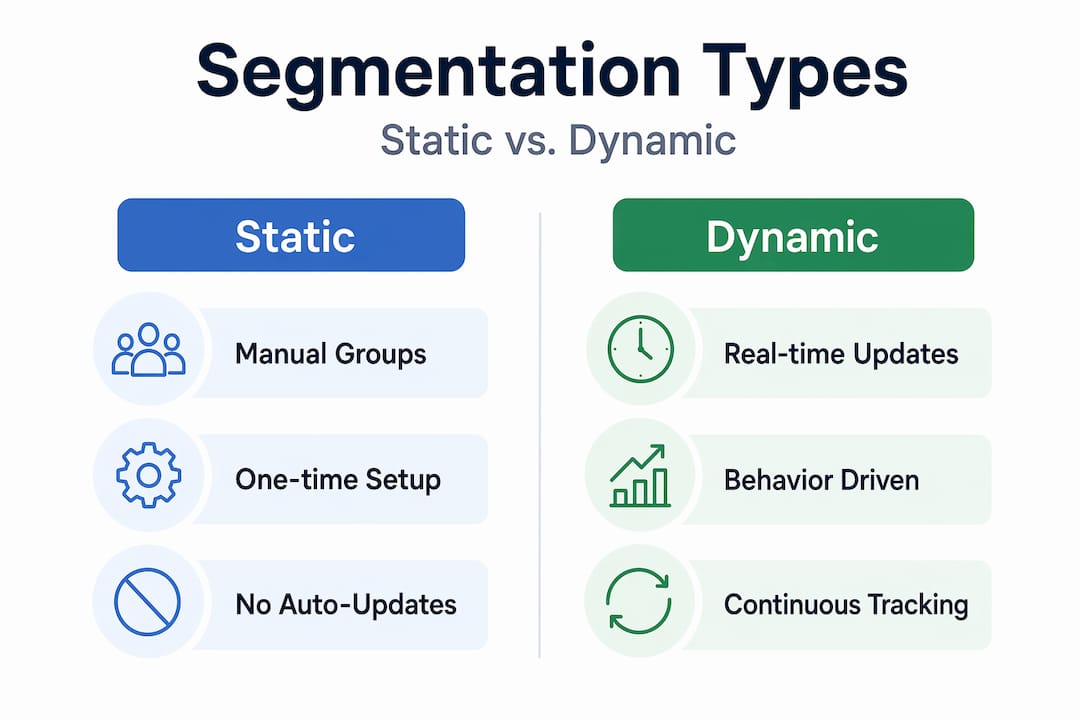
Not all segmentation is the same. Understanding the three main types helps you choose the right approach for your list size and technical setup.

Static segmentation is the simplest form. You manually assign subscribers to a segment based on a fixed criterion, like everyone who attended a specific webinar. Static segments do not update automatically. If a subscriber's behavior changes, they stay in the old group until someone manually moves them.
Dynamic segmentation solves that problem. Automated segments update in real time based on behavior and lifecycle changes. A segment for "subscribers who clicked a pricing page in the last 14 days" will automatically include new matches and drop people who no longer qualify. Dynamic segments work especially well for drip campaigns and lifecycle email journeys because the messaging stays aligned with where each subscriber actually is.
AI-powered segmentation takes this further. Rather than relying on rules you define manually, AI analyzes behavioral patterns, purchase data, and engagement history to predict which segment each subscriber fits best. It can also optimize content, subject lines, and send times at a scale no manual process can match.
Here is a quick comparison of the three types:
- Static: Manual, fixed membership, low overhead, but drifts out of date quickly
- Dynamic: Rule-based, real-time updates, requires clean data and solid tracking
- AI-powered: Pattern-driven, predictive, scales across large lists, requires unified data infrastructure
Pro Tip: Before building dynamic segments, audit your contact properties and tracking setup. Reliable dynamic segmentation depends entirely on clean, consistent data across every touchpoint. Gaps in tracking create ghost segments that look active but produce zero results.
Segmentation and your sender reputation
This is where most marketers miss a critical connection. Segmentation is not just about making emails feel personal. It is a direct lever on your sender reputation and inbox placement.
Here is how it works. Email providers like Gmail use engagement signals, including open rates, delete-without-read rates, and spam reports, to decide whether your future emails land in the inbox or the promotions tab. Every time you send an irrelevant email to a disengaged subscriber, you generate a negative signal. Enough of those signals and your domain reputation degrades gradually over a period of weeks, quietly tanking your deliverability long before you notice in your reports.
Consider the practical impact in this table:
| Sending behavior | Engagement signal | Reputation impact |
|---|---|---|
| Relevant email to active segment | Opens, clicks | Positive, improves placement |
| Generic blast to full list | Low opens, some deletes | Neutral to slightly negative |
| Irrelevant email to cold subscribers | Delete-without-read, spam reports | Strongly negative, erodes domain score |
| Suppressed disengaged contacts | No signal at all | Neutral, protects domain |
Segmentation lets you suppress low-intent or disengaged users from high-stakes campaigns. Targeting high-engagement segments reduces the negative signals that erode inbox placement. This matters most when you are launching a product, running a promotion, or warming up a new sending domain.
Pro Tip: When warming up a new domain, start by emailing only your most engaged segment, people who have opened or clicked in the last 30 days. This builds a positive engagement history quickly and gives your new domain a strong reputation baseline before you expand to colder contacts.
How to implement effective segmentation strategies
You do not need a sophisticated marketing automation platform to start segmenting well. You need a clear process and a willingness to act on the data you already have.
1. Start with engagement data. Split your list into active subscribers (opened or clicked in the last 90 days) and inactive ones. This one move alone will improve your deliverability and give you a cleaner baseline to work from.
2. Layer in behavioral signals. Look at purchase history, product pages visited, or content downloaded. A subscriber who downloaded a pricing guide is in a different mindset than one who only read a blog post. Effective B2B segmentation uses these lifecycle signals to tailor messaging at each stage of the buyer journey.
3. Add demographic and firmographic criteria. For B2B marketers, industry, company size, and location are powerful segmentation axes. A message relevant to a 10-person agency will not resonate with an enterprise procurement team.
4. Build dynamic lists connected to automated workflows. A static segment is better than nothing, but a dynamic list tied to an email journey is far more powerful. Automated segmentation driven by real-time behavior keeps your campaigns accurate without constant manual updates.
5. Integrate your CRM data. Siloed contact data is the enemy of good segmentation. When your email platform and CRM share the same contact records, you can build segments that reflect the full customer relationship, not just email behavior.
6. Measure segment performance separately. Do not average your results across unsplit lists. Track open rates, click rates, and conversions by segment. This tells you which groups are responding well and where your messaging needs refinement.
7. Avoid over-segmentation. Splitting a 5,000-person list into 50 micro-segments creates operational complexity without proportional gains. Start with 4 to 6 clearly defined segments, prove the model, then add granularity.
AI-driven personalization and the future of segmentation
Segmentation is the prerequisite for everything that makes modern AI personalization work. Without stable, well-defined segments, AI tools have no reliable context to work from. They produce generic output dressed up as personalization.
When you build solid segments, AI personalization can tailor subject lines, body content, offers, and send times at the individual level using unified CRM data and lifecycle signals. The result is a level of relevance that manual processes simply cannot achieve at scale.
Here is what AI-powered segmentation enables in practice:
- Dynamic content modules that change based on the subscriber's segment context, showing different product offers to different industries within the same email send
- Predictive send-time optimization that delivers each email when that specific subscriber is most likely to open
- AI-generated subject line variants tested and selected automatically per segment
- Churn prediction models that flag disengaged subscribers before they damage your sender reputation
The operational efficiency gains are real, too. Platforms that combine segmentation, dynamic content, and AI copywriting in one environment reduce the manual workload significantly. That said, governance matters. You need clear rules about which segments receive which content, and you need to audit AI outputs regularly to catch messaging that drifts off-brand or off-strategy.
Monday.com's research on targeted campaigns confirms that AI-powered segmentation enables faster campaign launches and measurable revenue gains. The marketers seeing those gains are not the ones with the most sophisticated AI tools. They are the ones who did the foundational segmentation work first.
My take on why segmentation gets undervalued
I've worked with enough email marketing setups to tell you that segmentation is almost always the gap between campaigns that produce real revenue and campaigns that just burn send credits.
What I've seen consistently is that marketers treat segmentation as a one-time setup task. They build a few segments at launch, get decent results, and then stop refining. Over 12 to 18 months, subscriber behavior shifts. The segments drift. Performance degrades slowly. The team blames creative, subject lines, send frequency, anything but the stale segments underneath.
The uncomfortable truth is that audience segmentation is a living system. It requires ongoing maintenance, regular audits, and the discipline to suppress contacts who no longer fit an active segment. Brands that ignore this erode their sender reputation quietly, then face a costly re-engagement problem down the line.
What I've learned from campaigns that actually work is that the automation and AI tools are only as good as the segmentation underneath them. Invest in the data foundation first. Build clean, dynamic segments second. Then layer on personalization. That sequence produces compounding returns. Reversing it produces expensive noise.
— Raphael
Start with better lists from Spherescout
Strong segmentation starts with quality contact data. If your list is filled with outdated records, misclassified contacts, or contacts who never matched your audience, no amount of segmentation logic will fix the underlying problem.
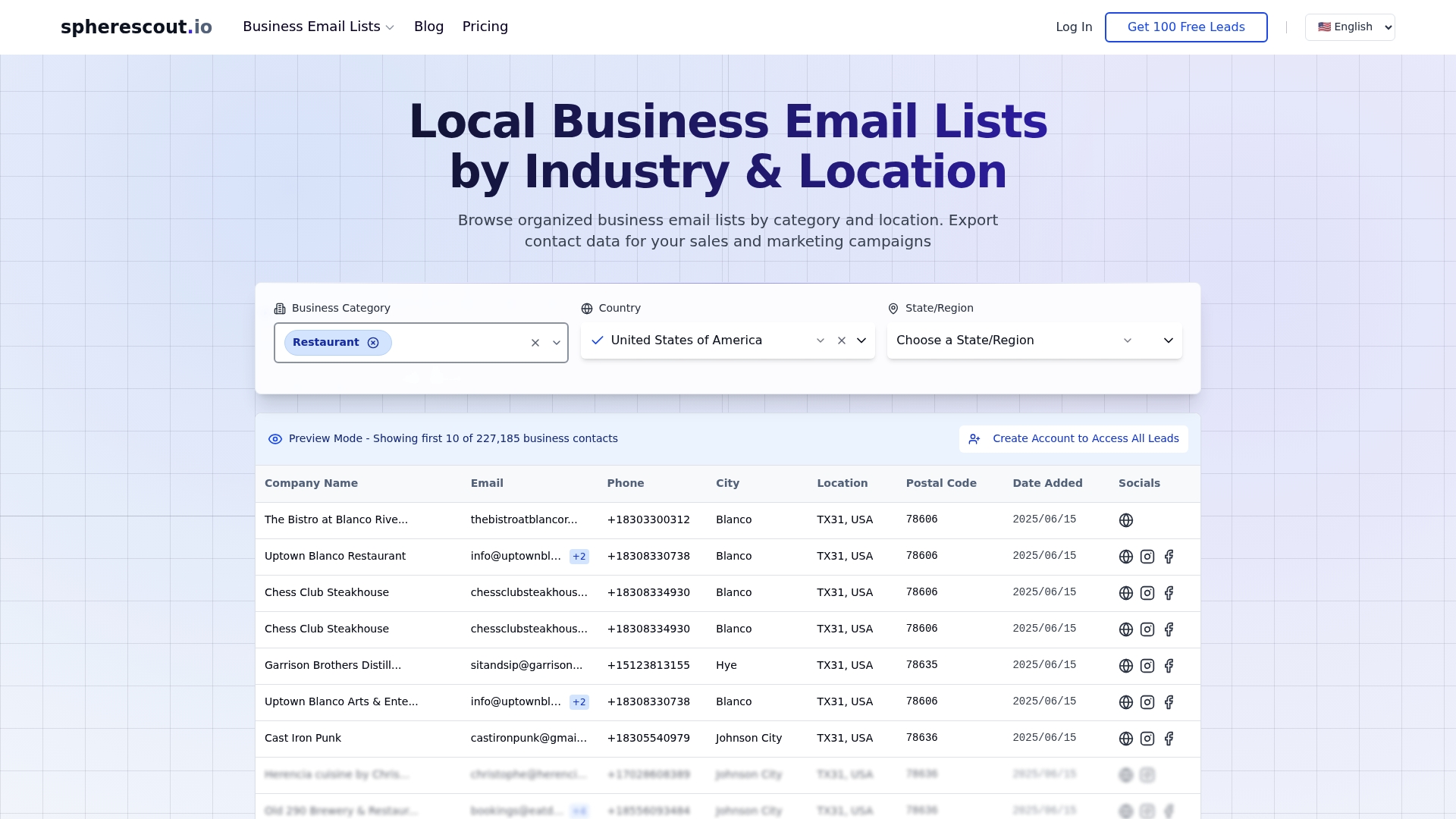
Spherescout gives B2B marketers and business owners access to over 30 million verified business contacts, already organized by industry, location, and company type. You can filter by category, city, or postal code, then export a clean CSV ready for CRM integration and immediate segmentation. Whether you are building segmented email lists by industry or sourcing fresh contacts for a new market, Spherescout provides the structured data you need to make your segmentation strategy work from day one. Explore Spherescout's lead generation tools and see how targeted, clean contact data transforms what segmentation can actually deliver.
FAQ
What is the role of segmentation in email marketing?
Segmentation divides your email list into targeted groups based on behavior, demographics, or lifecycle stage, so each subscriber receives relevant messages. This improves open rates, click-through rates, and conversions while reducing unsubscribes and protecting your sender reputation.
How do you segment an email list effectively?
Start by splitting your list into active and inactive subscribers using engagement data, then layer in behavioral signals like purchase history and page visits, and add demographic criteria like industry or location. Connect dynamic segments to automated workflows so lists update in real time as subscriber behavior changes.
Why does segmentation affect email deliverability?
Email providers use engagement signals to score your sender reputation. When you send irrelevant emails to disengaged subscribers, the resulting delete-without-read actions and spam reports degrade your domain reputation over time, reducing inbox placement for all future sends.
What is the difference between static and dynamic segmentation?
Static segments are manually defined and do not update automatically, while dynamic segments use real-time behavioral rules to add or remove subscribers as their actions change. Dynamic segmentation is more accurate for ongoing campaigns because it prevents segments from drifting out of sync with actual subscriber behavior.
How does AI use segmentation in email marketing?
AI personalization depends on stable, well-defined segments to tailor subject lines, content, and send times at scale. Without reliable segmentation, AI-driven personalization lacks the context it needs to produce consistent, measurable improvements in campaign performance.
Recommended
- What is email list segmentation? Unlock targeted B2B results | spherescout.io Blog
- Boost lead generation with effective business list segmentation | spherescout.io Blog
- Email marketing strategies that drive real B2B results | spherescout.io Blog
- Effective email campaign workflow: a B2B pro's guide | spherescout.io Blog