

You've spent real time crafting what feels like a solid outreach email. You hit send on a batch of 200 prospects and wait. Then the replies trickle in, maybe two or three. That's a 1-2% response rate, and honestly? It's more common than most sales teams want to admit. The problem usually isn't your product or your pricing. It's the email itself. This article breaks down seven concrete B2B email outreach examples, explains exactly why each one works, and gives you a practical framework to replicate those results at scale.
- 7 real-world B2B email outreach examples with analysis
- Comparison table: Which outreach example fits your goal?
- Safeguards and mistakes to avoid in email outreach
- Why most email outreach advice misses the true conversion drivers
- Supercharge your outreach with accurate B2B email lists
- Frequently asked questions
Key Takeaways
| Point | Details |
|---|---|
| Focus on relevance | Personalize and segment outreach for the best engagement. |
| Keep it short | Emails under 200 words with a single CTA perform best. |
| Use proven templates | Real-world examples with clear CTAs boost responses and leads. |
| Avoid common pitfalls | Follow deliverability and compliance best practices to protect your reputation. |
What makes email outreach effective?
Before we look at specific examples, let's establish what separates a high-performing outreach email from one that gets deleted in three seconds. The criteria matter because they give you a filter for evaluating your own campaigns.
According to B2B email marketing principles, effective outreach requires personalization, segmentation, strong calls to action (CTAs), and automation for sequences. Those four pillars show up in every high-response campaign we've analyzed.
Here's what each one means in practice:
- Personalization: This goes beyond inserting a first name. Real personalization means referencing the prospect's industry, their recent company news, their job role, or a specific pain point tied to their segment. A VP of Sales at a SaaS company has different concerns than an Operations Manager at a logistics firm. Your email needs to reflect that.
- Segmentation: Sending one message to your entire list is the fastest way to tank your deliverability and your reply rate. Effective list segmentation tips help you group contacts by industry, geography, company size, or buying stage so your message lands with the right people.
- Clear CTAs: Every outreach email needs one clear action. Not three options. One. "Are you free for a 15-minute call Thursday?" beats "Let me know if you want to connect, check out our website, or reply with any questions."
- Automation: Sequences and follow-ups scale your effort without sacrificing quality. A single cold email rarely converts. Most replies come from follow-up touchpoints.
- Brevity: Short emails outperform long ones consistently. If your email takes more than 45 seconds to read, most busy professionals won't finish it.
These aren't opinions. They're repeatable patterns backed by the B2B email marketing strategies that consistently produce results across industries.
With criteria in mind, it's easier to see what separates average outreach from examples that actually get attention.
7 real-world B2B email outreach examples with analysis
Now let's put those criteria into use by examining real outreach examples and the reasons each one succeeds.
1. The cold intro email (problem-first approach)
This format leads with a specific pain point the recipient likely faces, then offers a targeted solution. Subject line: "Cutting sales cycle time for [Industry] teams"
Structure:
- One-sentence opener referencing their role or company size
- One sentence naming the specific pain point
- One sentence introducing your solution with a measurable outcome
- Low-friction CTA: "Worth a 15-minute call this week?"
Why it works: It's entirely about them, not you. The proof comes in the form of measurable outcomes ("we helped similar teams reduce cycle time by 30%"), and the CTA requires almost no commitment.

2. The follow-up email (value-add touchpoint)
Most reps send a follow-up that says "Just checking in." That's noise. A better approach adds something new, a relevant article, a quick insight, or a data point tied to their industry.
Structure:
- Reference the previous email without being apologetic
- Drop one new piece of value (a statistic, insight, or quick win)
- Repeat the CTA or soften it further: "No pressure, just reply with a thumbs up if timing is better next quarter."
Why it works: It respects the prospect's time and gives them a reason to re-engage beyond obligation.
3. The drip nurture email (middle-of-funnel education)
HubSpot's examples of drip campaigns from companies like Figma and Circle show that nurture emails work by delivering consistent value over time, not pushing for a meeting on every send. These emails build trust gradually and prime prospects for conversion.
Structure:
- Educate first, sell second
- Use a conversational tone, not a pitch deck format
- CTA points to a resource (case study, guide, webinar) rather than a sales call
Pro Tip: Space your nurture sequence across 7 to 14 days. Hitting someone five times in a week reads as desperation and often triggers unsubscribes.
4. The onboarding or post-signup email (engagement trigger)
If someone downloads a resource, signs up for a trial, or requests a sample, that action is a behavioral trigger. Onboarding-style emails sent within minutes of that action see dramatically higher open rates than standard cold sends.
"The best email I ever sent had one line: 'You just downloaded our report on [topic]. Here's the one thing most teams miss in it.' We got a 38% reply rate on that sequence." — SDR Manager, SaaS company
Structure:
- Acknowledge the trigger event immediately
- Add one unexpected insight or tip
- CTA: Start a conversation, not a close
5. The re-engagement email (dormant lead revival)
Contacts who went cold 60 to 90 days ago aren't dead. They just need the right hook. A re-engagement email works when it's honest and low-pressure.
Subject line example: "Should I close your file?"
This subject line works because it triggers curiosity and a small fear of missing out (FOMO). The body is short: acknowledge the gap, restate your value in one sentence, and offer a simple yes or no CTA.
6. The social proof email (credibility-first approach)
Proof trumps persuasion in cold outreach. A cold email format that focuses on a specific customer result, with their industry and a concrete outcome, consistently outperforms generic benefit statements. Structure it as: "We helped [Company Type] achieve [Result]. Here's how." Then one CTA.
Why it works: Prospects relate to peers more than to vendors. A real case study beats a feature list every time.
7. The multi-channel trigger email (LinkedIn plus email combo)
Before sending this email, connect with the prospect on LinkedIn or engage with one of their posts. Then the email opener becomes: "I commented on your post about [topic] last week."
This approach is one of the cold emailing best practices that turns a cold email into a warm one. It works because context is established before the ask.
Pro Tip: Use email verification for outreach before launching any sequence. Bad email addresses inflate your bounce rate, damage your sender reputation, and skew your response data. Always clean your list first.
A strong subject line also plays a role in business contact strategies that extend beyond email to phone and multi-channel engagement.
Comparison table: Which outreach example fits your goal?
With all examples mapped out, a side-by-side comparison makes it easy to choose the best approach for your specific situation.
| Email type | Use case | Sequence stage | CTA style | Best segment | Automate? |
|---|---|---|---|---|---|
| Cold intro (problem-first) | New prospect contact | Stage 1 | Low-friction ask | Cold list, role-specific | Yes |
| Follow-up (value-add) | Re-engage no-response | Stage 2-3 | Softer reply option | All cold prospects | Yes |
| Drip nurture | Build trust over time | Mid-funnel | Resource or insight link | Warm leads, MQLs | Yes |
| Onboarding trigger | Post-signup or download | Immediate | Start conversation | Trial users, downloaders | Yes |
| Re-engagement | Dormant leads (60-90 days) | Late stage | Yes/No response | Stale pipeline | Semi-manual |
| Social proof | Skeptical or high-value prospect | Stage 1-2 | Call or reply | Enterprise, key accounts | Semi-manual |
| Multi-channel trigger | LinkedIn-warmed prospect | Stage 1 | Meeting request | Decision-makers | Manual |
When to automate vs. send manually: Automation works well for stages 1 through 3 in a sequence. As you move toward higher-value accounts or later in the funnel, manual personalization delivers better results.
Per sales sequences best practices, sequences should use multiple channels including email, LinkedIn, and calls, with varied value in each follow-up, spaced 2 to 5 days apart. This pacing gives prospects time to process your message without letting them forget about you.
For more detail on structuring your full funnel, the lead generation process guide covers sequencing in depth.
Safeguards and mistakes to avoid in email outreach
Next, make sure your chosen template actually reaches the inbox by mastering the technical and strategic pitfalls that trip up even experienced outreach teams.
Here are five mistakes that hurt results more than most teams realize:
- Emails over 200 words: Longer emails lose busy readers fast. Concise emails under 200 words consistently outperform longer ones in reply rate. Say more with less.
- Multiple CTAs in one email: Giving someone three options often results in them taking none. One clear ask performs better every time.
- Self-focused copy: Emails that lead with "We are a leading provider of..." get deleted immediately. Lead with their problem, not your pitch.
- No proof: Vague claims like "we help companies grow" are meaningless. A specific result, "we reduced churn by 22% for a 50-person SaaS team," builds credibility fast.
- Using your primary domain for cold outreach: This is a technical mistake that many teams skip over. Sending domain risks are real. If your cold outreach domain gets flagged or blacklisted, your primary business email deliverability suffers. Use a separate sending domain and configure SPF, DKIM, and DMARC authentication on it.
Pro Tip: Before scaling any campaign, warm up your sending domain gradually over 2 to 4 weeks. Start with 10 to 20 emails per day and increase slowly. Jumping straight to 500 sends on a new domain is the fastest path to spam folder placement.
Also, outdated or incorrect contact data is a silent campaign killer. If 20% of your list has bad emails, your bounce rate climbs, your domain reputation drops, and all that great copy goes to waste. Contact verification before you send is not optional. It's table stakes.
Why most email outreach advice misses the true conversion drivers
Having covered execution and safeguards, here's a candid take on what most teams still get wrong even after reading a dozen outreach guides.
Most articles focus heavily on templates and subject line tricks. They'll tell you to use curiosity gaps, power words, or personalization tokens. And yes, those things matter at the margin. But in practice, we've seen campaigns with "ugly" subject lines and plain copy outperform polished, highly designed emails simply because the message matched what the prospect actually cared about at that moment.
The real conversion driver is contextual relevance. Not cleverness. If you're emailing a regional staffing agency in the middle of a hiring surge, a subject line that references that specific market pressure will beat the most perfectly worded generic opener every single time. That requires knowing your segment deeply, not just filtering by job title.
The second thing most guides miss: proof beats persuasion at every funnel stage. People don't want to be convinced. They want to see evidence that your solution worked for someone who looks like them. A single sentence like "We helped three regional marketing agencies cut their prospecting time in half" outperforms a full paragraph about your platform's features.
Finally, most teams over-analyze and under-execute. They spend weeks perfecting templates while their pipeline dries up. The teams that drive real B2B results send faster, measure ruthlessly, and iterate based on data. A 30% open rate with a 4% reply rate tells you far more than a brainstorm session ever will.
Simple beats clever. Context beats copy. Action beats perfection.
Supercharge your outreach with accurate B2B email lists
If you're ready to put these email outreach tactics into action, the next step is making sure you have a high-quality, verified contact list that matches your target segments.
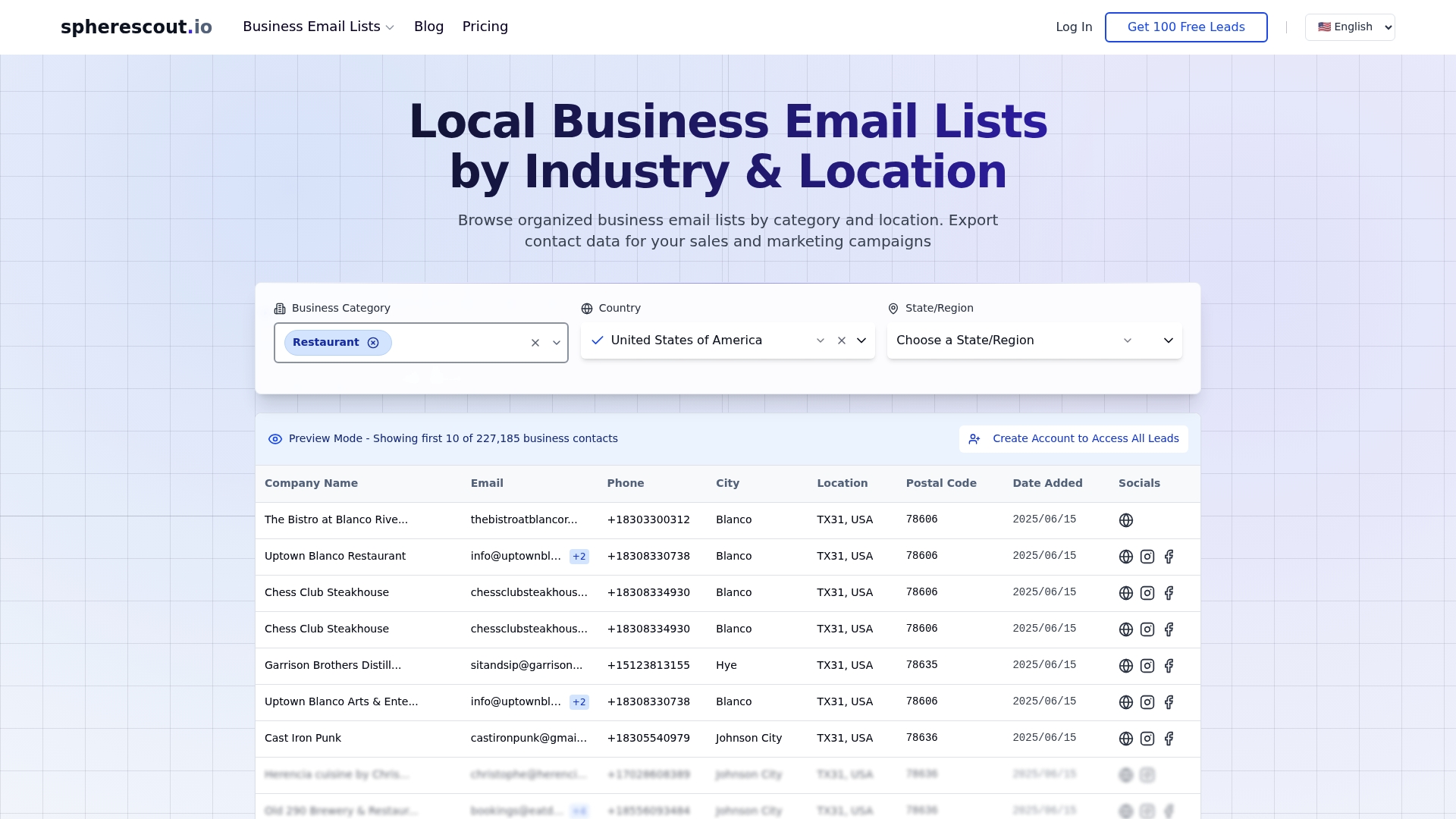
Great templates without great data produce mediocre results. At SphereScout.io, we provide structured B2B contact lists filtered by industry, city, postal code, and company type, so you can plug proven outreach frameworks into the right audience immediately. Whether you need USA B2B email lists for a nationwide campaign or hyper-local contacts for a regional push, our database of over 30 million contacts is ready to export into your CRM or email platform. Explore our lead generation services or browse business lists by location to find exactly who you need to reach today.
Frequently asked questions
What is the ideal length for a B2B email outreach message?
Keep your email under 200 words for the highest response rates. Shorter emails respect the reader's time and make your ask harder to ignore.
How many follow-up emails are effective in a sequence?
A well-paced sequence includes 3 to 5 follow-up messages spaced 2-5 days apart, with each touchpoint adding new value rather than simply restating your original ask.
Which call to action works best in outreach emails?
Low-friction CTAs like "15-minute call next week?" reduce the decision burden and make it easy for prospects to say yes quickly.
What technical setup improves outreach email deliverability?
Use dedicated sending domains with SPF/DKIM/DMARC authentication, and warm up your domain gradually before scaling volume to protect your sender reputation.
Recommended
- Email marketing strategies that drive real B2B results | spherescout.io Blog
- Master cold emailing: best practices for B2B success | spherescout.io Blog
- Email verification: A complete B2B outreach guide | spherescout.io Blog
- B2B Email Marketing Process for Lead Generation Success | spherescout.io Blog
- Understanding Email Security: Protecting Your Business - IT Start