Choose Apify when you want to build and maintain custom extraction actors. Choose SphereScout when your automations or agents need clean local-business data without running extraction first.
What kind of alternative is this?
SphereScoutLocal-business market database
vs
ApifyLive scraping platform
Choose SphereScout if
Knowing cost upfront: the free preview shows the exact record count, including how many have an email, before you pay.
Sales and agency teams that want a CSV without choosing between multiple similar actors, add-ons, and output formats.
Staying fresh without re-running jobs: the database refreshes monthly as part of the product.
Choose Apify if
Teams that want to build and maintain custom extraction actors themselves.
Real-time extraction of a precise live query, reviews, photos, or non-local-business websites.
Engineering teams that want to own scraper configuration, chaining, monitoring, and maintenance.
Apify is a developer platform with several Google Maps and contact-enrichment Actors. Each has its own maintainer, inputs, pricing, add-ons, and output format. That flexibility is useful when you want to build and operate the extraction yourself.
With SphereScout, you choose a country and category, see how many businesses and email addresses are available, and export the records. The cost difference matters when emails are sparse: a live scraper may charge for websites that return no email. At a 30% email rate, finding 10,000 businesses with email could require processing about 30,000 businesses.
SphereScout vs Apify
Compare features ↓
SphereScout
Apify
Know cost before you run
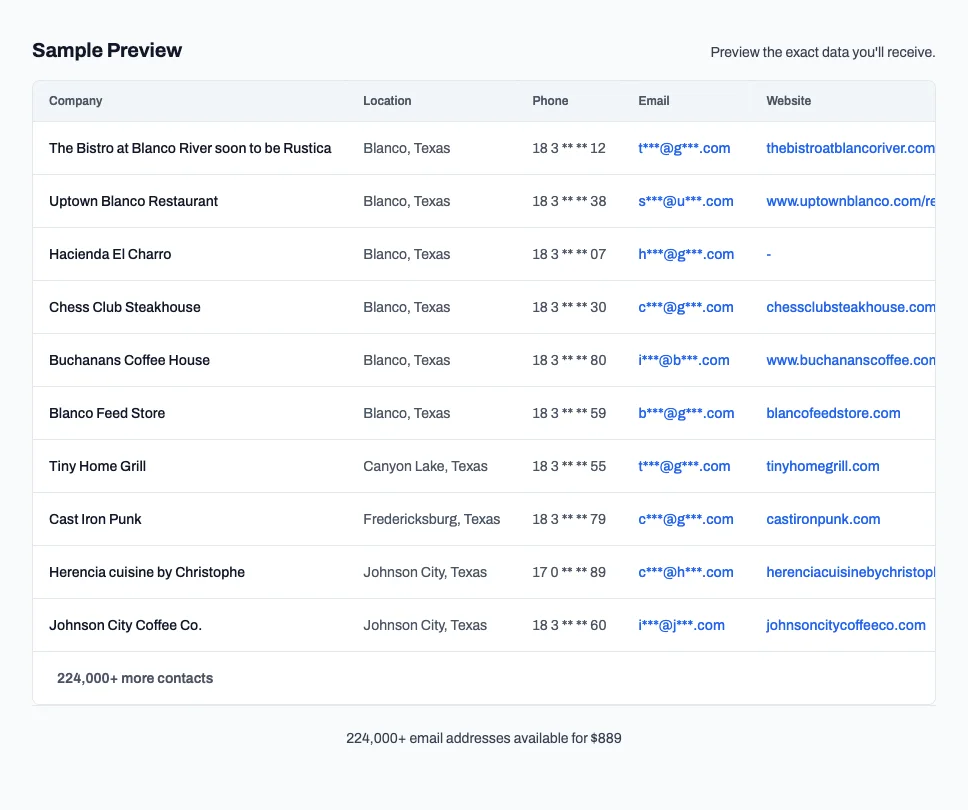
Free preview: exact business count and email coverage for any segment, before payment.
Pricing is actor-specific and yield-dependent when contact enrichment is involved.
Getting emails
In the export. Filter to has-email records and pay only for those.
Email/contact enrichment is configurable through actors or add-ons, but misses still consume processing.
Cost of staying fresh
Re-check any past export for fresh data and pay only for the new records, never the whole list again.
Fresh data usually means re-running the job and paying for the new processing.
Setup
Filter, preview, export.
Choose an actor, configure inputs, geolocation, categories, add-ons, and output views; then clean/dedupe the result.
Market coverage
The full pre-collected category segment per country, not bounded by query design.
Bounded by what each query returns; completeness depends on grid and query engineering.
Best buyer
Non-technical sales, growth, and agency teams.
Technical operators and automation builders.
Actor choice is part of the cost
Apify's strength is also its complexity: the marketplace has multiple actors for Google Maps scraping and contact enrichment. Before a buyer compares cost, they must decide which actor, maintainer, input model, and add-ons fit the job. SphereScout removes that decision for local business lists.
The email-yield problem
Live scraper economics depend on yield. If enrichment checks 30,000 websites and only 30% have usable emails, the buyer paid to process all 30,000 to end with about 10,000 emailable businesses. SphereScout shows the emailable segment before export.
Updating the same list later
To update an Apify result next quarter, you run the extraction and enrichment again. SphereScout keeps your export history and shows how many businesses, emails, and phones were added since your purchase. You pay only for the new records when you re-export; delta exports are included with subscription plans.
Where Apify can be the wrong fit
Not product defects, just workflow mismatches that matter when the goal is outbound prospecting.
Actor choice is part of the work: Apify has multiple Google Maps and contact-detail actors with overlapping promises, different maintainers, inputs, pricing, and add-ons.
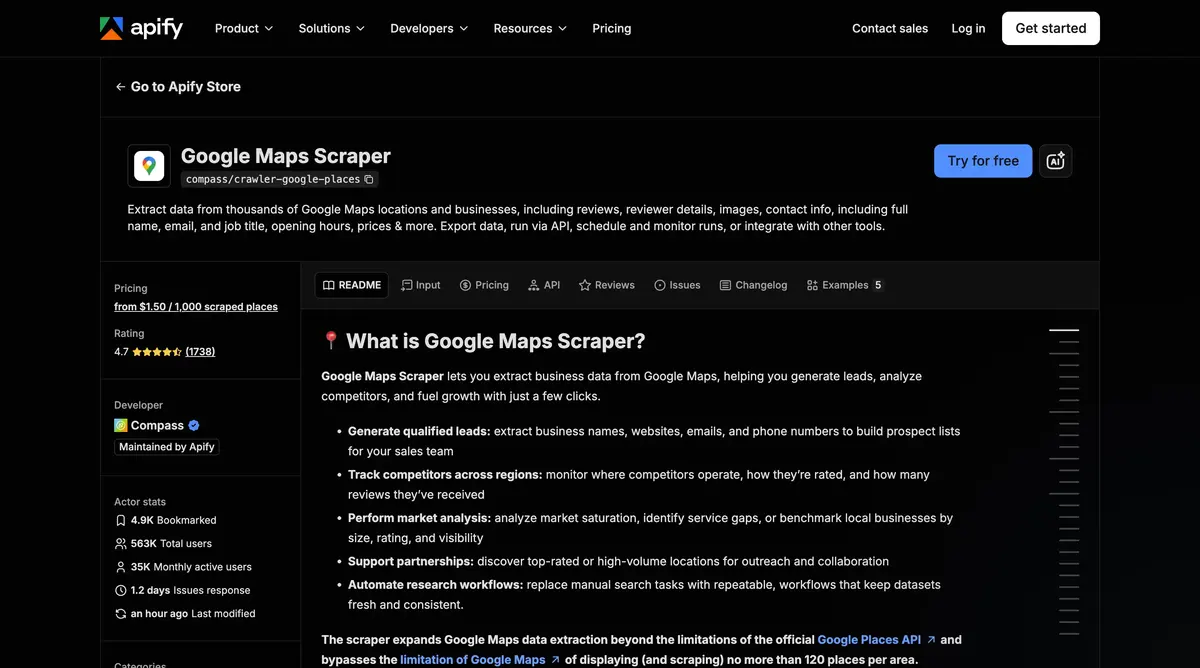
Contact enrichment is yield-based. If you ask an actor to enrich websites for emails, you can pay for businesses or domains that do not produce an email. A 30% email yield means roughly 30,000 businesses processed to obtain 10,000 emailable records.
Direct Google Maps URL or single-screen searches can cap around 120 results; larger markets require location setup, area definitions, categories, and query design.
Best Apify alternatives by use case
SphereScoutA local-business database updated monthly, not a scraper. Before paying, see the business and email counts for any category and country, then export a CSV in minutes. Best for sales teams and agencies that do not want to operate their own extraction system.
OutscraperA managed Google Maps scraping API with pay-as-you-go, per-request pricing and optional contact enrichment. Closer to Apify than to SphereScout: you still choose what to scrape and pay for every request, including ones that never return an email. A middle ground if you want less setup than Apify but still want to control the scrape yourself.
LobstrA no-code platform with 30+ pre-built cloud scrapers (Google, LinkedIn, Instagram, and more), billed on monthly subscription plans rather than per-actor credits. Good fit for non-technical teams scraping multiple platforms beyond Google Maps, though you're still paying for scrape volume rather than previewing emailable-contact counts upfront.
ScraperAPIDeveloper infrastructure: proxy rotation, CAPTCHA handling, and JS rendering as an API, billed on a credit system where different target sites cost different credit amounts. Built for engineers scraping any website, not specifically Google Maps or local-business data, so it fits teams building custom pipelines rather than teams that just need a contact list.
FirecrawlA crawling API built for AI workflows: turns pages into clean, LLM-ready markdown on a credit-based subscription model. Not built for structured local-business data — the right tool when the job is feeding arbitrary web content into an LLM or agent, not extracting a business contact list.
FAQ
Is SphereScout a scraper like Apify?
No. Apify is a platform for building extraction and automation Actors. SphereScout provides ready-to-export local-business records without requiring an extraction run first.
When is Apify better?
Apify is better when you want to build and maintain custom scraping logic across many websites. SphereScout is better when your workflows need reliable local-business records, coverage visibility, and repeatable exports.
Can SphereScout replace the Apify Google Maps Scraper?
For local-business lead generation, often yes. If the job is building extraction infrastructure, Apify fits. If the job is feeding sales systems, enrichment workflows, or agents with clean local-business data, SphereScout is the stronger fit.
What's the best Apify alternative for Google Maps leads in 2026?
It depends on the job. For building and maintaining custom extraction actors, Apify itself remains the most flexible option.
For teams that just need local-business emails and phone numbers without running a scrape, SphereScout is the most direct alternative — Outscraper and Lobstr.io are the next-best options if you still want to control the scrape yourself.
Is there a free Apify alternative for Google Maps scraping?
Apify offers free platform credits that run out based on usage. SphereScout offers a free preview of up to 100 leads per category so you can check real record and email counts before paying anything. Neither is unlimited-free at meaningful volume.
Which Apify alternative is best for large-scale local-business lead generation?
For volume, the deciding factor is email yield, not raw record count. Live scrapers process every business you point them at, including ones with no public email, so getting around 10,000 contacts at a 30% yield may require processing roughly 30,000 businesses.
SphereScout filters to has-email records before you pay, so cost tracks contacts you'll actually use, not businesses you had to check first.
How this comparison was checked
Reviewed by Raphael Canyasse, SphereScout's founder and the person responsible for its local-business data product.
We checked the cited public product and pricing pages in a browser. Plans can change, so confirm current terms in the official sources before buying.
We reviewed localized search results to identify common buyer questions. Product claims still required an official public source.
SphereScout is our product. We state when the competitor is the better fit and do not publish accuracy claims we have not tested.
What we reproduced in the browser
We opened Apify's Google Maps Scraper Actor. The page exposes per-1,000-place pricing, an Actor workflow, API and scheduling controls, and optional contact enrichment. Apify is a configurable scraping platform, not a ready-made market database.
Apify · Last reviewed Aug 17, 2026SphereScout control check: on 17 August 2026, the public USA Restaurants page showed 719,000+ listings, 209,000+ businesses with email, 649,000+ with phone, and 11 masked sample rows.
Sources
Official product pages, review directories, and public comparisons, linked so you can verify every claim above.