Best D7 Lead Finder alternative for local business leads in 2026
Choose D7 Lead Finder for quick keyword-and-location searches. Choose SphereScout when you want a defined country-and-category segment before exporting.
Choose D7 for fast, targeted keyword-and-location searches. Choose SphereScout for repeatable country-and-category exports with visible size, contact coverage, and refresh timing.
What kind of alternative is this?
SphereScoutLocal-business market database
vs
D7 Lead FinderLive scraping platform
Choose SphereScout if
Seeing before buying: free preview with record counts and email coverage per segment.
Filter depth: country, region/county, city, category, profession, has-email, has-phone, has-website, ratings, and review counts.
Verifiable freshness: every country shows its latest extraction date publicly.
Choose D7 Lead Finder if
Keyword-plus-location searches with a short path from query to lead list.
Teams that want optional business, contact, social, review, or advertising fields.
Users whose daily prospecting volume fits the selected plan allowance.
D7 Lead Finder is a search-first tool: enter a keyword and location, review a list, apply filters, and export the results. Its public pages describe up to 1,200 business leads per search, Excel/CSV/PDF exports, monthly plans with daily search allowances, and optional fields such as email, phone, social profiles, reviews, advertising signals, and website data.
SphereScout is a different workflow: select a country and category, preview the business and email counts, then export a maintained segment with a public country-level refresh date.
SphereScout vs D7 Lead Finder
Compare features ↓
SphereScout
D7 Lead Finder
Know what you get before paying
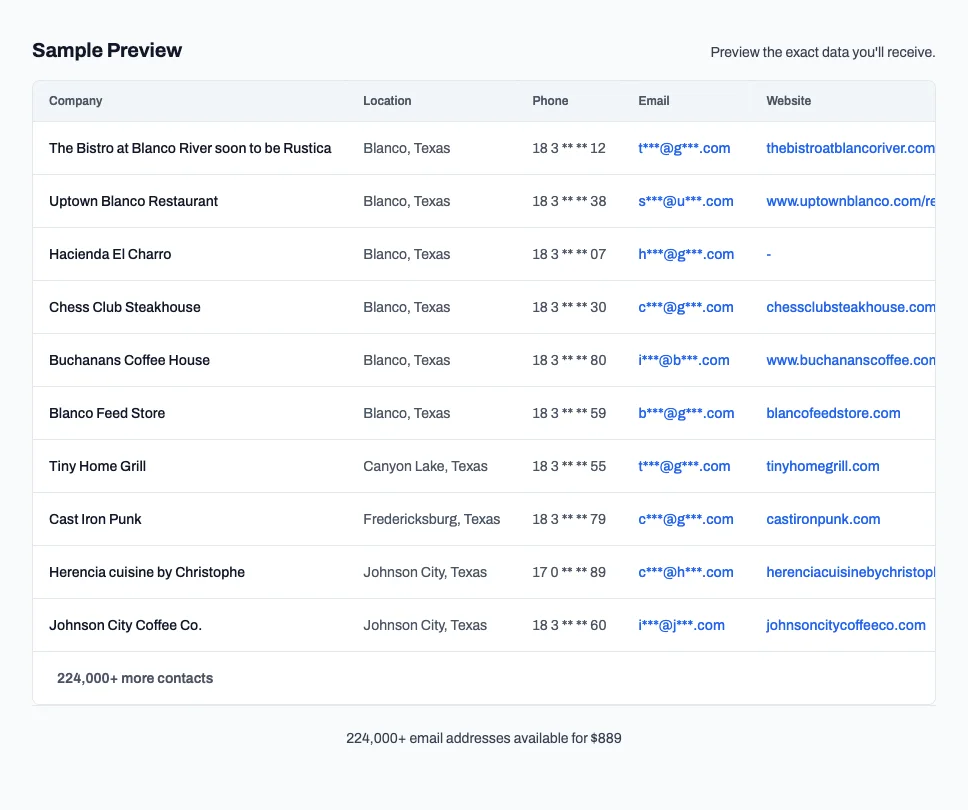
Free preview: exact business count and email coverage per segment.
Search results depend on the keyword, location, and the plan's daily search allowance.
Usage model
Subscription credits plus one-off top-ups for larger campaigns.
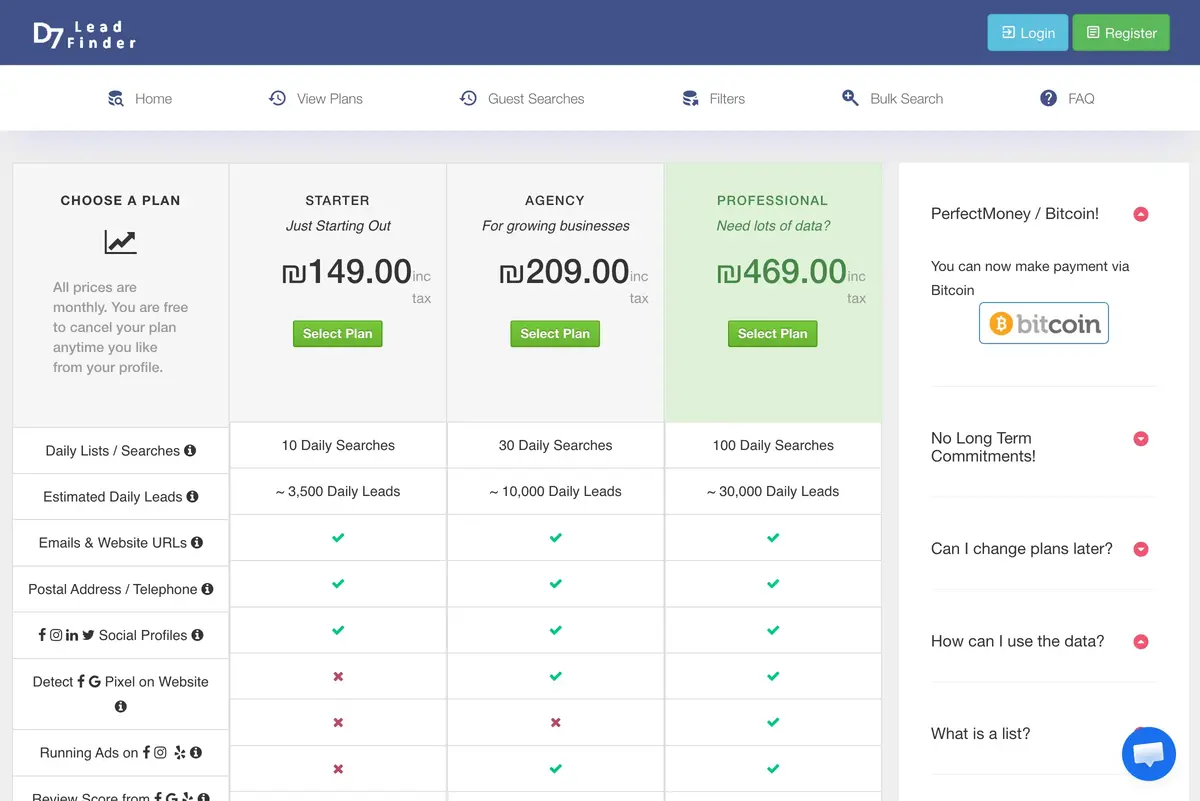
Monthly plans with daily searches, estimated daily leads, exports, and feature gates such as bulk search/API.
Filters
Country, region, city, category, profession, has-email/phone/website, ratings, review counts.
Keyword/location search plus output filters for fields like email, phone, website, address, reviews, category, and advertising signals.
Freshness transparency
Monthly refresh with public per-country extraction dates.
Public pages describe the search workflow but no comparable country-level refresh log.
Best buyer
Outbound teams that need scoped, verifiable segments.
Casual users running a few simple searches a day.
A simple search with a defined quota
D7 makes the first step easy: enter what you sell and where you want to find businesses. The commercial constraint is the plan allowance—daily searches and estimated daily leads—so a campaign covering many locations needs quota planning. SphereScout is organized around reusable country-and-category segments instead.
Output filters are not the same as segment design
D7 can hide leads without an email, telephone, website, or address and can choose which fields appear in the export. Those are useful output controls, but they do not replace designing a maintained segment by country, category, profession, and contact coverage.
Check the date before you buy
D7's public pages describe fields, search volume, and exports, but not a comparable country-level freshness log. SphereScout publishes the latest extraction date for each country so buyers can check the age of a selected market before export.
Where D7 Lead Finder can be the wrong fit
Not product defects, just workflow mismatches that matter when the goal is outbound prospecting.
The workflow is quota-shaped: daily searches, estimated daily leads, and plan-gated features determine campaign capacity.
A keyword-and-location query is not the same as a maintained country-and-category market segment.
The public pages describe search and export capabilities, but do not expose a comparable country-level refresh log.
Best D7 Lead Finder alternatives by use case
SphereScoutA maintained local-business database built around country/category/profession segments, not keyword-plus-location searches. Preview exact business and email counts before paying, with public per-country refresh dates.
Scrap.ioA step up from D7's live-search model: Scrap.io maintains the dataset behind the scenes instead of running a fresh query per search, though it still gates whole-country coverage to higher-tier plans the way D7 gates volume by daily quota.
Lead ScrapeSwaps D7's daily-search-quota model for one flat annual price, throwing in tech-stack and revenue-estimate data most keyword-search tools don't carry — at the cost of the category/geography precision a per-country database gives you.
LeadSwiftA local B2B lead-gen tool that searches live across Google Maps, Yelp, Facebook, and YellowPages for decision-maker emails, priced on daily-search-quota subscription plans with built-in outreach tooling. Closer to D7 in usage model — search quotas rather than a maintained database — but bundles email sending on top.
Saleshandy Lead FinderA B2B contact database (800M+ contacts) bundled with email outreach and CRM tooling, priced with the outreach platform rather than sold as a standalone list export. Fits teams that want prospecting and sending in one subscription.
FAQ
Is SphereScout easier than D7 Lead Finder?
It depends on the job. D7 is simple for one-off searches. SphereScout is easier when you repeatedly buy filtered local business segments and want refreshed exports.
Why compare D7 Lead Finder with a database?
Because buyers often use D7 to get local business leads. SphereScout solves the same outbound-list problem with a database and refresh workflow instead of one-off searches.
When should I still use D7 Lead Finder?
Use D7 Lead Finder when you need a lightweight search tool for a small or simple lead list and do not need recurring segment refreshes.
What's the best D7 Lead Finder alternative for local business leads?
It depends on whether you want another search-box tool or a maintained database. LeadSwift and Lead Scrape are the closest alternatives if you still want live keyword/location search. SphereScout is the more direct alternative if you want pre-filtered country/category segments with known size and email coverage instead of running searches.
Is there a free D7 Lead Finder alternative?
D7 Lead Finder's plans are usage-quota-based with a limited trial. SphereScout offers a free preview of up to 100 leads per category so you can check real record and email counts before paying anything.
Which alternative is best for repeatable local business prospecting?
Repeatability favors a maintained database over daily-quota search tools. SphereScout's segments refresh monthly with public per-country dates, so a campaign you run today can be re-checked for fresh records later without re-running searches from scratch.
How this comparison was checked
Reviewed by Raphael Canyasse, SphereScout's founder and the person responsible for its local-business data product.
We checked the cited public product and pricing pages in a browser. Plans can change, so confirm current terms in the official sources before buying.
We reviewed localized search results to identify common buyer questions. Product claims still required an official public source.
SphereScout is our product. We state when the competitor is the better fit and do not publish accuracy claims we have not tested.
What we reproduced in the browser
D7 Lead Finder's plan table limits daily searches and estimated daily leads by tier, while stating monthly billing and cancellation from the profile. SphereScout packages a defined country-and-category market instead of a daily search allowance.
D7 Lead Finder · Last reviewed Aug 17, 2026SphereScout control check: on 17 August 2026, the public USA Restaurants page showed 719,000+ listings, 209,000+ businesses with email, 649,000+ with phone, and 11 masked sample rows.
Sources
Official product pages, review directories, and public comparisons, linked so you can verify every claim above.