

Most people think B2B lead generation means a sales rep dialing through a list of contacts and hoping someone picks up. That picture is outdated by about a decade. What is B2B lead generation today? It's a coordinated, multi-channel process of identifying companies that fit your ideal customer profile, attracting their attention, and moving them toward a buying conversation. This guide breaks down the definitions, lead types, strategies, and tools you actually need, without the theory overload.
- What B2B lead generation really means
- Types of B2B leads and why they matter
- Modern B2B lead generation strategies
- Step-by-step B2B lead generation process
- Top industries and tools for B2B lead generation
- My honest take on where most teams go wrong
- How Spherescout helps you put this into practice
- FAQ
Key Takeaways
| Point | Details |
|---|---|
| B2B vs. B2C lead gen | B2B targets companies with longer sales cycles, requiring educational content rather than emotional appeals. |
| Lead types matter | Knowing the difference between MQLs, SQLs, and cold leads helps you prioritize and convert more efficiently. |
| AI changes the game | AI-qualified leads deliver measurably higher win rates by automating scoring and targeting high-intent prospects. |
| Process over tactics | A repeatable, step-by-step lead gen process outperforms any single channel or one-off campaign. |
| Data quality is foundational | Accurate, segmented contact data is the starting point for every effective outreach effort. |
What B2B lead generation really means
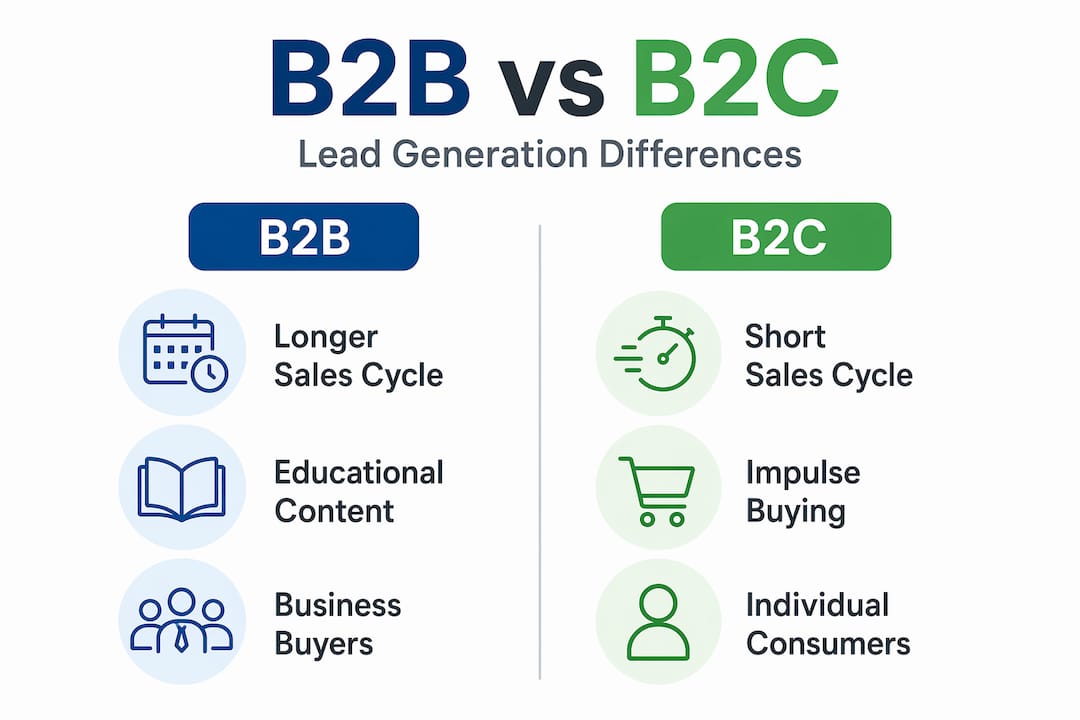
B2B lead generation is the process of identifying and attracting potential business buyers, then capturing enough information about them to start a sales conversation. The "B2B" distinction matters more than it sounds. You're not selling to an individual consumer who makes an impulse purchase. You're selling to an organization, often involving multiple stakeholders, budget approvals, and decision timelines that can stretch across months.
B2B targets companies with longer sales cycles and demands educational content at every stage, unlike B2C, which relies heavily on emotional, individual-oriented messaging. That fundamental difference shapes everything: the content you create, the channels you use, and how you define a "qualified" lead.
Here's a quick comparison to make that concrete:
| Factor | B2B Lead Generation | B2C Lead Generation |
|---|---|---|
| Target audience | Companies and organizations | Individual consumers |
| Sales cycle length | Weeks to months | Hours to days |
| Decision makers | Multiple stakeholders | Usually one person |
| Content type | White papers, case studies, webinars | Ads, social posts, promotions |
| Relationship focus | Long-term partnership | Transactional |
| Average deal size | High | Lower |
Understanding this table isn't just academic. If you apply B2C tactics to B2B prospects, you'll generate a lot of noise and very few conversations worth having.
Types of B2B leads and why they matter
Not every lead deserves the same attention. One of the biggest time-wasters in sales is treating a cold contact with the same urgency as someone who just downloaded your pricing guide. Here are the core types of B2B leads you need to know:
- Cold leads: Contacts who match your ideal customer profile but haven't engaged with your brand yet. They require more education before they're ready to talk.
- Warm leads: Prospects who have shown some interest, like visiting your website, opening an email, or following your company on LinkedIn.
- Marketing Qualified Leads (MQLs): Leads that marketing has identified as worth pursuing based on engagement behavior, such as downloading a white paper or attending a webinar.
- Sales Qualified Leads (SQLs): Leads that sales has reviewed and confirmed as ready for a direct conversation. They've cleared the threshold of interest, budget, authority, and need.
- Product Qualified Leads (PQLs): Common in SaaS, these are users who've already experienced your product (via a free trial) and shown behaviors indicating they're ready to buy.
Here's the stat that puts lead qualification in perspective: only 13% of MQLs convert to SQLs on average. Top-performing teams push that number to 40% by using behavioral scoring. That's not a minor difference. It's the gap between a pipeline that grows and one that stalls.
Aligning marketing and sales on lead definitions prevents wasted resources and directly improves conversion rates. When your marketing team considers someone an MQL but sales considers them unqualified, leads fall through the cracks and both teams point fingers at each other.
Pro Tip: Set a shared SLA (service-level agreement) between marketing and sales that defines exactly what an MQL and SQL look like for your business, including specific behavioral triggers and firmographic criteria. Review it quarterly.
Modern B2B lead generation strategies
The strategy question isn't "inbound or outbound?" It's "how do you use both together?" Most B2B companies combine inbound and outbound approaches for a pipeline that stays full rather than one that surges and dries up.
Inbound strategies pull prospects to you through content, SEO, and social proof. Think blog posts, gated reports, LinkedIn thought leadership, and webinars. They build trust over time and attract buyers who are already researching solutions like yours. The trade-off is that inbound takes time to compound.
Outbound strategies put you in front of prospects directly. Cold email, LinkedIn outreach, paid ads, and phone prospecting all fall here. Done right, outbound is targeted, not random. It's how you find business contacts that match your ICP and reach them before they've started actively comparing vendors.
Where things get genuinely interesting is AI. AI-driven lead generation tools improve conversion and close rates by automating the parts of prospecting that used to eat hours: researching accounts, scoring leads, personalizing messages, and identifying when a prospect is likely to buy.

AI-qualified leads deliver 76% higher win rates compared to leads qualified through traditional manual methods. That number comes from AI's ability to process behavioral signals at scale. An AI tool can analyze hundreds of data points per prospect, including web visits, content consumption, and email interaction, to build dynamic profiles that predict buying readiness. Static contact lists can't do that.
Intent data platforms go a step further by identifying prospects with high purchase intent based on real-time engagement signals across the web. When a company starts consuming content about a category you sell in, you want to know before your competitor does.
Pro Tip: Don't bolt AI onto a broken process. Before adding an AI scoring tool, make sure your CRM data is clean and your MQL/SQL definitions are agreed upon. AI amplifies your process, good or bad.
Step-by-step B2B lead generation process
Here's a practical framework for building or fixing your lead generation process from the ground up:
1. Define your Ideal Customer Profile (ICP). Get specific: industry, company size, geography, tech stack, revenue range, and the job titles of your decision makers. A vague ICP produces vague leads.
2. Build your contact list. Use a mix of data sources to find prospects that match your ICP. This is where platforms with segmented business email lists save hours of manual research.
3. Create lead-generating content. Produce content that answers real questions your buyers have at each stage of their journey. Educational content like white papers and case studies builds trust and supports longer decision-making cycles.
4. Run multi-channel outreach. Don't rely on a single channel. Combine email, LinkedIn, paid ads, and content distribution. A prospect might ignore your first email and click your LinkedIn post three days later.
5. Nurture leads with automation. Not every lead is ready to buy. Set up drip sequences and triggered emails that keep your brand present while the prospect researches. Multi-touch, multichannel nurturing integrated with your CRM is what separates pipelines that convert from those that go cold.
6. Score and qualify leads. Apply lead scoring based on firmographic fit and behavioral signals. Use criteria like page visits, email opens, content downloads, and demo requests to rank leads by readiness.
7. Hand off to sales with context. When a lead crosses the SQL threshold, pass it to sales with full context: which content they engaged with, how many times they visited your site, and what their company looks like. A warm handoff with data beats a cold name on a list every time.
The B2B lead generation process for email outreach is worth reading separately if email is a core channel for you. The structure of your outreach sequence matters as much as the list you send it to.
Top industries and tools for B2B lead generation
Some industries see consistently high demand for B2B lead generation because their sales models depend on a continuous flow of new business contacts. The biggest ones include:
- Technology and SaaS: High competition, short product cycles, and constant need for new accounts
- Manufacturing and industrial: Long sales cycles with high-value contracts that reward systematic prospecting
- Professional services: Accounting, legal, consulting, and HR firms that grow through referrals and targeted outreach
- Healthcare services: Medical suppliers, software vendors, and service providers targeting clinics, hospitals, and practices
- Financial services: Insurance, lending, and fintech companies that need compliant, targeted contact data
Industry targeting matters because the right message to the wrong industry wastes everyone's time. A manufacturing buyer and a SaaS buyer have completely different priorities, timelines, and content preferences.
For tools, here's a practical overview:
| Tool Category | What It Does | Best For |
|---|---|---|
| Contact data platforms | Provide segmented business contact lists | Building outreach lists quickly |
| CRM systems | Manage and track lead interactions | Pipeline visibility and follow-up |
| Email automation tools | Run drip campaigns and sequences | Nurturing leads at scale |
| Intent data platforms | Identify high-purchase-intent accounts | Timing outreach to buyer readiness |
| LinkedIn Sales Navigator | Social selling and account research | Mid-market and enterprise prospecting |
Professional lead gen services use a combination of targeted outreach, data platforms, and intent signals to deliver consistent pipeline volume. If you're building your own stack, prioritize data quality and CRM integration first. Everything else is downstream.
My honest take on where most teams go wrong
I've seen a lot of B2B teams pour money into lead generation tools and walk away frustrated. The problem is almost never the tool. It's the process underneath it.
The most overlooked issue is the MQL/SQL alignment gap. In my experience, when marketing and sales can't agree on what a "qualified lead" means, the whole pipeline underperforms. Marketing celebrates a 500 MQL month while sales ignores half the list. That friction is expensive. Fixing it doesn't require new software. It requires a single document and a meeting.
The other uncomfortable truth: more leads is not always better. I'd take a list of 200 genuinely well-qualified contacts over 2,000 loosely matched ones every single time. The obsession with volume leads teams to filter leads poorly and burn out their sales reps on unqualified conversations.
On AI adoption: the technology is real and the AI-driven lead gen improvements are measurable. But I'd caution against automating your way to impersonal outreach. Buyers still respond to messages that feel human and relevant. The best results come from using AI to identify who to talk to, then letting your team have a real conversation when the moment is right.
Stay focused on buyer intent. Everything else is just tactics.
— Raphael
How Spherescout helps you put this into practice
Building a strong B2B lead generation process starts with one thing: knowing who to contact. That's exactly what Spherescout is built for.
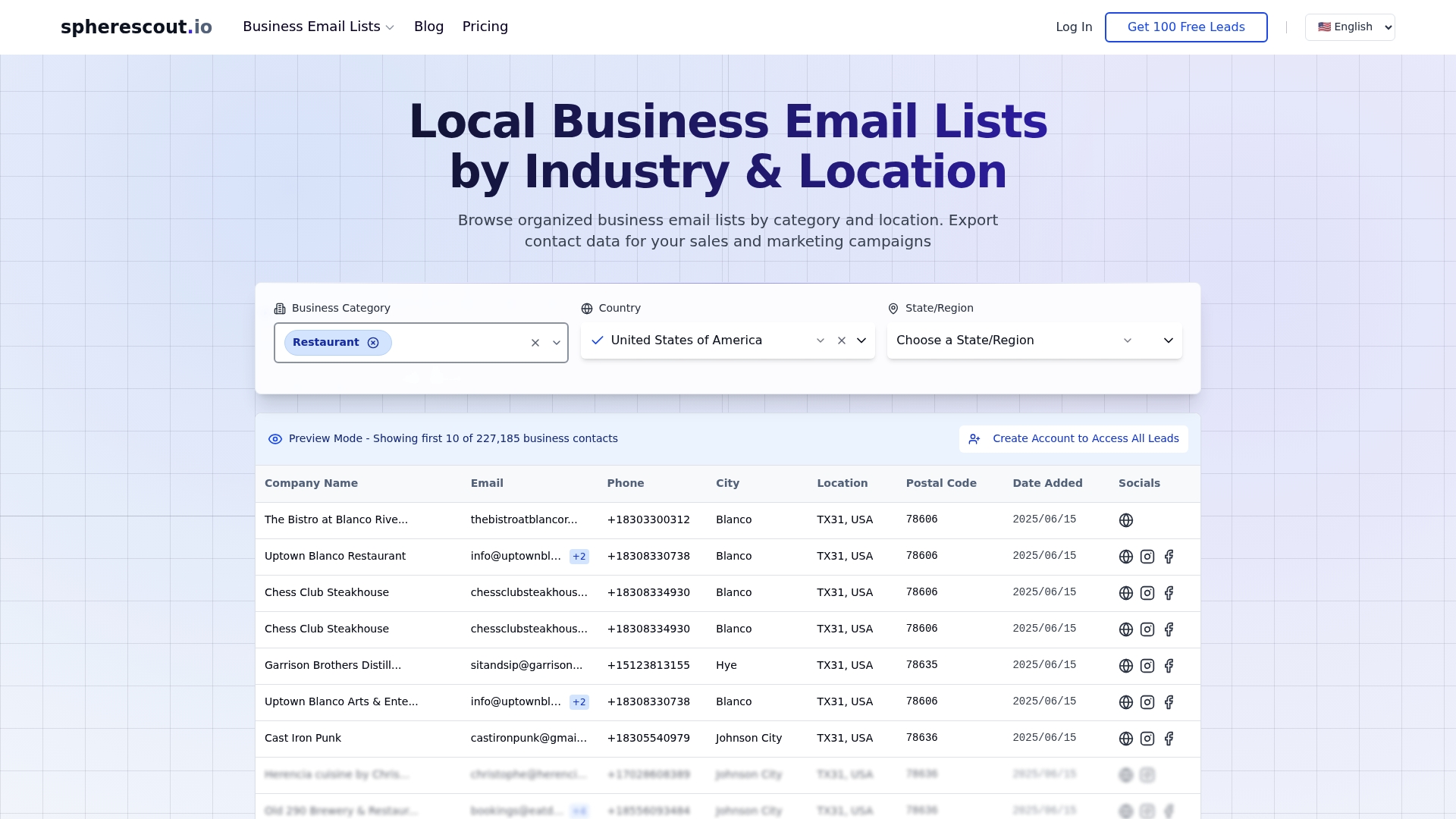
Spherescout gives sales teams and marketers access to a database of over 30 million business contacts, organized by industry, location, and company type. You can filter by city, postal code, or sector to build targeted prospecting lists in minutes, then export them as CSV files ready for your CRM or email platform. If you're looking to buy USA business email lists by industry or explore Spherescout's lead generation functions, the platform makes it straightforward to move from targeting to outreach without the usual research grind. You can even grab free sample leads to test data quality before committing. When your contact data is accurate and segmented correctly, every other step in your lead generation process gets easier.
FAQ
What is B2B lead generation in simple terms?
B2B lead generation is the process of finding companies that could buy your product or service and capturing their contact information to start a sales conversation. It involves targeted outreach, content, and data to attract the right prospects.
What are the main types of B2B leads?
The main types are cold leads, warm leads, Marketing Qualified Leads (MQLs), Sales Qualified Leads (SQLs), and Product Qualified Leads (PQLs). Each type reflects a different level of buyer readiness and requires a different follow-up approach.
How do you generate B2B leads effectively?
Effective B2B lead generation combines inbound content marketing with outbound outreach, backed by clean contact data and a defined lead scoring process. Aligning marketing and sales on qualification criteria is the single biggest factor in improving conversion rates.
Which industries benefit most from B2B lead generation?
Technology, manufacturing, professional services, healthcare, and financial services consistently see the highest demand for structured B2B lead generation due to their reliance on new business pipelines and longer sales cycles.
How does AI improve B2B lead generation?
AI automates lead scoring, identifies high-intent prospects through behavioral signals, and personalizes outreach at scale. AI-qualified leads show up to 76% higher win rates compared to manually qualified leads.
Recommended
- B2B Email Marketing Process for Lead Generation Success | spherescout.io Blog
- B2B sales tips that drive real results for 2026 | spherescout.io Blog
- Boost lead generation with effective business list segmentation | spherescout.io Blog
- B2B email campaign types that drive lead generation | spherescout.io Blog