

Choosing the right email campaign type is one of the most consequential decisions a B2B marketer makes, yet most teams approach it reactively rather than strategically. You pick a newsletter because it feels consistent, send a one-off blast because there's news to share, and wonder why your pipeline stays flat. The highest-performing B2B teams think differently. They map every email send to a lifecycle stage, choose a delivery mechanism that fits the goal, and layer automated flows on top of targeted, human-driven campaigns. This guide maps each major campaign type, benchmarks their performance, and gives you a framework to make smarter decisions starting today.
- Deep dive: Core types of B2B email campaigns
- Comparing campaign performance: One-off sends vs automated flows
- Specialty campaigns: Re-engagement and sales cadence sequences
- What most B2B teams miss: Lifecycle-driven, layered email campaigns
- Connect campaign strategy to actionable results with SphereScout
- Frequently asked questions
Key Takeaways
| Point | Details |
|---|---|
| Lifecycle and mechanics matter | Mapping email campaigns to lifecycle stage and delivery style drives performance and ROI. |
| Automated flows outperform campaigns | Lifecycle-driven automated flows deliver higher click rates and engagement than one-off blasts. |
| Specialties for advanced strategy | Re-engagement and sales cadence campaigns resolve specific business and compliance challenges. |
| Compliance is critical | Re-engagement emails must confirm opt-in without trying to gain new permissions to avoid deliverability harm. |
| Blend tactics for maximum impact | Combining automated flows, one-off campaigns, and specialty sequences maximizes B2B outcomes. |
Understanding email campaign categories: lifecycle and mechanics
Before you choose a campaign type, you need a framework that cuts through the noise. Most marketers think of email campaigns as a flat list of options. In reality, every campaign sits at the intersection of two dimensions: where your prospect is in their journey and how your email gets delivered.
The customer lifecycle email marketing model gives you the first dimension. It breaks your contact's journey into distinct stages: onboarding, nurture, activation, retention, and advocacy. Each stage demands a different tone, content depth, and call to action. Sending a product announcement to someone who just signed up for your newsletter is like asking someone to marry you on a first date. The mechanics dimension covers how emails are delivered: a one-off dedicated send, an automated multi-step flow, or a triggered transactional message.
As Litmus explains, B2B campaign type should be treated as both lifecycle stage and delivery mechanics, because those choices drive different KPIs and expected performance. A welcome email flow and a newsletter blast have totally different success benchmarks, so measuring them the same way leads to wrong conclusions.
Here are the classic B2B campaign types you need to know:
- Welcome and onboarding emails sent immediately after signup or purchase
- Lead nurturing drip sequences that move prospects through the funnel
- Webinar and event promotions for driving registrations
- Newsletters delivering value on a regular cadence
- Product and feature announcements targeting existing users or prospects
- Customer retention and advocacy emails to deepen loyalty
- Account Based Marketing (ABM) emails hyper-personalized for specific target accounts
These common B2B email types span the full range of lifecycle stages and mechanics your team will work with.
| Campaign type | Lifecycle stage | Delivery mechanic |
|---|---|---|
| Welcome/onboarding | Onboarding | Automated flow |
| Lead nurture drip | Nurture | Automated flow |
| Event promotion | Activation | One-off send |
| Newsletter | Retention | One-off send |
| Feature announcement | Activation | One-off send |
| Retention/advocacy | Retention/advocacy | Automated or one-off |
| ABM email | Nurture/activation | Triggered or manual |
Pro Tip: Map every campaign type you run against your sales funnel stages before you build a single email. It takes 30 minutes but saves weeks of misdirected effort. You can find practical B2B email campaign strategies that align with this approach.
Deep dive: Core types of B2B email campaigns
Let's get concrete. Here's how each major campaign type actually works in practice, with the mechanics and examples that matter.
Welcome and onboarding campaigns are your highest-leverage touchpoint. When someone joins your list or starts a trial, they're most engaged right now. Trigger an automated flow that delivers value immediately: introduce your product, set expectations, and invite a next action. A SaaS company might send a three-email sequence over seven days covering setup, key features, and a check-in from customer success.
Lead nurturing drip sequences are sequenced emails designed to move a prospect from awareness to consideration. Good structuring lead nurturing sequences means spacing emails based on engagement signals, not just fixed timers. Start with educational content, build credibility with case studies, then introduce your offer when trust is established.

Webinar and event promotions combine time sensitivity with value framing. These can be one-off sends or short series, usually three to five emails covering the initial invitation, a reminder, a last-chance message, and a post-event follow-up with the recording. The pre-event emails focus on the outcome attendees will get, not just the logistics.
Newsletters are the long game. They work when they consistently deliver genuine value without selling too hard. The best B2B newsletters balance about 80% editorial content with 20% promotional content. The downside is cadence pressure: skipping issues trains your audience to disengage, so commit only to a schedule you can sustain.
Product and feature announcements target two audiences: existing users who need to know what's new, and prospects who've been waiting for a specific capability. Segment carefully here. Sending a feature announcement to someone who doesn't use your product yet requires a different framing than sending it to a power user.
Customer retention and advocacy campaigns focus on depth rather than breadth. These emails celebrate milestones, invite reviews, offer loyalty rewards, or introduce referral programs. They're often underinvested because they don't drive new pipeline directly, but the revenue protection they provide is significant.
ABM emails are the most resource-intensive type. You're creating near-custom content for specific accounts or buying groups. Personalization goes beyond "Hi [First Name]" to include the prospect's industry, company news, or specific pain points. HubSpot distinguishes email types by mechanics and purpose, including informational sends, lead-nurturing series, and transactional emails triggered by specific actions, which is exactly the framework ABM relies on.
"Dedicated" sends deliver a single message to a defined segment. "Transactional" emails are triggered by a specific action a contact took. "Lead nurturing" sequences are automated series designed to build progressive relationships. Knowing which mechanic you're using shapes every design and copy decision.
Here are the key considerations before you deploy each type:
1. Define the trigger or send condition before you write a single line of copy
2. Set a primary metric matched to the campaign's lifecycle stage
3. Establish a suppression rule so no contact gets irrelevant emails simultaneously
4. Test subject lines for every send, regardless of type
You can find strong B2B email outreach examples that show how top-performing teams execute on each of these campaign types.
Comparing campaign performance: One-off sends vs automated flows
Here's where the numbers get interesting. There's a persistent myth that more sends equals more results. The data argues otherwise.
Automated flows outperform broader campaign emails on clicks and overall efficiency, according to Klaviyo's 2026 benchmarks. The performance gap is significant. Flows generate a 5.58% click rate on average compared to 1.69% for one-off campaign emails. That's more than three times the engagement from the same list.
| Campaign type | Avg open rate | Avg click rate | Avg order rate |
|---|---|---|---|
| Campaign email (one-off) | ~21% | ~1.69% | Lower |
| Automated flow | ~35% | ~5.58% | Higher |
| Welcome series | ~45%+ | ~8%+ | Highest |
| Win-back flow | ~28% | ~3.5% | Moderate |
Why do flows win? Timing and relevance. An automated welcome email arrives when someone just opted in, so they're actively thinking about you. A Friday afternoon newsletter blast hits when attention is scattered. Flows deliver the right message at the moment someone signals interest through their own behavior.
The strategic implication here is clear. If your business list segmentation is solid, layering automated flows on top of your existing campaign schedule is the highest-ROI move available to most B2B teams. You don't need to eliminate one-off sends, but you do need to stop treating them as your primary engagement engine.
Benchmark data also suggests that if you're choosing between more one-off campaign sends and more automated lifecycle flows, flows are usually the higher-performing option on clicks and downstream outcomes.
Pro Tip: Segment your flows further by industry vertical or company size. A generic welcome flow might get you 5.58% clicks. A segmented welcome flow for manufacturing leads versus professional services leads can push that number significantly higher because the content is tighter and more relevant. Check out cold email campaign best practices for tactics that also apply to your broader campaign architecture.
Specialty campaigns: Re-engagement and sales cadence sequences
Two campaign types deserve extra attention because they're powerful when done right and problematic when done wrong.
Re-engagement campaigns target subscribers who have gone quiet. Re-engagement email campaigns are one-time sends aimed at inactive subscribers to confirm ongoing interest and rebuild engagement. They work by presenting a compelling reason to stay and asking the contact to confirm they still want to hear from you.
Here's what triggers a re-engagement send:
- No email opens in 90 to 180 days
- No website visits tracked via your marketing platform
- No response to your last three or more automated touches
- Contact approaching list-cleaning or suppression threshold
A typical re-engagement email is direct and low-pressure: "We've noticed you haven't engaged in a while. Still interested in [specific topic]? Click here to stay subscribed." The language is honest, not desperate.
Here's the critical compliance point. Re-engagement should not be used to create new permission. It is specifically meant to reconfirm existing verifiable consent, not to reach cold contacts who never opted in. Misusing it will damage your sender reputation and create compliance risk under regulations like CAN-SPAM and GDPR.
Re-engagement is about list health, not list growth. If you blur that line, you'll watch deliverability rates drop across your entire sending domain, which hurts every campaign you run.
Make sure your email data is clean before launching a re-engagement sequence. Email verification in B2B matters here more than anywhere else, and solid email list verification practices protect your deliverability before you scale.
Sales cadence sequences are structured email progressions used by sales-qualified teams to convert warm leads. A sales cadence sequence typically progresses from relationship-building and evidence-based trust to a direct ask, meaning campaign type can be defined by stage and CTA mechanics rather than channel alone.
A five-email sales cadence looks like this:
1. Email 1: Connection and context. Acknowledge a specific pain point relevant to their role or industry. No hard sell.
2. Email 2: Evidence and credibility. Share a case study or data point that proves you can solve the problem.
3. Email 3: Deepening the value. Introduce a secondary use case or benefit that expands the opportunity.
4. Email 4: Direct ask. Request a meeting, call, or demo. Clear CTA, no ambiguity.
5. Email 5: Final attempt. Low-pressure close. Give them an easy out while keeping the door open.
Each email in the cadence should stand alone clearly enough that someone who misses the previous message still understands the context. Space emails three to five business days apart to avoid appearing pushy while maintaining momentum.
What most B2B teams miss: Lifecycle-driven, layered email campaigns
Here's our honest take after working with B2B teams across industries: most email programs fail not because of bad copy or poor design, but because of structural misalignment. Teams build campaigns in silos. The newsletter team doesn't talk to the demand gen team running drip sequences, and neither coordinates with sales running cadences. Contacts end up receiving three emails in one day from the same company, all with different tones, different offers, and competing CTAs. That's a trust problem before it's a performance problem.
The fix isn't just better coordination. It's lifecycle-driven architecture. Every email your brand sends should be assigned to one lifecycle stage and one mechanic. That discipline forces your teams to ask the right question before building anything: "What does this contact need right now, and what's the best way to deliver it?"
Relying solely on one-off blasts is the most common structural mistake we see. Blast-heavy programs burn list goodwill fast. Your contacts start associating your brand with noise rather than value, and unsubscribes follow. Automated advanced B2B nurturing frameworks solve this by keeping communications relevant to where a contact actually is.
The counterintuitive lesson here is that sending fewer, better-targeted emails almost always outperforms sending more emails to a broad list. The data supports it. The compliance environment demands it. And your prospects will reward you for it with actual engagement.
The winning formula is a blend: automated flows as your backbone, human-driven one-off sends for timely news and events, and re-engagement campaigns as your maintenance layer. If you also have a sales team running cadences, coordinate suppression so a prospect in active sales outreach doesn't simultaneously receive a marketing blast. You can explore different email campaign types to build a full picture of what your contact base needs at each stage.
Compliance must be built into the architecture from day one, not bolted on after a problem surfaces. Map consent status, manage suppression lists proactively, and audit your sending domains regularly.
Connect campaign strategy to actionable results with SphereScout
Knowing which campaign type to use is only half the equation. You also need the right contacts to send to.
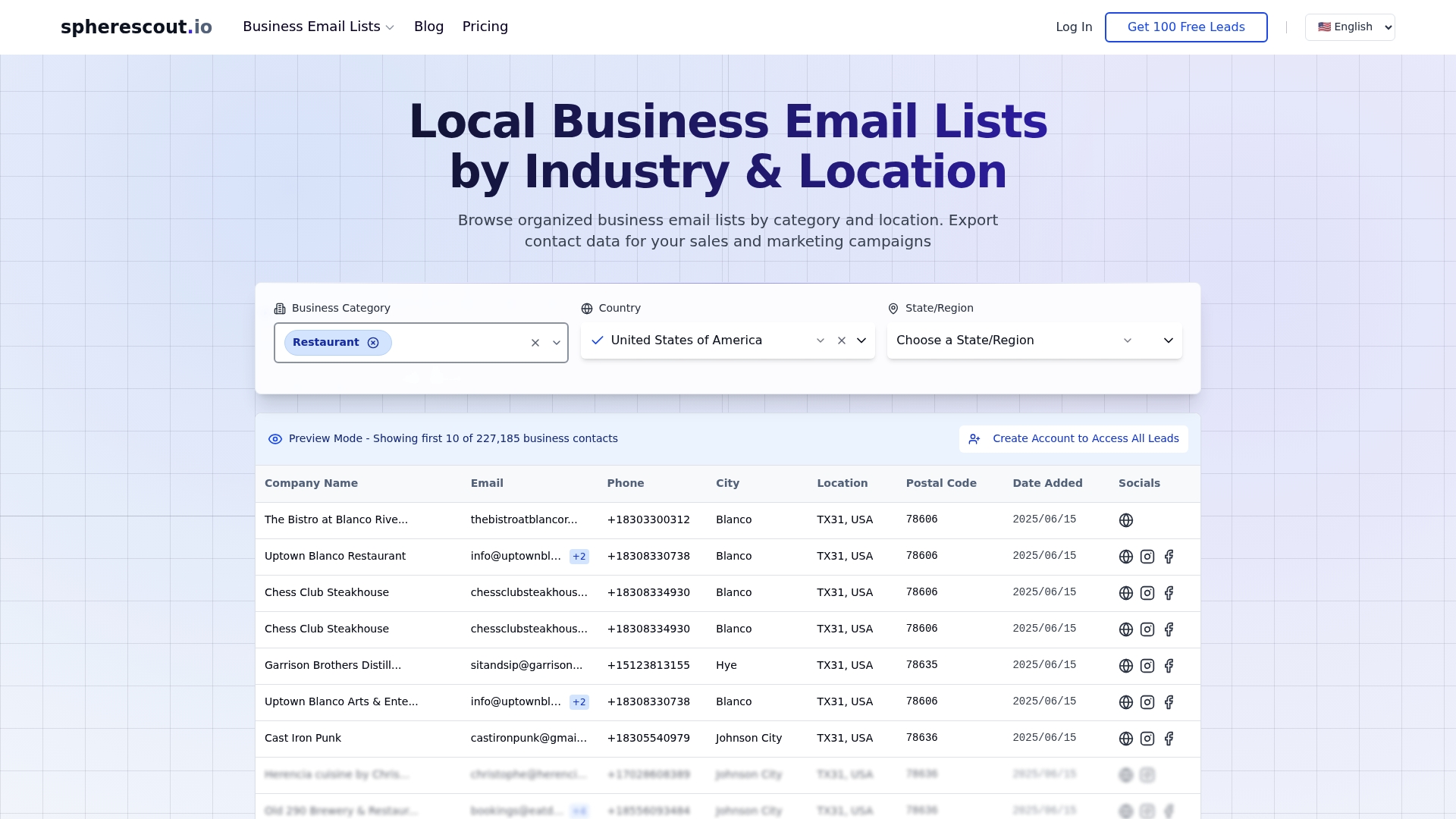
SphereScout gives B2B marketing and sales teams direct access to structured, industry-specific contact lists with over 30 million verified contacts across geographies and verticals. Whether you're building a lead nurturing flow for manufacturing decision-makers or launching an ABM sequence targeting specific zip codes, our lead generation solutions let you filter, download, and CRM-integrate contact data in minutes. If your campaigns are solid but your list quality isn't, you're leaving serious pipeline on the table. Explore our business email list by industry to find the contacts that match your ideal customer profile and put your campaign strategy into action immediately.
Frequently asked questions
What is the best type of email campaign for lead generation?
Automated flows outperform single campaign emails for lead generation thanks to higher click and order rates, making them the default choice for B2B teams focused on pipeline growth.
How do re-engagement campaigns impact sender reputation?
Used correctly to confirm existing opt-in, re-engagement campaigns help maintain list health. But misusing re-engagement to reach contacts who never opted in will hurt deliverability and create compliance risk across your entire sending domain.
How should B2B marketers segment their email campaigns?
Segmenting by lifecycle stage, industry, and engagement levels leads to the highest relevance. Treating campaign type as both lifecycle stage and delivery mechanic helps you set the right KPIs and measure performance accurately.
What is the difference between a campaign email and an automated flow?
Campaign emails are one-off sends for a specific message or moment. Flows are automated, trigger-based sequences designed to drive engagement over time, and benchmarks consistently show flows generate higher engagement than one-off blasts.
How many emails are in a typical sales cadence?
Sales cadences typically use five emails, each with a distinct focus: relationship-building, evidence, value expansion, a direct ask, and a final low-pressure close.
Recommended
- B2B Email Marketing Process for Lead Generation Success | spherescout.io Blog
- Email marketing strategies that drive real B2B results | spherescout.io Blog
- 7 High-Response Email Outreach Examples for B2B Teams | spherescout.io Blog
- Boost lead generation with effective business list segmentation | spherescout.io Blog