Best Scrap.io alternative for Google Maps leads in 2026
Both tools use subscriptions and monthly credits. The difference is geography: SphereScout lets you export whole-country category segments from the first tier.
Choose Scrap.io when you want map-source extraction workflows and advanced drawn-area search. Choose SphereScout when workflows or agents need whole-country local-business data from the entry plan.
What kind of alternative is this?
SphereScoutLocal-business market database
vs
Scrap.ioLocal-business intelligence platform
Choose SphereScout if
Buyers who need full-country category segments without upgrading to an enterprise-style tier.
Teams that want subscription credits plus one-off top-up credits when a campaign needs more volume.
Teams that want the database maintained for them, with public per-country refresh dates.
Choose Scrap.io if
Maps-derived extraction workflows across Google Maps, Apple Maps, and Bing Maps.
Teams with steady monthly volume that will consume a subscription quota.
Radius and polygon geo-targeting drawn directly on a map on higher tiers.
Scrap.io is the closest product to SphereScout in this group: it offers local-business data from Google Maps, Apple Maps, and Bing Maps with detailed filters. Although it calls itself a scraper, its site also describes a continuously updated database.
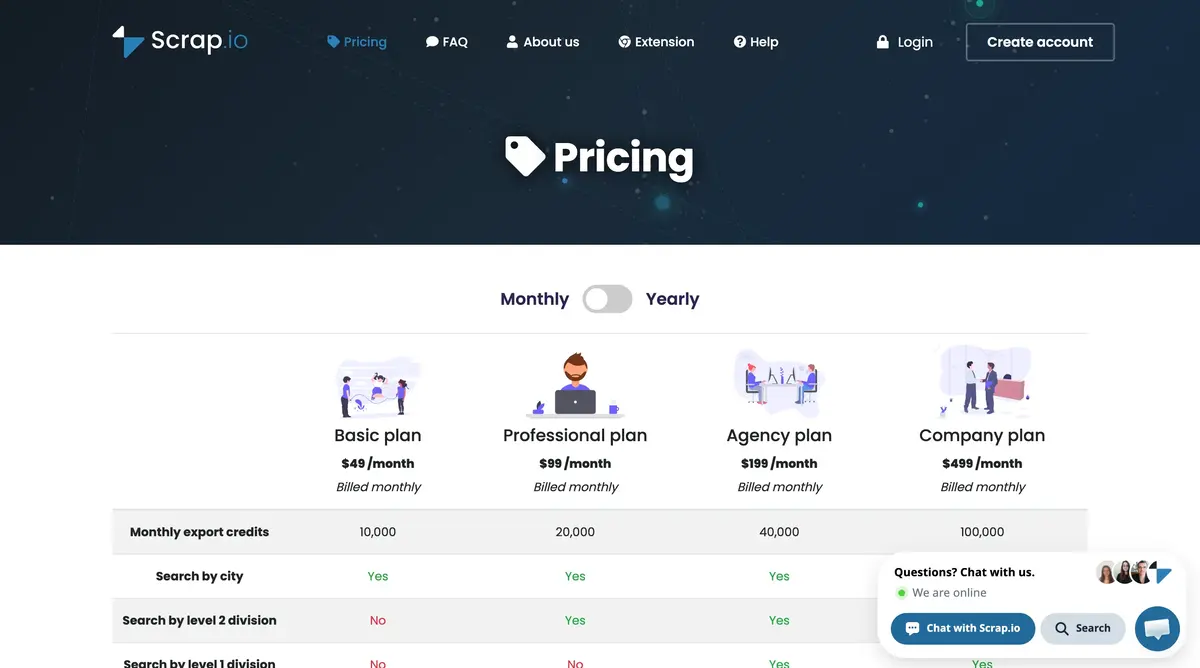
The main difference is the plans. Scrap.io limits whole-country searches to its Company plan. SphereScout allows whole-country category exports from its first subscription tier. Both use monthly credits; SphereScout also sells one-off credit top-ups.
SphereScout vs Scrap.io
Compare features ↓
SphereScout
Scrap.io
Buying model
Subscription credits reset monthly; extra credits can be bought as one-off top-ups without changing subscription.
Monthly subscription with export credits that expire each month.
Know cost before you run
Preview segment size and email coverage before choosing what to export.
Free trial exists, but the product is built around monthly plans and export-credit limits.
Country-level coverage
Default on every plan: a category across a whole country is the normal working unit.
Whole-country search is a higher-tier feature.
Cost of staying fresh
Monthly refresh is part of the dataset, with public refresh dates per country.
Scrap.io says its data is continuously updated; exports remain governed by the active plan and monthly credit quota.
Best buyer
Country/category list buyers who want broad geography from the first tier.
Steady high-volume maps export workflows that fit the monthly plan limits.
Both have expiring monthly credits
The difference is not that SphereScout is subscription-free. SphereScout also uses subscription credits that reset monthly. The operational difference is flexibility: buyers can add one-off credits for a larger campaign without changing the underlying subscription.
Whole-country exports from the first tier
SphereScout's working unit is the full category segment: every record we hold for a category in a country, previewable before purchase. Scrap.io lists whole-country search as a Company-plan feature, so the size of the market you can address depends on the plan tier.
Scraper positioning, database reality
Scrap.io presents itself as a maps scraper, but also says it continuously updates its database. That matters because buyers are not just choosing a scraping tool; they are choosing how a maintained maps dataset is packaged, refreshed, searched, and metered.
Where Scrap.io can be the wrong fit
Not product defects, just workflow mismatches that matter when the goal is outbound prospecting.
Subscription credits reset monthly and do not carry over, so irregular volume can raise the effective cost per exported lead.
Search scope is tier-gated: whole-country search is on the Company plan, radius starts on Professional, and polygon search is on Company.
The positioning is mixed: Scrap.io sells the product as maps scraping, while also describing continuously updated data. Buyers should treat it as a maintained maps lead database with export/search limits by plan.
Best Scrap.io alternatives by use case
SphereScoutA maintained local-business database with whole-country category segments available from the first subscription tier. Preview exact business and email counts before paying, with public per-country refresh dates.
OutscraperRuns on the same pay-per-request logic most scrapers in this space use, unlike Scrap.io's monthly-credit plans. Worth it over Scrap.io if you'd rather pay per job than commit to a subscription tier that gates whole-country search.
ApifyWhere Scrap.io packages maps extraction as a subscription product, Apify leaves the packaging to you: choose an actor, configure it, pay per compute unit and processed record. Fits teams that want to own the pipeline, not rent a finished one.
D7 Lead FinderThe simplest tool in this comparison: type a keyword and a location, get a list, capped by a daily search quota. No maintained database behind it the way Scrap.io or SphereScout have — each search is a fresh live query.
OpenmartAn all-in-one local-business platform bundling database, scraping, enrichment, owner-finding, and outreach sequencing — a bigger surface than a focused maps lead database if you want the bundle, more than you need if you just want the list.
FAQ
Is SphereScout a Google Maps scraper like Scrap.io?
No. SphereScout is a refreshed local business database. Scrap.io presents itself as a maps scraper, while also describing continuously updated data, so the practical comparison is between two maintained maps-data products with different export and plan constraints.
When is Scrap.io better?
Scrap.io is better when you specifically want maps-source export workflows across Google Maps, Apple Maps, and Bing Maps.
When is SphereScout better?
SphereScout is better when you want repeatable, pre-normalized local business segments, whole-country category exports from the first tier, and the option to buy one-off extra credits for larger campaigns.
What's the best Scrap.io alternative for Google Maps leads?
It depends on the plan tier you'd need. Scrap.io gates whole-country search to its higher-tier plans; SphereScout makes full-country category segments available from the first tier, which makes it the more direct alternative if broad geography matters from day one.
Is there a free Scrap.io alternative?
Scrap.io offers a free trial tied to its plan structure. SphereScout offers a free preview of up to 100 leads per category so you can check real record and email counts before paying anything.
Which alternative is best for whole-country lead generation?
The deciding factor is which plan tier unlocks country-wide search. SphereScout treats a full-country category segment as the default working unit on every plan; Scrap.io requires upgrading to a higher tier for the same geographic scope.
How this comparison was checked
Reviewed by Raphael Canyasse, SphereScout's founder and the person responsible for its local-business data product.
We checked the cited public product and pricing pages in a browser. Plans can change, so confirm current terms in the official sources before buying.
We reviewed localized search results to identify common buyer questions. Product claims still required an official public source.
SphereScout is our product. We state when the competitor is the better fit and do not publish accuracy claims we have not tested.
What we reproduced in the browser
Scrap.io's pricing table ties monthly export credits and geographic search scope to the plan: whole-country search appears only on the $499 Company plan. SphereScout lets buyers inspect and purchase a country-and-category market without moving up a seat plan.
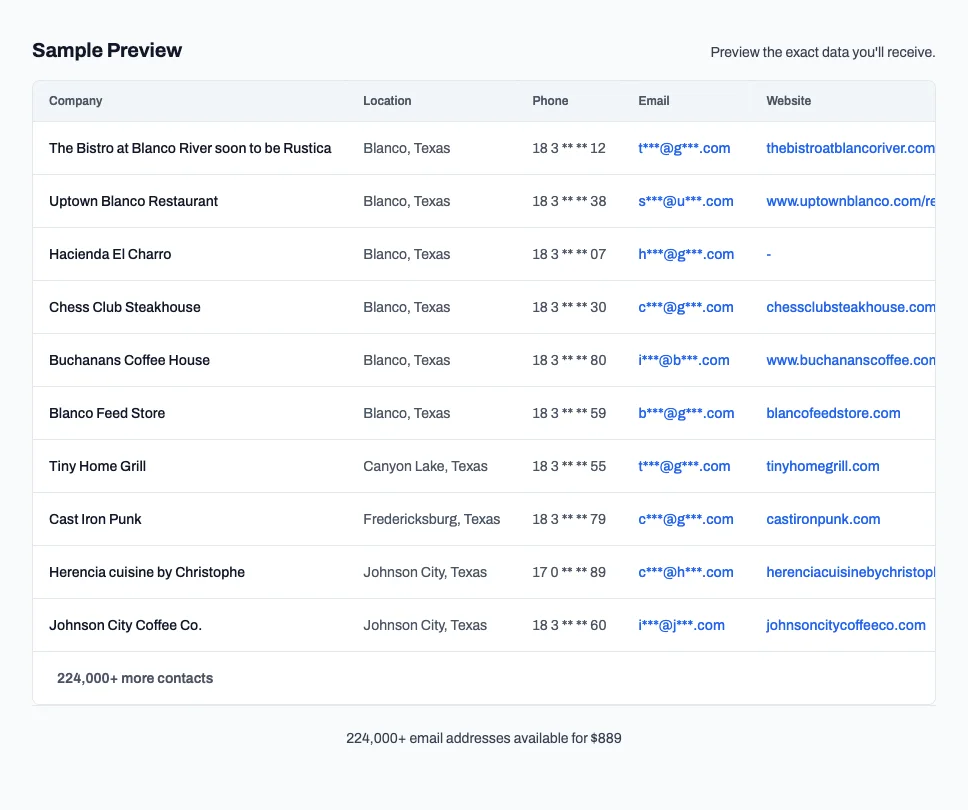
Scrap.io · Last reviewed Aug 17, 2026SphereScout control check: on 17 August 2026, the public USA Restaurants page showed 719,000+ listings, 209,000+ businesses with email, 649,000+ with phone, and 11 masked sample rows.
Sources
Official product pages, review directories, and public comparisons, linked so you can verify every claim above.
Scrap.io homepageOfficial positioning: Google Maps, Apple Maps, and Bing Maps scraping for local lead generation.