

You've probably been there: you pull a list of 500 "leads," spend a week crafting outreach, and get three replies. The problem usually isn't your message. It's the contacts. Finding genuinely useful business contacts for B2B sales is one of the most underrated challenges for SME sales teams, and the gap between a quality list and a mediocre one can be the difference between a full pipeline and a frustrating quarter. This article walks you through smart, proven tactics for sourcing contacts that actually convert.
- Top sources: The most effective channels to find business contacts
- LinkedIn, referrals, and networking: Low-budget, high-impact tactics
- Data providers and cold outreach: Tools for scaling your pipeline
- Quality versus quantity: How to choose the right approach
- Our take: What most articles get wrong about finding business contacts
- Unlock high-quality business contacts with SphereScout
- Frequently asked questions
Key Takeaways
| Point | Details |
|---|---|
| Prioritize quality contacts | Focusing on relevant, verified contacts beats out mass outreach for B2B lead conversions. |
| Leverage multiple channels | Combine networking, modern tools, and referrals to maximize your pool of high-potential business leads. |
| Verify and clean data | Always check, enrich, and update your data to avoid wasted effort and compliance risks. |
| Balance cost and ROI | Assess the true value of each channel using benchmarks like reply rates and cost-per-lead. |
Set your criteria: What makes a quality business contact?
Before you go hunting for contacts, you need to know exactly what you're hunting for. This sounds obvious, but most teams skip this step and wonder why their outreach falls flat.
A high-value business contact typically checks several boxes:
- Decision-making authority: You want someone who can say yes, not just someone who passes your email along. Target titles like VP, Director, Head of, or C-suite depending on your offer.
- Relevance to your solution: The best contact in the world is useless if their company doesn't need what you sell. Industry, company size, and business model all matter here.
- Accurate, current contact information: A verified email and a direct phone number beat a generic info@ address every time.
- Buying intent or trigger signals: Has this company recently raised funding, hired for a relevant role, or expanded into a new market? These are signs they're open to solutions like yours.
The risk of skipping this qualification step is real. Outdated or poorly targeted lists inflate your bounce rate, damage your sender reputation, and waste your team's most valuable resource: time. B2B lead generation strategies research confirms that top-performing sales reps prioritize quality over volume, building warm contacts through networking, referrals, and LinkedIn introductions rather than blasting every name they can find.
Smart business list segmentation upfront means your team spends energy on prospects that actually fit, not just contacts that exist. Pair this with a clear framework to filter for quality leads before any outreach begins, and you'll see conversion rates climb.
Pro Tip: Use data enrichment tools to layer firmographic data (company size, industry, revenue range) onto your raw contact lists before outreach. This one step can reduce wasted calls and emails by 30 to 40 percent.
Now that you know what matters most in a business contact, let's look at the best ways to actually find and verify them.
Top sources: The most effective channels to find business contacts
With so many channels available, it's important to select the source that fits your resources and goals.
Here's a quick breakdown of the main channels SME sales teams use:
Data providers and enrichment platforms
These services offer large databases of verified B2B contacts filterable by industry, geography, revenue, and more. B2B data providers like ZoomInfo, Apollo.io, UpLead, and AdRoll ABM Contact Data supply verified emails, phone numbers, and firmographics, all filterable by industry, revenue, and tech stack. Great for scaling outreach quickly.
LinkedIn remains the gold standard for professional networking. You can research prospects, find mutual connections, and send direct messages all in one place. The quality is high, but it takes time and consistency.

Referrals
Your existing customers are your best source of new contacts. A warm introduction carries more weight than any cold email, and the conversion rates reflect it.
Website visitor identification tools
Website visitor tools like Leadinfo reveal anonymous visitors' company details and employee contacts, surfacing high-intent leads who are already showing interest in your offer.
Content marketing and inbound
Blog posts, webinars, and downloadable guides attract contacts who self-select based on genuine interest. Slower to build but yields warm, engaged prospects.
Cold outreach and event networking
Traditional methods still work, especially in niche industries where personal relationships drive deals.
| Channel | Accuracy | Cost | Relationship value | Best for |
|---|---|---|---|---|
| Data providers | High (varies) | Medium to high | Low | Scaling fast |
| High | Low to medium | High | Targeted outreach | |
| Referrals | Very high | Very low | Very high | High-value deals |
| Visitor ID tools | Medium to high | Medium | Medium | Intent-based targeting |
| Content marketing | Medium | Medium | High | Inbound nurturing |
| Cold email lists | Low to medium | Low | Low | Volume testing |
"The channels that consistently deliver the best ROI for SMEs are the ones rooted in real relationships. Volume without relevance is just noise." — B2B lead generation research, Venture Harbour
A solid LinkedIn strategy tailored to your business stage can dramatically improve your contact quality without a large ad budget. The key is combining multiple channels rather than relying on any single source.
LinkedIn, referrals, and networking: Low-budget, high-impact tactics
Digital channels work well, but automation and data tools can further expand your reach if used wisely.
LinkedIn and referrals are the highest-converting, lowest-cost tactics available to SME sales teams. But most people use them inconsistently or incorrectly. Here's how to build a real engine around both.
Building your LinkedIn outreach system:
1. Optimize your profile so it speaks to your buyer, not just lists your credentials. Your headline should answer the question: "What problem do you solve?"
2. Identify second-degree connections at target companies using LinkedIn's search filters. Mutual connections dramatically increase acceptance rates.
3. Send personalized connection requests with a short, specific message. No pitching yet. Just a genuine reason to connect.
4. Once connected, follow up with value: share a relevant article, comment on their post, or ask a thoughtful question.
5. Move to a meeting ask only after two or three genuine exchanges. This sequencing is everything.
📊 Stats that matter: LinkedIn outreach data from H1 2026 shows connection acceptance rates average 29.61%, and reply rates hit 10.3%, which is double cold email's 5.1% average. Sales Navigator users see a 312% three-year ROI, making it a genuinely worthwhile investment for teams doing regular prospecting.
Building a referral engine:
1. After a successful project or positive feedback, simply ask: "Is there anyone in your network who might benefit from what we do?"
2. Make it easy by providing a short description of your ideal customer they can forward.
3. Offer a referral incentive if appropriate for your industry, whether that's a discount, gift, or charity donation.
4. Follow up referrals quickly and keep the referring customer in the loop. This builds trust and encourages repeat referrals.
5. Track referral sources in your CRM so you know which customers generate the most introductions.
SME-focused research consistently shows that LinkedIn outreach, referrals, and content marketing deliver compounding returns over time, especially when your network or domain expertise is strong. Teams that rely too heavily on paid data miss the relationship equity that makes buyers say yes.
You can see this dynamic in real client success stories from referral-driven businesses: relationships built on trust close faster and with less friction than cold-sourced contacts.
Pro Tip: When reaching out on LinkedIn, always reference a mutual connection or a specific piece of content the prospect recently engaged with. Personalized messages that demonstrate you did your homework get accepted and replied to far more often than generic templates.
Pairing LinkedIn and referral work with a smart B2B email marketing process keeps warm contacts moving through your pipeline even when you're not actively reaching out.
Data providers and cold outreach: Tools for scaling your pipeline
Now that you've seen the tradeoffs between organic and data-driven channels, let's look at how to scale using purchased data without the usual pitfalls.
Data providers can be powerful for SMEs that need to fill their pipeline fast, but they come with real risks if you don't use them carefully. The biggest issues are data decay, compliance, and relevance.
What to watch out for when buying lists:
- Data decay: B2B contact data degrades fast. Industry research confirms that cold email benchmarks vary significantly by industry, and regular enrichment is essential to maintain deliverability and accuracy.
- Compliance risks: GDPR, CAN-SPAM, and similar regulations require opt-in consent in many contexts. Data accuracy research highlights that some major providers skew heavily toward US-centric data and may have compliance gaps for international outreach. Always verify the source and opt-in status of any list you purchase.
- List quality: Even "verified" contacts can bounce at rates of 15 to 25 percent if the data hasn't been refreshed recently. Enrich and verify before you send.
| Metric | Industry average | Strong performer |
|---|---|---|
| Cold email open rate | 20 to 28% | 35%+ |
| Reply rate | 3 to 5% | 8 to 12% |
| Meeting booked rate | 0.5 to 1.5% | 3 to 5% |
| Bounce rate (acceptable) | Under 2% | Under 1% |
Refer to the full B2B data providers overview when evaluating which platforms fit your outreach goals and compliance requirements.
Getting your cold emailing practices right is just as important as having accurate data. A great list sent with a weak email still produces poor results. The reverse is also true.
Pro Tip: Run every purchased list through a real-time email verification tool before your campaign launches. This simple step reduces bounce rates, protects your sender reputation, and is one of the highest-ROI habits in cold outreach. Learn more about verifying contact information as a standard step in your workflow.
Quality versus quantity: How to choose the right approach
You're ready to put these insights into practice and select the best channel for your next campaign.
This is the debate that never quite goes away in B2B sales: do you reach more people, or do you focus tighter? The data gives a clear answer, but with some nuance.
| Approach | Typical weekly volume | Meeting booked rate | Cost per lead | Best for |
|---|---|---|---|---|
| High volume (100+ contacts/week) | 100 to 200 | 0.5 to 1% | Low per contact | Brand new pipelines, testing messaging |
| Targeted quality (<25 contacts/week) | 15 to 25 | 3 to 8% | Higher per contact | Complex deals, senior buyers |
LinkedIn sales statistics show clearly that quality wins in terms of meetings booked. Teams sending fewer than 25 highly targeted connection requests per week consistently outperform those sending 100+ generic ones. The difference shows up not just in reply rates but in deal size and sales cycle length.
Cost is another lens. B2B lead generation data for 2026 puts cost per lead (CPL) anywhere from $31 in AdTech to $748 in insurtech, with a median MQL-to-SQL conversion rate of 13%. If your CPL is high, you absolutely cannot afford to waste it on poorly qualified contacts.
Signs you should rethink your approach:
- Your reply rate is under 3 percent consistently
- Your bounce rate is above 2 percent
- Your meetings-to-close ratio is getting worse, not better
- You're spending more time sending than qualifying
- Your sales team is complaining about lead quality
"Quality always wins when you measure what matters: booked meetings, closed deals, and saved time. Volume is a trap if your targeting isn't sharp." — PhantomBuster B2B outreach research
Smart lead segmentation strategies let you get the benefits of scale without sacrificing relevance. Segment your list by industry, company size, and buyer persona before you reach out, and treat each segment with a tailored message.
Our take: What most articles get wrong about finding business contacts
Here's something we see constantly: SME sales teams invest heavily in purchasing large contact databases, build elaborate automation sequences, and then wonder why their pipeline feels hollow. The problem isn't the tool. It's the mindset.
Most articles tell you to "buy quality data" and "personalize at scale." That's not wrong, but it misses the harder truth. The contacts that close deals for SMEs are almost never the ones that came from a cold list. They're the ones that came from a referral, a LinkedIn conversation that took three weeks to warm up, or a customer who trusted you enough to make an introduction. This relationship layer is what turns a contact into a conversation, and a conversation into a deal.
We've seen teams triple their close rates not by buying more data, but by investing in contact data hygiene, trimming their lists down to the 20 percent that actually fit their ICP, and focusing energy on genuine relationship-building before automation kicks in.
The uncomfortable lesson: scaling before you've validated your messaging and your ICP is expensive and demoralizing. Get those right first, at small volume, then scale with data providers and automation behind them.
Results-driven B2B email works best when it follows relationship work, not replaces it. Use data tools to scale what's already proven to convert, not to shortcut the trust-building process.
Unlock high-quality business contacts with SphereScout
Finding the right contacts manually takes hours. Keeping them fresh and organized takes even more. That's exactly the problem SphereScout was built to solve.
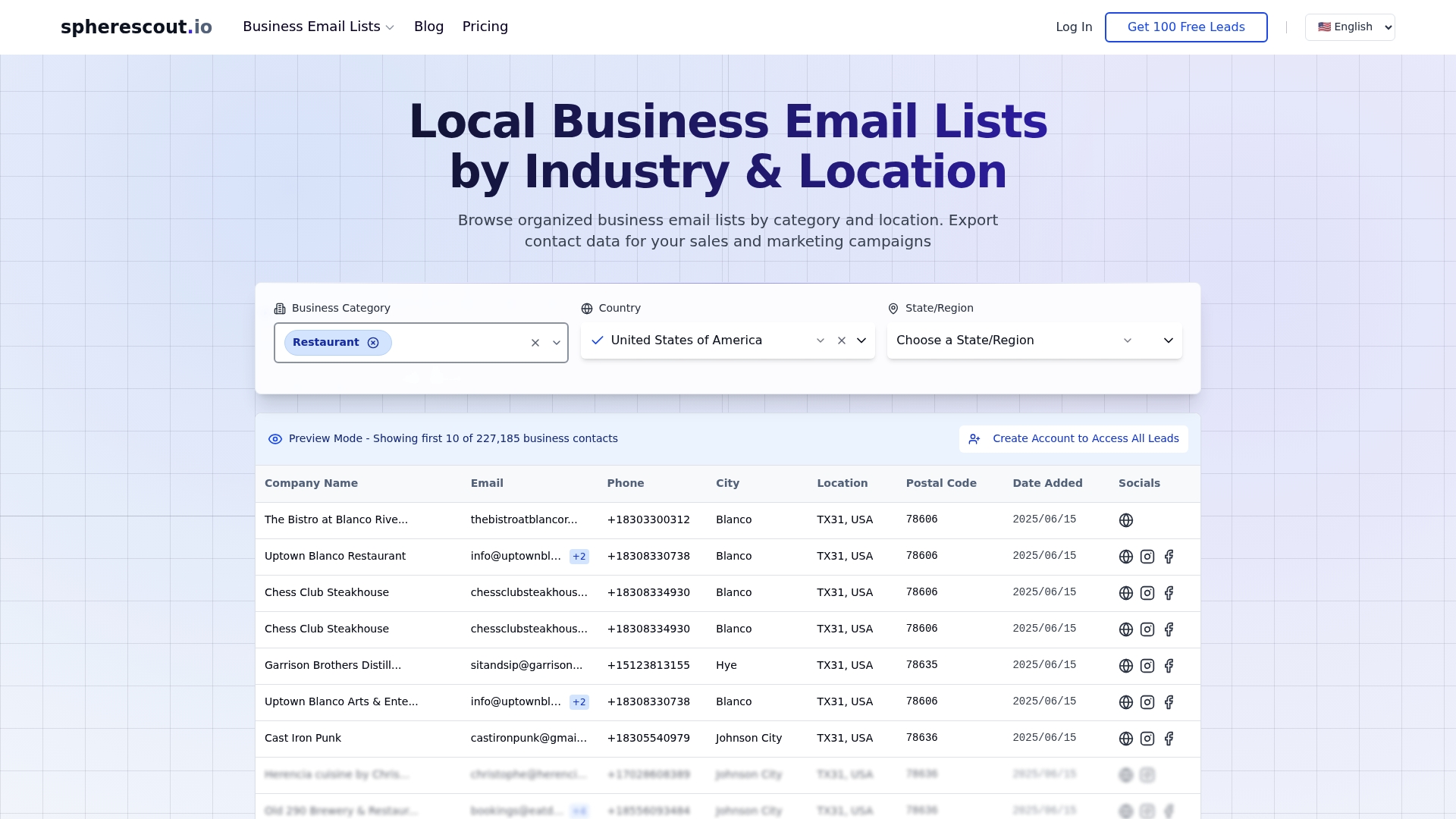
SphereScout gives your sales and marketing team direct access to a database of over 30 million verified business contacts, filterable by industry, city, postal code, and company profile. Whether you need a targeted business email list for a specific campaign or want to purchase an email database segmented by geography and sector, SphereScout delivers export-ready CSV files that integrate directly with your CRM or email platform. Try the free sample leads to see the contact quality firsthand, then explore the full suite of lead generation solutions to build a pipeline that actually moves.
Frequently asked questions
What is the best way to find business contacts for a small B2B sales team?
Focus on quality by combining LinkedIn outreach, referrals, and segmentation tools to build warm, high-intent contacts. Networking and referrals consistently outperform volume-based tactics for teams with limited resources.
How do I avoid bad data and outdated contacts when buying lists?
Choose providers that offer real-time enrichment and always verify contacts before sending. Regular data enrichment and prioritizing opt-in lists are the most reliable ways to protect your sender reputation and deliverability.
Are LinkedIn connections more effective than cold emails?
Yes, LinkedIn outreach delivers roughly double the reply rate of cold email, making it a stronger channel for starting real conversations. LinkedIn reply rates average 10.3%, compared to 5.1% for cold email.
What metrics matter most when evaluating business contact sources?
Focus on response rate, meeting-booked rate, and MQL-to-SQL conversion when comparing lead sources. CPL ranges from $31 to $748 depending on industry, making quality evaluation essential for ROI.
Recommended
- B2B Email Marketing Process for Lead Generation Success | spherescout.io Blog
- Boost lead generation with effective business list segmentation | spherescout.io Blog
- Why verifying contact information boosts B2B leads | spherescout.io Blog
- How to export contact lists efficiently for B2B outreach | spherescout.io Blog