

Most B2B outreach fails before it even reaches an inbox. Generic messaging, untargeted contact lists, and zero follow-up strategy turn what should be a revenue engine into a time sink. If your reply rates are flat, your pipeline is thin, or your sequences feel like they're disappearing into a void, this guide is for you. You'll find concrete best practices for B2B outreach that cover everything from building your ideal customer profile to measuring what actually matters, so you stop guessing and start booking meetings.
- Best practices for B2B outreach start with your ICP
- Crafting messages that earn a response
- Tools for B2B outreach campaigns
- Speed-to-lead and follow-up practices
- Measuring and optimizing outreach performance
- My honest take on what most teams get wrong
- Start your next campaign with better data
- FAQ
Key takeaways
| Point | Details |
|---|---|
| ICP precision drives results | Define your ideal customer profile by vertical, company size, and trigger events before sending a single message. |
| Multi-channel sequences win | 5-8 touches across email, LinkedIn, and phone over 14-21 days consistently outperform single-channel volume. |
| Value before the ask | Follow the 70/30 rule: 70% of your outreach should educate or help, 30% should pitch. |
| Speed-to-lead changes everything | Responding to warm replies within 60 minutes drives qualification rates 7x higher than next-day responses. |
| Measure what moves pipeline | Track reply rate, meeting rate, and pipeline velocity weekly, not just open rates. |
Best practices for B2B outreach start with your ICP
What is targeted B2B outreach, really? It's not just sending emails to companies in your industry. It's reaching exactly the right person at exactly the right company at exactly the right moment. That starts with a sharply defined ideal customer profile (ICP).
Your ICP should go beyond "mid-market SaaS companies." You need to define:
- Vertical and sub-vertical (e.g., logistics tech within SaaS, not just SaaS)
- Company size range by headcount and revenue
- Tech stack signals that indicate fit or buying readiness
- Trigger events such as a funding round, new hire in a key role, or recent product launch
- Decision-maker titles and the buying committee structure
The broader your ICP, the more you dilute your message and waste your budget. A campaign targeting "VP of Sales at companies with 50-500 employees" is already more focused than most teams manage. But adding a trigger event layer, like companies that hired a new CRO in the last 90 days, moves you into a different tier of precision entirely.
Data quality is where most teams quietly lose ground. Triple verification of contact data costs roughly $0.02-$0.05 per contact and keeps bounce rates below 3%, which protects your sender domain from reputation damage. A burned domain can take weeks to recover. The math makes verification a straightforward call.
Use behavioral and intent data to sharpen your list further. If a prospect has been visiting your pricing page or downloading competitor comparisons, they're signaling readiness. Prioritize those contacts at the top of your sequence.
Pro Tip: When building your segmented contact lists, create two or three distinct ICP tiers. Tier 1 gets your most personalized outreach; Tier 2 gets a modified version; Tier 3 gets lighter automation. This protects your time without abandoning good leads.
Crafting messages that earn a response
Once your targeting is locked, the message is where deals live or die. The single biggest mistake in B2B outreach is treating every touchpoint as a pitch. 70% of B2B buyers prefer hearing from vendors who educate them rather than push them. Your sequence needs to reflect that.

The 70/30 rule is practical guidance, not theory. Seventy percent of your touchpoints should deliver genuine value: a relevant insight, a case study, a data point specific to their industry. Thirty percent can make a direct ask. When you flip that ratio, you become noise.
Here's how a well-structured multi-channel sequence looks in practice:
1. Day 1, Email: Short, personalized introduction with one specific observation about their business or industry. No pitch yet.
2. Day 3, LinkedIn connection: Send a connection request with a brief, relevant note. Reference the email only if it adds context.
3. Day 5, Email: Share something useful. A benchmark report, a short case study, a question worth thinking about.
4. Day 8, Phone call: Brief voicemail that ties back to the email thread. Mention a specific detail to prove you've done your homework.
5. Day 11, LinkedIn message: Add another value point, a different angle from the email thread.
6. Day 14, Email: Create light urgency. Reference a trigger event or a deadline that makes acting now sensible.
7. Day 18, Final email: Clear, direct close. Offer an easy next step. No guilt, no pressure.
Targeted multi-channel outreach outperforms generic single-channel efforts by 10-20x. LinkedIn alone sees connection-plus-note acceptance rates of 25%-40% when the message is relevant. That's a channel too many teams underuse because their messaging isn't ready for it.
Pro Tip: Never let two consecutive touchpoints say essentially the same thing. If your Day 5 email covered cost reduction, your Day 8 voicemail should reference a different angle, like risk mitigation or time savings. Real email outreach examples can help you see this in practice.
Tools for B2B outreach campaigns
Technology doesn't replace good strategy, but it makes good strategy scalable. The top tools for B2B outreach campaigns fall into a few clear categories, and knowing which you need prevents expensive overlap.
| Tool Category | Primary Function | What to Look For |
|---|---|---|
| Sequencing platforms | Automate multi-channel cadences across email, LinkedIn, and phone | Channel breadth, reply detection, A/B testing |
| Email verification tools | Clean contact lists before sending to protect domain health | Bounce rate reduction, bulk verification speed |
| Intent data providers | Surface accounts showing active buying signals | Integration with your CRM, signal freshness |
| AI writing assistants | Generate personalized message variations at scale | Tone control, context input flexibility |
| CRM integration layer | Sync contact activity and engagement data centrally | Two-way sync, custom field support |
AI-powered personalization tools drive roughly 10% higher open rates and double the reply rates compared to generic templates. The key is using AI for research synthesis and first-draft generation while keeping a human in the loop for final review. Automation that sends without any human context check creates exactly the kind of generic outreach you're trying to avoid.
Inbox health is often overlooked until it's a crisis. Warm up new sending domains for at least four weeks before launching campaigns. Rotate between multiple domains and mailboxes if you're sending at volume. Email verification tools should run on every list before it ever enters a sequence. Think of it as the inbox equivalent of checking your tires before a long drive.
For tracking, you want to monitor engagement at the individual contact level, not just campaign averages. When someone opens an email three times in one day or clicks a link twice, that's a signal. Your sequencing platform should flag those contacts for priority follow-up.
Speed-to-lead and follow-up practices
You can have the best sequence in your market and still lose the deal by responding too slowly. Responding within 60 minutes to a warm reply produces qualification rates 7x higher than waiting until the next business day. That stat tends to surprise people. It shouldn't. When a prospect replies, they're in the moment. Delay cools that interest fast.
The mechanics of speed-to-lead require actual operational planning:
- Assign ownership clearly. Every active sequence needs a named rep responsible for monitoring replies in real time during business hours.
- Build pre-written response templates for the four or five most common reply types: interested but busy, skeptical, wrong person, or ready to book. Templates let you personalize quickly without starting from scratch.
- Set reply alerts in your sequencing platform so hot leads surface immediately rather than sitting in a general inbox.
- Use calendar links in every response so the path to booking is frictionless for the prospect.
Follow-up messages deserve the same discipline. The phrase "just checking in" is the single most common way to kill a B2B conversation. Every follow-up should introduce a new angle: a client result, a regulatory change that affects their business, or a question they haven't considered yet. High-performing outreach teams treat each touchpoint as a standalone reason to engage, not a nudge to remember the previous email.
The metrics that tell you whether your speed-to-lead and follow-up processes are working include reply rate by sequence day, meeting booked rate, time-to-reply from your end, and cost per meeting. These four together give you a real picture of pipeline health.
Measuring and optimizing outreach performance
You can't fix what you don't measure, and most teams measure the wrong things. Open rates are a vanity metric. They tell you whether your subject line worked, not whether your outreach is building pipeline.
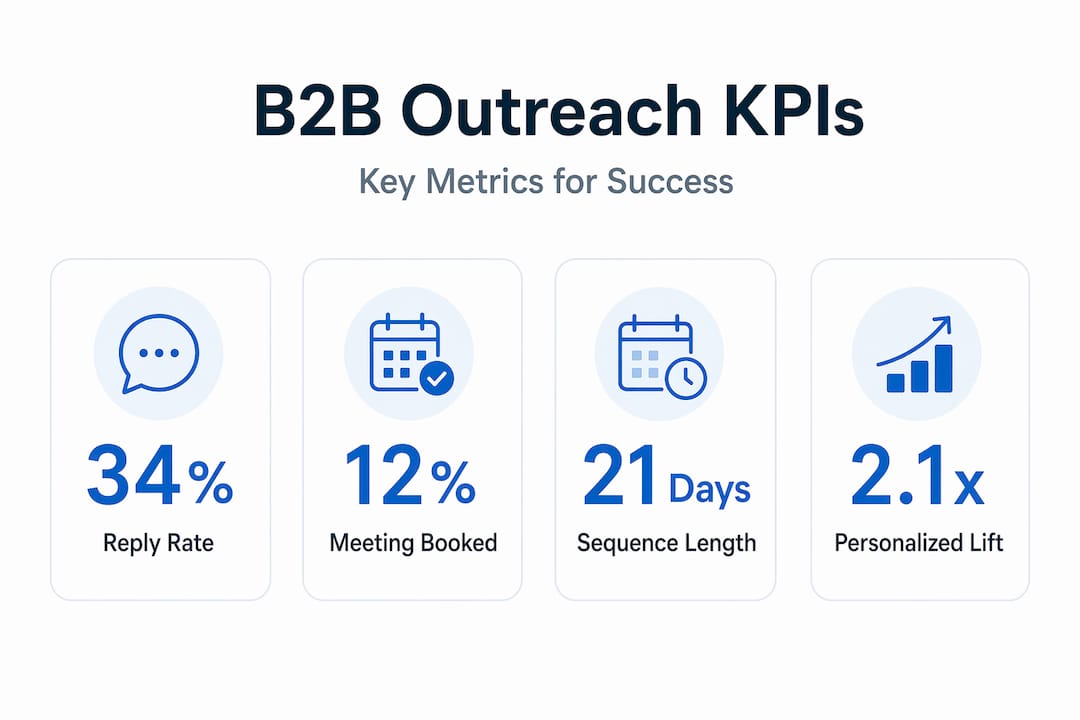
| Metric | Why It Matters | Benchmark to Target |
|---|---|---|
| Reply rate | Shows whether your message earns a response | 5-10% for cold outreach |
| Meeting booked rate | Ties outreach directly to pipeline generation | 1-3% of contacts reached |
| Pipeline velocity | Measures how fast deals move from first touch | Compare week over week |
| Cost per meeting | Tracks efficiency of your outreach investment | Varies by deal size and channel |
| Deliverability rate | Ensures your messages actually arrive | Above 95% |
Tracking these metrics weekly lets you spot message fatigue quickly. If reply rates drop after week three of a campaign, your messaging has worn out or your ICP segment is exhausted. The fix might be a new angle, a new channel, or a fresh prospect list.
A/B testing should run continuously. Test one variable at a time: subject line, opening line, value proposition framing, or call-to-action. Give each variant at least 100 sends before drawing conclusions. Teams that treat their outreach as a system to iterate rather than a one-time launch consistently outperform those that don't.
My honest take on what most teams get wrong
I've worked with enough B2B sales teams to say this with confidence: most outreach failures aren't strategy failures. They're execution failures in specific, predictable places.
The biggest one is response time. I've seen teams build beautifully personalized sequences, get a warm reply, and then respond 36 hours later. The prospect had moved on. Treating response time as an operational priority, with real ownership and real systems, transforms outcomes more reliably than any new tool.
The second issue is what people call "personalization." Adding a first name and a company name is not personalization. Mentioning that a company just raised a Series B and connecting it to a specific pain that typically follows that milestone, that's personalization. Modern B2B buyers consume multiple pieces of content before engaging, so they can spot a mail-merge trick from across the inbox.
Multi-channel sequencing also beats single-channel volume almost every time I've tested it. One rep sending 500 emails a week to the same persona almost always underperforms a rep sending 150 touches across email, LinkedIn, and phone with a coherent story across all three.
And finally: value-first communication builds pipeline that actually closes. Buyers who feel educated rather than sold to enter conversations at a different level of trust. That trust shortens sales cycles more than any urgency tactic I've tried.
— Raphael
Start your next campaign with better data
When your targeting is precise and your data is clean, every other part of your outreach gets easier. Good messaging lands better. Follow-ups feel relevant. And the metrics actually move.
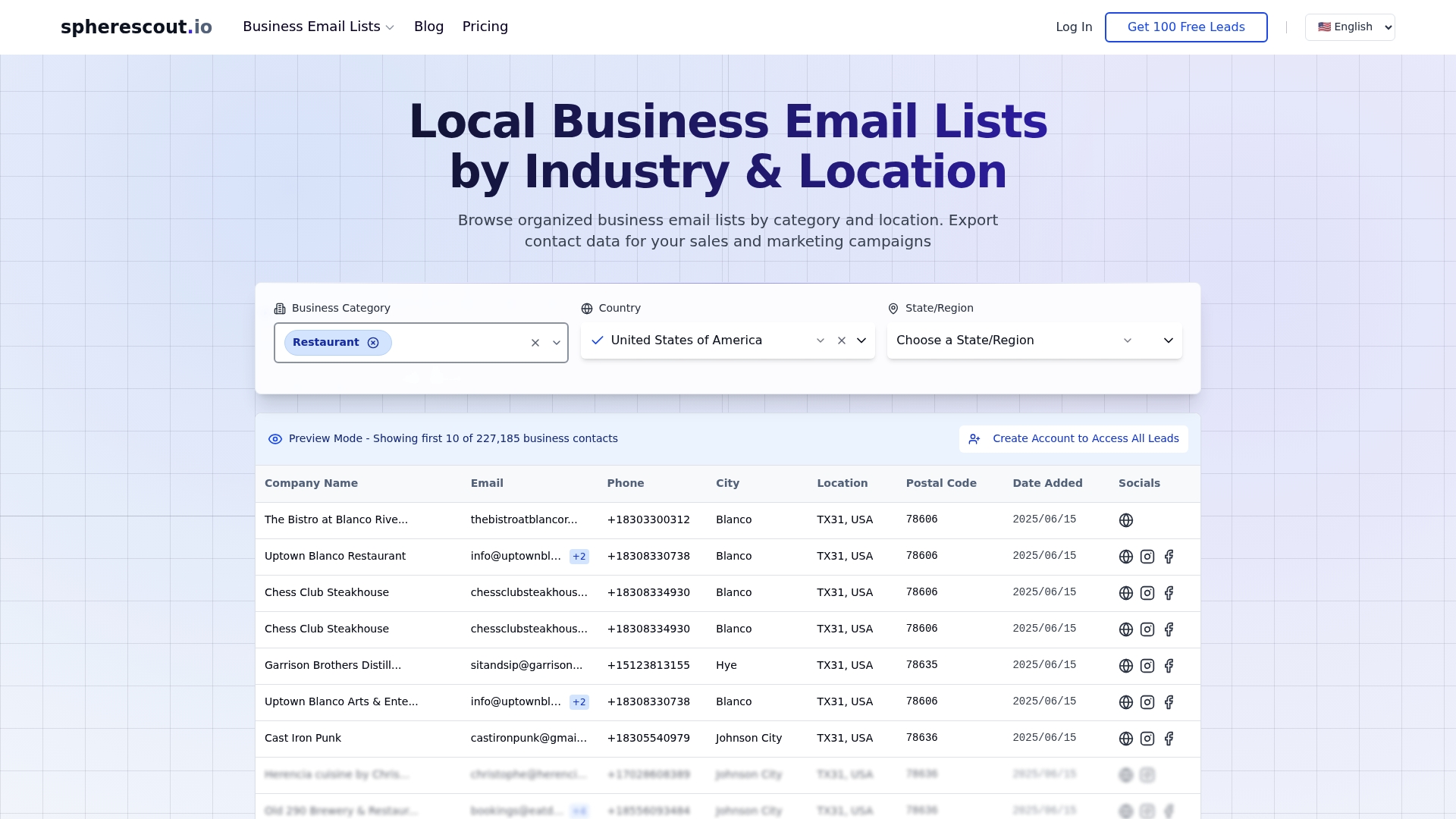
Spherescout gives B2B sales and marketing teams direct access to verified business email lists segmented by industry, company type, and location across a database of over 30 million contacts. You can filter by category, city, or postal code, then export a ready-to-use CSV in minutes. If you're ready to put a sharper list behind your next campaign, explore Spherescout's lead generation tools to see how targeted data changes your results. Want to go deeper on the execution side? The guide on structuring outreach emails for B2B lead generation is worth your time.
FAQ
What is targeted B2B outreach?
Targeted B2B outreach is the practice of reaching specific decision-makers at defined companies using personalized messaging based on ICP criteria like industry, company size, and trigger events. It contrasts with broad spray-and-pray tactics that produce low engagement and poor ROI.
How many touchpoints does an effective B2B sequence need?
Research shows that 5-8 multi-channel touches over 14-21 days produces the highest reply and meeting rates. Each touch should deliver a distinct value point rather than repeating the same message.
What is the 70/30 rule in B2B outreach?
The 70/30 rule recommends that 70% of your outreach touchpoints focus on educating or helping the prospect, while only 30% make a direct ask. This ratio builds trust and increases the likelihood of a response.
Which metrics should I track to improve B2B outreach?
Focus on reply rate, meeting booked rate, pipeline velocity, and cost per meeting. Open rates alone don't tell you whether outreach is generating real pipeline, so measure the metrics that tie directly to revenue outcomes.
How do I protect my sender domain during outreach campaigns?
Use triple verification on all contact lists before sending, keep bounce rates below 3%, and warm up new sending domains for at least four weeks. Rotate across multiple domains and mailboxes when sending at high volume to avoid deliverability penalties.
Recommended
- How to structure outreach email for B2B lead generation | spherescout.io Blog
- 7 High-Response Email Outreach Examples for B2B Teams | spherescout.io Blog
- B2B sales tips that drive real results for 2026 | spherescout.io Blog
- Boost B2B outreach: maximize phone numbers for results | spherescout.io Blog