

Sending an email feels like the finish line. You hit "send," the campaign goes out, and you wait for replies to roll in. But here's the thing: delivery confirmation is not the same as inbox delivery. A huge portion of your list could be bouncing silently, dragging down your sender reputation, and burning your campaign budget without a single warning. Failing to verify emails can silently drain B2B outreach effectiveness, turning a well-crafted sequence into wasted effort. This guide breaks down what email verification is, how it works technically, and how it fits into a smarter B2B lead generation strategy.
Key Takeaways
| Point | Details |
|---|---|
| Email verification basics | Email verification checks if addresses are valid and reaches real inboxes, protecting outreach quality. |
| Business impact | Skipping verification leads to higher bounce rates, wasted budgets, and lower B2B campaign ROI. |
| Choosing solutions | Compare tools like ZeroBounce and NeverBounce to fit list size, speed, and accuracy needs. |
| Workflow integration | Incorporate verification at every step, from sign-up forms to campaign sends, for best results. |
Understanding email verification: What it is and why it matters
Email verification is the process of checking whether an email address is valid, actually exists on a live mail server, and is capable of receiving messages. It sounds simple, but the implications for B2B sales and marketing are significant. Without it, you are essentially mailing into the dark.
Think about what happens when you acquire a new list of local business email lists. Even if the data was accurate six months ago, email addresses decay. People change jobs, companies shut down, and IT teams deactivate old accounts. Industry estimates suggest that B2B email lists can degrade at a rate of 20 to 30 percent per year. That means a list of 10,000 contacts could have 2,000 to 3,000 bad addresses within twelve months, even if you sourced it carefully.
Here is what unverified emails actually cost you:
- High bounce rates: When your bounce rate climbs above 2 percent, email service providers (ESPs) start flagging your account. Above 5 percent, you risk suspension.
- Damaged sender reputation: ESPs like Gmail and Outlook use sender scores to decide where your emails land. A poor score means spam folders, not inboxes.
- Wasted budget: You are paying for sends, CRM storage, and outreach tools on contacts that will never convert.
- Skewed analytics: High bounce rates distort your open and click data, making it harder to judge what is actually working.
- Blacklisting risk: Repeatedly hitting invalid addresses, especially spam traps, can get your sending domain blacklisted entirely.
Email verification is not a one-time cleanup task. It is an ongoing hygiene practice that protects every campaign you run.
Accurate verification tools like ZeroBounce help maintain list quality by continuously catching invalid, risky, and disposable addresses before they cause damage. For B2B teams who regularly buy email database contacts or build lists through outreach, this is not optional. It is the foundation of a deliverable, effective campaign.
The ROI case is straightforward. A verified list of 5,000 contacts that reaches the inbox consistently will outperform an unverified list of 15,000 contacts where 40 percent bounce and the rest land in spam. Volume is not the goal. Reach is.
How email verification works: The process and key steps
With a clear definition in mind, it is time to dig into what actually happens during email verification. Most people assume it is just a format check, but modern verification tools run through several distinct layers before giving you a result.
Here is the standard verification process, step by step:
1. Syntax check: The tool first confirms the address is formatted correctly. Does it have an "@" symbol? Is the domain structured properly? This catches obvious typos like "john@@company.com" or missing domain extensions.
2. Domain and MX record lookup: Next, the tool checks whether the domain actually exists and whether it has a valid mail exchange (MX) record. An MX record tells the internet where to deliver emails for that domain. No MX record means no mail can be received, regardless of how the address looks.
3. SMTP handshake (mailbox ping): This is where it gets more technical. The verification tool connects to the mail server and simulates sending a message, stopping just before actual delivery. It checks whether the specific mailbox exists and is active. Many tools do this without sending a real email, protecting your sender reputation in the process.
4. Catch-all detection: Some domains accept all incoming emails regardless of whether the specific mailbox exists. These are called "catch-all" domains. Verification tools flag these addresses as risky because you cannot confirm the individual mailbox.
5. AI risk scoring: Advanced tools add a final layer of intelligence. They analyze patterns, historical data, and behavioral signals to assign a risk score to each address. High-risk addresses may be technically valid but are associated with spam complaints or low engagement.
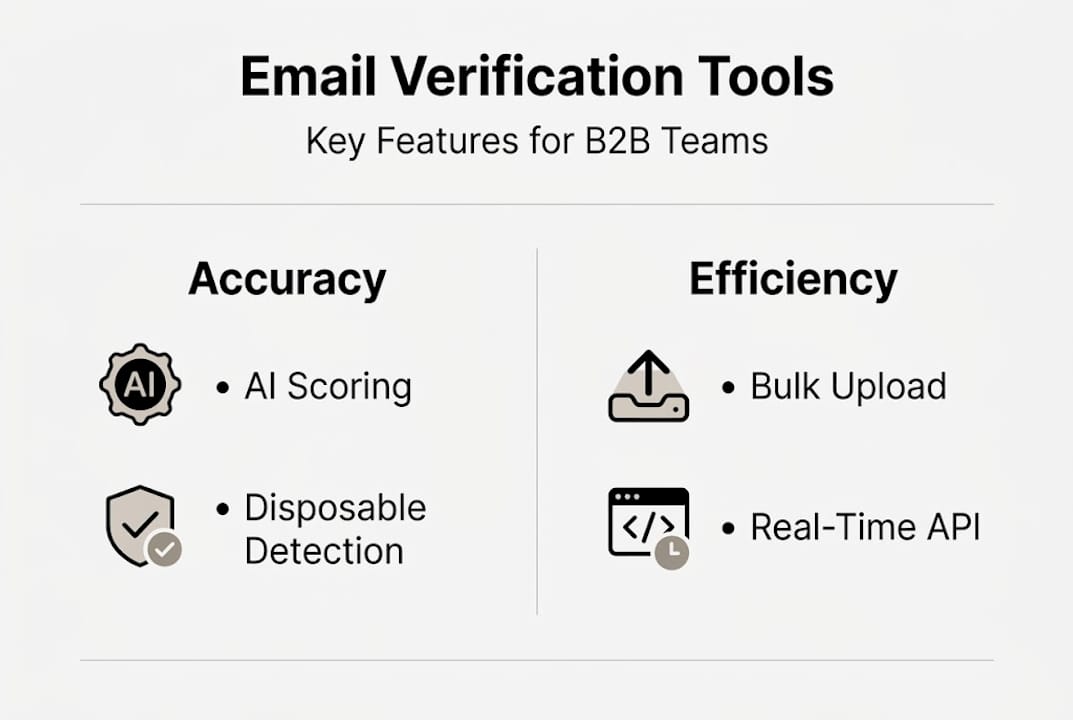
Different tools offer different strengths, such as ZeroBounce's smart AI scoring and NeverBounce's batch processing speed, so matching the tool to your workflow matters.
Batch vs. real-time verification is another key decision. Batch verification lets you upload an entire list and process thousands of addresses at once. This is ideal before a major campaign launch. Real-time verification checks addresses as they are entered, like on a sign-up form or CRM intake field. Both have their place depending on your workflow.
Pro Tip: Run batch verification on any list older than 90 days before sending. Even a list you verified three months ago may have decayed enough to hurt your deliverability. For US business email lists, where job turnover rates are high, this cadence is especially important.
The right tool depends on your volume, how fast you need results, and whether you need API integration for real-time checks. Speed, accuracy, and CRM compatibility are the three factors worth prioritizing when evaluating options.
Comparing popular email verification tools for B2B teams
Once you understand how verification works, the next challenge is choosing the right tool. Let us see how top solutions stack up.
The three tools most commonly used by B2B marketing teams are ZeroBounce, NeverBounce, and Hunter. Each has a distinct strength, and the best choice depends on your specific use case.
| Feature | ZeroBounce | NeverBounce | Hunter |
|---|---|---|---|
| AI risk scoring | ✅ Yes | ❌ No | ❌ No |
| Bulk verification | ✅ Yes | ✅ Yes (fastest) | ✅ Yes |
| Real-time API | ✅ Yes | ✅ Yes | ✅ Yes |
| Email finder | ❌ No | ❌ No | ✅ Yes |
| Catch-all detection | ✅ Yes | ✅ Yes | ✅ Yes |
| Free credits | ✅ 100/month | ✅ 1,000 trial | ✅ 25/month |
| CRM integrations | ✅ Broad | ✅ Moderate | ✅ Moderate |
| Best for | Accuracy + scoring | Speed + volume | Finding + verifying |
ZeroBounce is the go-to when accuracy is your top priority. Its AI scoring system does not just tell you if an address is valid. It tells you how risky it is to send to. ZeroBounce provides an AI score for accuracy, while NeverBounce is valued for fast bulk verification, making them complementary rather than competing tools depending on your needs.

NeverBounce shines when you have large lists and need results fast. If you are running a campaign to thousands of contacts across B2B email lists or international B2B email lists, NeverBounce's batch speed is hard to beat. It is clean, straightforward, and reliable for high-volume work.
Hunter takes a different angle. It combines email finding with verification, making it useful for prospecting from scratch. If your team is building lists manually by researching company domains, Hunter lets you find and verify in one workflow.
Pro Tip: Do not choose a tool based on reviews alone. Run a sample of 500 to 1,000 addresses from your actual list through each tool and compare results. The tool that catches the most invalid addresses on your specific data is the right one for your team.
The key takeaway here is that no single tool is universally best. Your choice should match your list size, how often you verify, and whether you need email finding capabilities alongside verification.
Best practices for integrating email verification into your B2B workflow
With tool options covered, let us talk about how you can seamlessly build verification into your daily workflow. Knowing the tools is one thing. Using them consistently is where most teams fall short.
Here is what a solid verification workflow looks like in practice:
- Verify before every major send: No exceptions. Whether you are launching a cold outreach sequence or a nurture campaign, run your list through verification first. Even lists you have used before can degrade between campaigns.
- Automate verification at the point of entry: If you use sign-up forms, lead magnets, or webinar registrations, integrate a real-time verification API. This stops bad addresses from entering your CRM in the first place.
- Segment risky addresses separately: Do not delete catch-all or risky addresses immediately. Put them in a separate segment and test them with low-volume sends before making a final call.
- Set a re-verification schedule: Any contact that has not engaged in 90 days should be re-verified before you include them in a new campaign.
Testing your own lists is advised to see which service fits best for your specific data and industry mix. This is especially true if you work with contacts from a international business directory data or other international markets where domain structures and catch-all configurations vary widely.
Here is a quick reference for the metrics you should track after implementing verification:
| Metric | Before verification | Target after verification |
|---|---|---|
| Bounce rate | 5 to 15% | Below 2% |
| Spam complaint rate | 0.5 to 1%+ | Below 0.1% |
| Inbox placement rate | 60 to 70% | 90%+ |
| Open rate | 10 to 15% | 20 to 30%+ |
| Unsubscribe rate | High | Stable or declining |
Pro Tip: Track your bounce rate trend over three consecutive campaigns after implementing verification. A consistent downward trend confirms your process is working. If bounce rates are not dropping, your data source may be the problem, not your verification tool.
The compounding effect of consistent verification is real. Teams that make it a standard step in their workflow see better deliverability, higher engagement rates, and ultimately more pipeline from the same number of sends.
Why most B2B teams underestimate email verification
Reflecting on all these tactical steps, there is a bigger truth most B2B marketing teams overlook. Email verification is consistently treated as a technical task for the IT or ops team, not a strategic priority for sales and marketing leadership. That framing is the problem.
When verification is buried in the ops backlog, it gets skipped during crunch time. Campaigns go out on unverified lists because the deadline pressure is higher than the perceived risk. Then deliverability drops, domain reputation erodes, and the team scrambles to figure out why open rates collapsed. Many professionals only see the impact of unchecked lists after deliverability issues emerge, not before.
The cumulative damage is what makes this so costly. A blacklisted domain can take weeks or months to recover. Lost sender reputation means even your best contacts stop seeing your emails. And the pipeline impact is invisible until it is too late.
The teams that treat verification as a revenue protection strategy, not a cleanup chore, are the ones that build compounding outreach advantages. Clean lists mean consistent inbox placement. Consistent inbox placement means more conversations. More conversations mean more closed deals. It really is that linear.
If you are prospecting into new markets, especially with international business prospects or other international segments, verification is even more critical because list decay rates and domain configurations differ across regions.
Level up your B2B outreach with expert-verified lists
Ready to put seamless email verification into practice? Start with the right foundation: a structured, targeted contact list that gives your verification workflow something worth protecting.
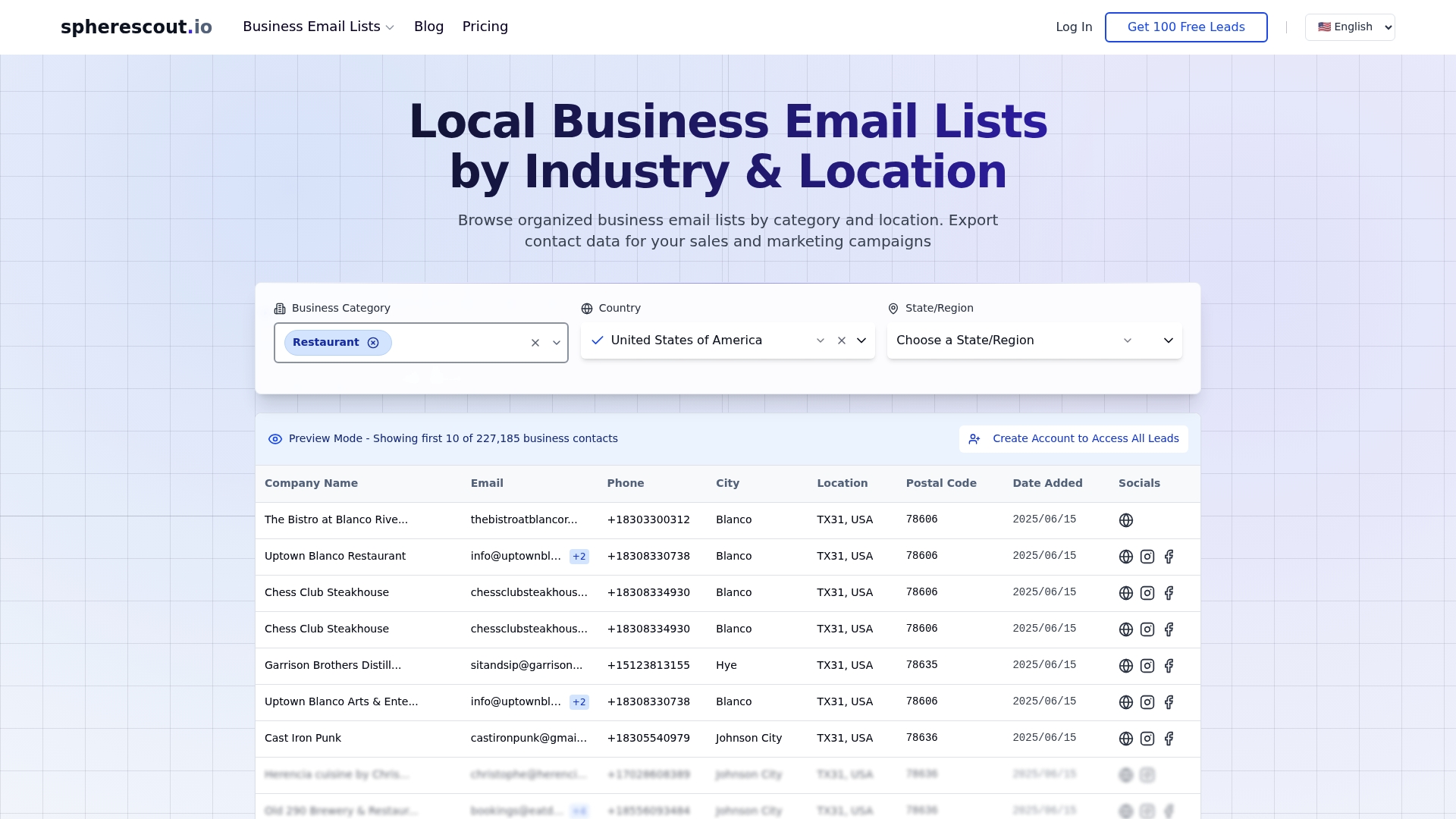
At SphereScout.io, we provide B2B teams with access to over 30 million business contacts, organized by industry, location, and company type. Our lead generation functions are built for sales and marketing professionals who need clean, actionable data fast. You can filter by city, postal code, or industry and export CSV files ready for CRM upload and campaign deployment. Pair our instant B2B email lists with a solid verification workflow, and you have a prospecting engine that actually delivers results.
Frequently asked questions
What is email verification?
Email verification is a process that checks address validity and confirms an email exists and can receive messages, helping ensure your outreach actually reaches real inboxes rather than bouncing or disappearing.
Why is email verification important for B2B sales?
It prevents high bounce rates, protects your sender reputation, and ensures your campaigns reach real decision-makers. B2B marketers risk engagement and ROI without consistent list verification built into their outreach process.
How often should I verify my lead lists?
Verify before every major campaign and re-verify any contacts that have been inactive for 90 days or more. Testing your own lists regularly also helps you identify which verification service performs best on your specific data.
What is the difference between real-time and bulk verification?
Real-time verification checks emails instantly at the point of entry, like a sign-up form, while bulk verification processes large lists all at once before a campaign. NeverBounce is known for fast bulk verification, making it a strong choice for high-volume outreach teams.
Can email verification eliminate all bounced emails?
No tool eliminates bounces completely, but consistent verification drastically reduces them and protects your sender reputation over time. Accurate tools help, but ongoing list hygiene is what sustains long-term deliverability improvements.
Recommended
- Cold email lead generation guide
- Buy Email Database | Instant B2B Email Lists & Contacts
- Prospecting list Excel: columns, CSV and CRM import
- Local Business Email Lists by Industry & Location | SphereScout
- email marketing vs cold email
- B2B email marketing process
- Email marketing strategies that drive real B2B results