

Most sales and marketing teams treat contact list validation as something you do once before a big campaign, then forget about. That thinking costs you deliverability, sender reputation, and real pipeline. Contact list validation is the process of verifying that every contact in your database is accurate, reachable, and worth sending to. It covers everything from syntax checks on email addresses to confirming that a mailbox actually exists. Done right, it is not a one-time task. It is an ongoing discipline that separates high-performing outreach programs from expensive bounce machines.
- What contact list validation actually means
- Real-time vs. bulk: how to validate contacts over time
- Beyond deliverability: the three dimensions of list quality
- How to implement validation in your workflow
- Risks, pitfalls, and compliance you cannot ignore
- My take: validation is an operational habit, not a project
- Start with verified contacts from Spherescout
- FAQ
Key Takeaways
| Point | Details |
|---|---|
| Validation is a multi-layer process | Five technical checks work in sequence to confirm each contact is deliverable and low-risk. |
| List decay is constant and fast | Contact data degrades at roughly 28 to 30% annually, making periodic re-validation every 60 to 90 days non-negotiable. |
| Quality beats quantity every time | A targeted list of 500 verified contacts will outperform a bloated, unverified list of 10,000 in both ROI and conversions. |
| Three dimensions define list quality | Email deliverability, role accuracy, and data freshness are separate metrics that each require attention. |
| Compliance depends on good records | Storing verification metadata in your CRM protects you during privacy regulation audits. |
What contact list validation actually means
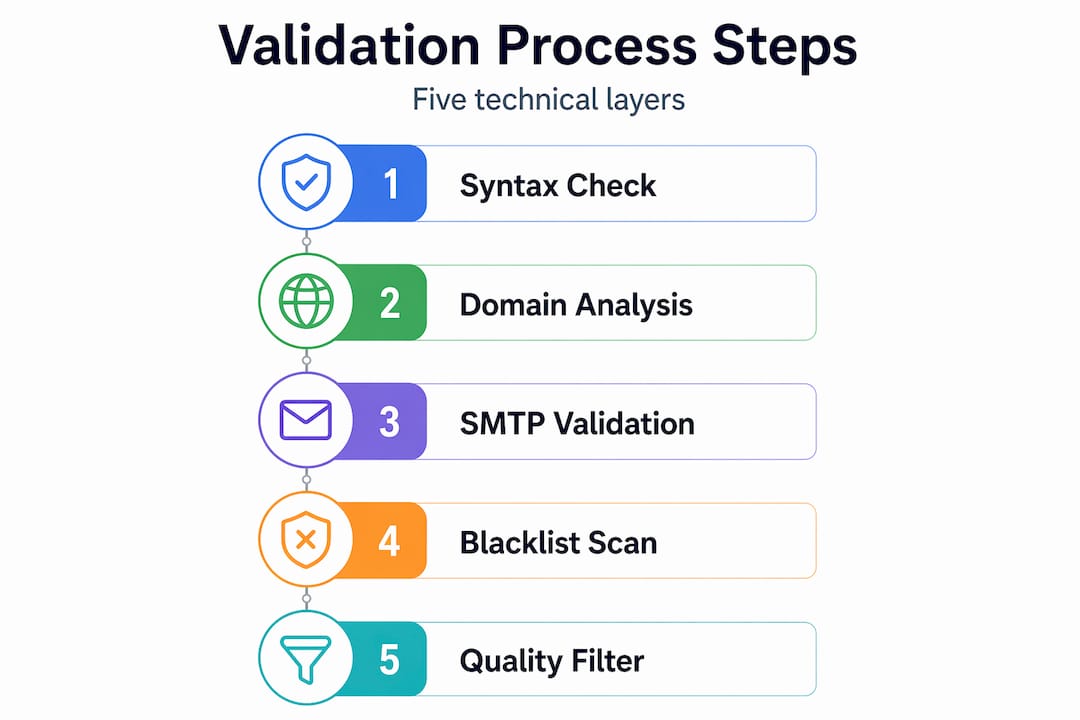
The simplest definition: contact list validation is the systematic process of confirming that the contacts in your database are real, reachable, and correctly formatted. But the practical reality is considerably more layered than that. Modern email validation runs through five distinct technical checks, each catching failure points that the previous layer misses.
Here is how that waterfall process works in practice:
1. Syntax check. The address is scanned for formatting errors. Missing the "@" symbol, illegal characters, or malformed domain extensions all get flagged here before any network requests are made.
2. DNS and MX record validation. The validator checks whether the domain actually exists and has mail exchange records configured. A perfectly formatted address at a dead domain is useless.
3. SMTP handshake (mailbox existence ping). This is where the real technical work happens. The validator opens a connection to the mail server and checks whether the specific mailbox exists, without sending any actual message. It is the closest you can get to confirming a live inbox without putting your sender reputation at risk.
4. Blacklist and spam trap detection. The address and domain are cross-referenced against known blacklists and spam trap registries. An address can be technically valid yet still destroy your deliverability if it sits on a major blocklist.
5. Risk scoring. This final layer flags disposable email addresses (temporary inboxes people use to bypass signup forms), role-based addresses like info@ or admin@, and any addresses showing unusual patterns that suggest risky engagement history.
Pro Tip: When evaluating any validation service, ask specifically about step three. Many cheaper tools skip the SMTP handshake and rely only on DNS checks, which means they will pass addresses that will hard bounce the moment you send.
Running all five layers transforms contact list validation from a basic formatting check into a meaningful quality filter. Each step addresses a specific category of failure, and skipping any one of them leaves a gap your campaigns will eventually fall through.
Real-time vs. bulk: how to validate contacts over time
One of the most practical ways to think about contact list accuracy is through two complementary processes: validation at the point of capture and periodic bulk cleaning of your existing database.
Real-time validation happens the moment a contact enters your system, whether that is through a web form, a CRM import, or a manual entry. The address gets checked instantly, and low-quality entries are flagged or rejected before they ever pollute your database. This is your first line of defense, and for a detailed look at how to set it up, the email verification B2B guide from Spherescout covers the mechanics thoroughly.
Bulk cleaning is what you do with the contacts already in your system. Here is why it cannot be skipped:
- Annual list decay runs 28 to 30%, meaning roughly one in three contacts in any static list becomes inaccurate within a year due to job changes, company closures, and email address updates.
- A hard bounce rate above 2% signals deliverability problems to major email providers. Cross the 5% threshold and you risk real damage to your sending domain's reputation.
- Re-validating your active send list every 60 to 90 days keeps decay from accumulating silently between campaigns.
The most important insight here is that validation must be ongoing, not a project you complete before Q4 and revisit next year. Real-time validation prevents bad data from entering. Bulk cleaning removes the decay that builds up regardless. You need both, running continuously.
Pro Tip: Schedule bulk re-validation as a recurring calendar event, not a reactive response to rising bounce rates. By the time your metrics degrade visibly, the damage to your sender reputation has already started.

Beyond deliverability: the three dimensions of list quality
Here is something most teams miss. Contact list accuracy is not a single metric. Three separate dimensions determine whether a contact is genuinely valuable: email deliverability, role accuracy, and data freshness. Collapsing these into one number hides the actual cause of campaign failures.
The table below shows how these dimensions differ and why each one requires its own attention:
| Dimension | What it measures | Common failure mode |
|---|---|---|
| Email deliverability | Does the message reach the inbox? | Hard bounces, spam folder placement |
| Role accuracy | Is this person still in the role you are targeting? | Contacting someone who left the company six months ago |
| Data freshness | Is the surrounding context (title, company, location) current? | Personalization fields that reference outdated information |
Generic email addresses deserve special attention here. B2B lists with more than 15% generic addresses like info@, sales@, or contact@ have critical quality problems. These addresses rarely connect you to a decision-maker, they generate low engagement, and some email service providers treat them as higher-risk senders. They pass technical validation but fail the intent test entirely.
The counterintuitive truth about list size applies here too. Smaller, highly qualified lists of around 500 contacts consistently outperform massive unverified lists of 10,000 or more on both ROI and conversion rates. Volume is not the goal. Verified, targeted contact data is.
How to implement validation in your workflow
Getting validation working in practice comes down to three choices: manual checking, programmatic API-based validation, or a third-party validation service. Manual checking only makes sense for very small lists (under 100 contacts) or for spot-checking individual addresses. For anything at campaign scale, you need either an API integration or a dedicated service.
When evaluating validation software or services for your team, look for these specific capabilities:
- Real-time API access so validation happens automatically at form submission and CRM import, not as a manual step someone forgets.
- Bulk list processing with results that include a confidence score or risk tier for each contact, not just a pass/fail flag.
- Disposable and role-based address detection as distinct output fields, so you can decide how to handle them rather than having them silently removed.
- CRM and ESP integration with native connectors or CSV export formats that map directly to your existing fields.
- Suppression list management that automatically flags unsubscribes and opt-outs before each campaign send.
On the workflow side, make pre-campaign validation a hard gate in your process. Running your active send list through a validation tool before every launch is a non-negotiable step, not an optional quality check. The few hours it takes is a fraction of the cost of resetting a damaged sending domain.
For teams using Spherescout to source contacts, learning how to export contact lists efficiently will help you build that pre-campaign validation gate directly into your export and import workflow.
Risks, pitfalls, and compliance you cannot ignore
The most dangerous misconception in contact list validation is that a clean technical report means a safe list. It does not. Spam traps are a good example of why. Spam traps cannot be detected by validation tools alone because they are technically valid addresses that accept mail. The problem is the source of your list, not the validation process itself. If your contacts came from a scraped database, a purchased list of unknown origin, or a poorly managed co-registration program, no amount of technical validation will remove that risk.
High volumes of "risky" or "unknown" flags in your validation output are usually a signal about list acquisition quality, not a tool limitation. If your source is producing addresses that fail at layers four and five consistently, you need a better source.
"Validation is more than avoiding bounces; it is foundational for compliance with privacy and auditing standards in modern marketing." (Fact Check Your Contacts: Ensuring Accuracy and Compliance)
On the compliance side, verification metadata storage matters more than most teams realize. Recording the timestamp, method, and result of each validation check in your CRM creates an audit trail that demonstrates data hygiene practices under GDPR, CAN-SPAM, and similar regulations. This is not just a legal formality. It is a practical record that protects you if your data handling is ever questioned.
Pro Tip: Do not rely on bounce rate as your only health metric. Bounce rate is a lagging indicator. Track your validation pass rates and unknown-flag percentages proactively. If unknown flags start rising between campaigns, your data is aging faster than your re-validation cadence can keep up with.
My take: validation is an operational habit, not a project
I have seen the same pattern play out across dozens of sales and marketing teams. They invest in a solid validation run before a big campaign launch, hit good deliverability numbers, and then coast on that success for the next eight months. By the time the next major send goes out, their list has quietly degraded by 25% and their bounce rates are creeping back up.
The teams that consistently outperform are not the ones with the largest lists or the most sophisticated tools. They are the ones that treat contact data hygiene the same way a good accountant treats the books: something you maintain continuously, not something you fix when the numbers stop adding up.
What I find genuinely underappreciated is the role accuracy dimension. You can have a perfectly deliverable email address for someone who left the company 90 days ago. Technical validation passes. The email reaches an inbox. But the campaign is wasted because the targeting context is wrong. Combining technical validation with regular role and data freshness checks is what actually protects your outreach ROI.
The teams that get this right share one habit: they treat validation as an operational process with a clear owner, a defined cadence, and measurable quality thresholds. It never gets skipped because a launch is running late or a campaign is already behind schedule.
— Raphael
Start with verified contacts from Spherescout
If you want outreach results to improve, the validation process has to start with the source data itself.
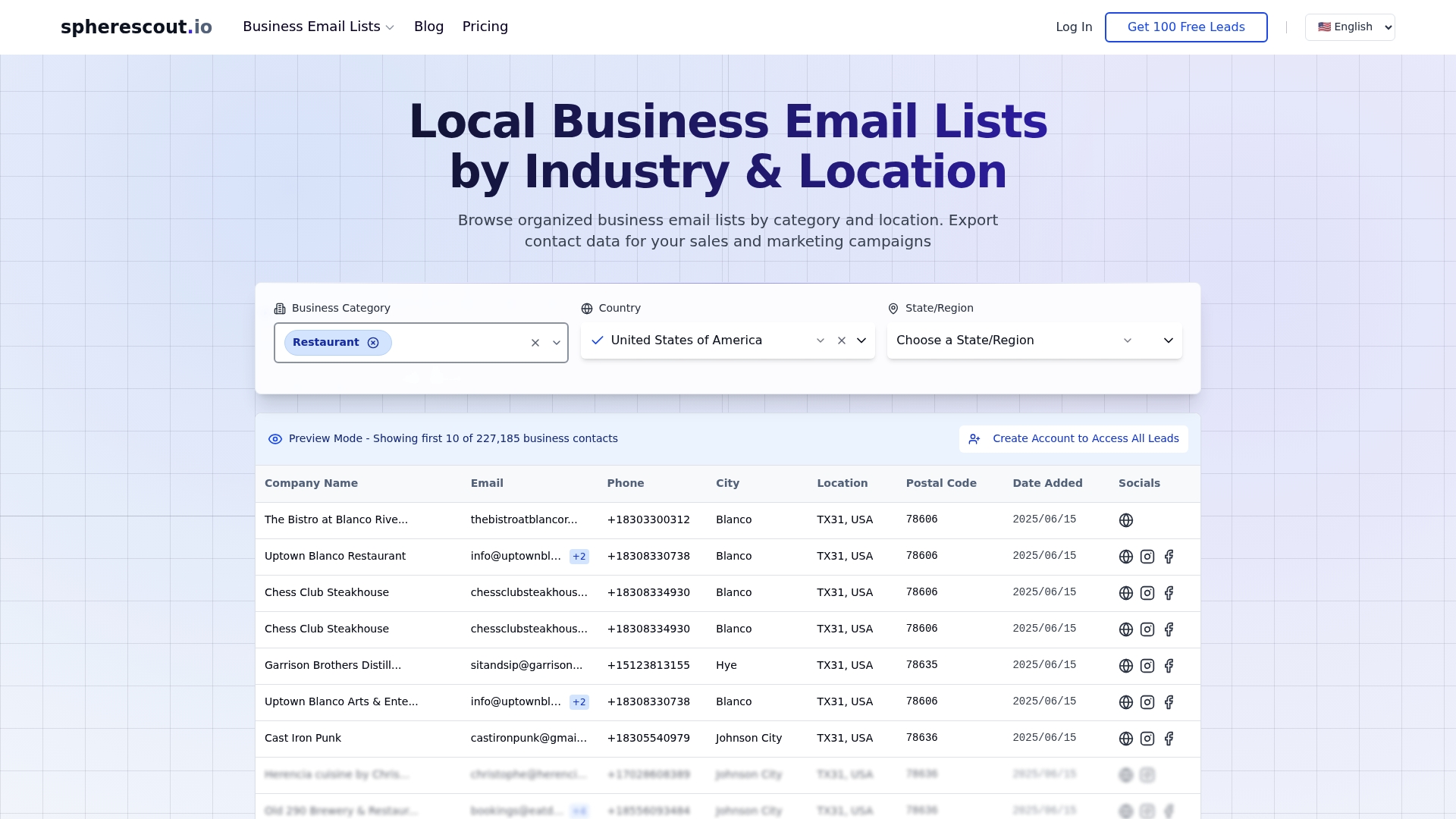
Spherescout gives sales and marketing teams access to a database of over 30 million business contacts, organized by industry, city, and postal code, with the contact data freshness and segmentation accuracy that makes pre-campaign validation faster and more effective. Instead of cleaning a poorly sourced list, you start with structured, regularly updated data you can actually trust. Explore Spherescout's validated industry email lists to see how targeted, quality-sourced contact data fits into your outreach workflow. For teams building a full prospecting engine, the lead generation platform integrates directly with your existing CRM and ESP setup.
FAQ
What is contact list validation?
Contact list validation is the process of verifying that every address in your database is correctly formatted, technically deliverable, and free from spam trap or blacklist associations. It typically runs through five layers: syntax, DNS, SMTP, blacklist, and risk scoring.
How often should you clean a contact list?
You should run bulk re-validation every 60 to 90 days. Contact data decays at approximately 28 to 30% per year due to job changes, company closures, and email address updates.
What bounce rate should trigger a list audit?
A hard bounce rate above 2% is a warning sign that warrants immediate review. Rates above 5% can critically damage your sending domain's reputation with major email providers.
Can validation tools detect spam traps?
No. Spam traps are technically valid addresses and pass most validation checks. High volumes of risky flags in your results usually point to a list acquisition quality problem, not a tool limitation.
Why do smaller lists sometimes outperform larger ones?
Tighter targeting and higher data quality drive better engagement rates. A verified list of 500 relevant contacts will generate more conversions than a bloated list of 10,000 unverified addresses because every send is relevant and reaches an active inbox.
Recommended
- Why email list verification is critical for B2B outreach | spherescout.io Blog
- Why verifying contact information boosts B2B leads | spherescout.io Blog
- How to export contact lists efficiently for B2B outreach | spherescout.io Blog
- Email verification: A complete B2B outreach guide | spherescout.io Blog