

Most sales and marketing professionals think business contact data is just a spreadsheet of names and phone numbers. That assumption costs them deals. What is business contact data, really? It's a structured set of professional identifiers that, when used correctly, tells you who to reach, how to reach them, and why they're worth reaching out to in the first place. This guide breaks down every component, explains where reliable data comes from, and shows you how to manage it without letting quality slip.
- What is business contact data, exactly?
- Why business contact information drives outreach results
- Types of business contact data and where to get it
- How to manage contact data the right way
- Legal considerations you cannot ignore
- My take on data vs. human connection
- Find pre-verified business contacts with Spherescout
- FAQ
Key takeaways
| Point | Details |
|---|---|
| More than names and emails | Business contact data includes job titles, company details, social profiles, and industry metadata beyond basic contact fields. |
| Data quality drives results | Accurate, verified contact information directly improves targeting precision and reduces wasted outreach effort. |
| Multiple data sources exist | Reliable data comes from B2B databases, professional networks, company websites, and CRM records combined. |
| Management is non-negotiable | Regular data hygiene, deduplication, and CRM integration keep your contact lists working at full value. |
| Legal compliance matters | GDPR, CAN-SPAM, and similar regulations apply to business contact data and carry real consequences if ignored. |
What is business contact data, exactly?
Business contact data refers to information used for communicating with a professional in relation to their business role. That definition sounds clean, but what it covers is broader than most people expect.
The core elements most professionals recognize are:
- Full name and job title
- Company name and industry
- Work email address
- Direct phone number or office line
- Physical work address
But that's only the baseline. Social media profiles and company metadata have become increasingly valuable additions, because they let you engage across multiple channels and build richer prospect profiles. A LinkedIn URL tells you someone's career trajectory. A company headcount field tells you whether they're a startup or an enterprise buyer. Department and seniority data tell you whether you're talking to a decision-maker or an influencer.
Business contact data powers targeting and lead generation precisely because it combines all these fields into one usable record. A record with just a name and email is a stub. A record with name, title, company, industry, phone, email, LinkedIn URL, and department is a prospect.
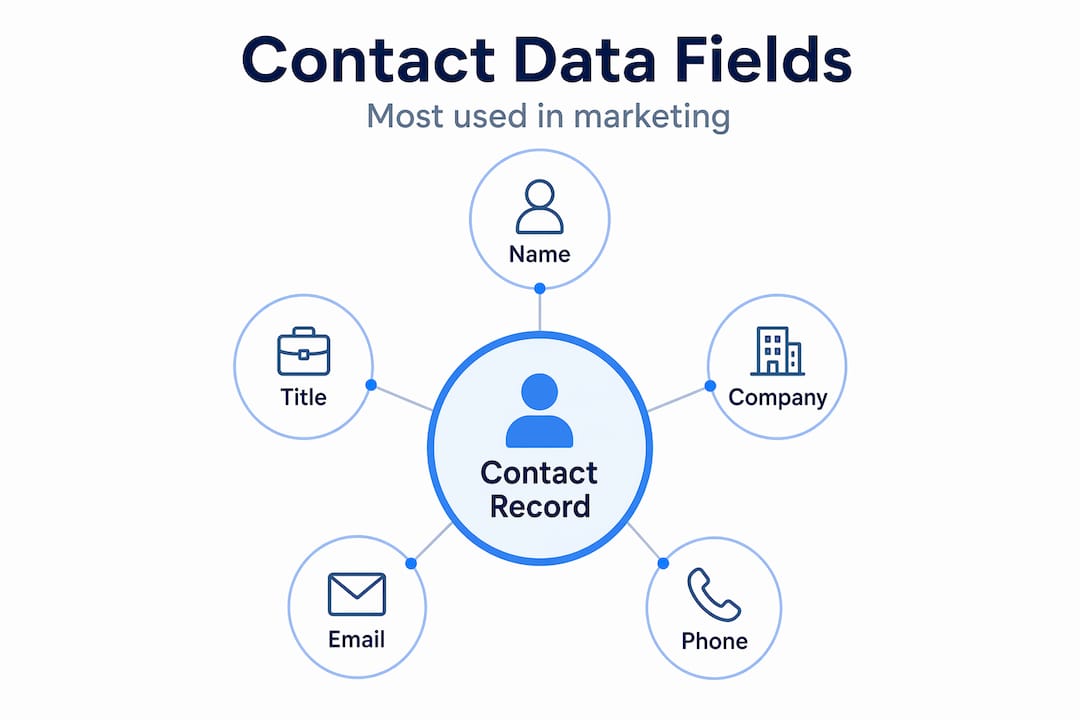
Why does completeness matter so much? Because incomplete records force your team to guess. A sales rep who doesn't know a contact's title might pitch the wrong solution. A marketer who doesn't have a contact's industry can't segment properly. Every missing field increases the chance of a wasted touchpoint.
Pro Tip: When evaluating a data provider or building your own list, score records by completeness. A record with six or more verified fields is worth significantly more than one with two.
Why business contact information drives outreach results
The importance of business contacts in a B2B context goes well beyond having a way to send an email. When your data is accurate and well-structured, it becomes the engine behind every campaign, sequence, and sales call.
Here's what good contact data makes possible:
- Precise segmentation. You can split your audience by industry, company size, job function, or geography. That means your fintech message goes to fintech people, not to retail managers.
- Personalization at scale. Segmentation and dynamic content based on fields like city, job title, or industry improve email relevance and engagement without requiring manual customization for every send.
- Shorter sales cycles. When you reach the right person at the right company with the right message, you skip the qualification phase. The contact is already relevant.
- Better ROI on campaigns. Targeting qualified contacts reduces cost per acquisition. You're not paying to send emails to people who will never buy.
The flip side is equally true. Poor contact data bleeds money quietly. Bounce rates rise, domain reputation suffers, and your sales team spends time chasing dead leads. Maintaining data hygiene by regularly removing duplicates and verifying contacts is not a back-office task. It's directly tied to pipeline quality.
Data point: Account-based marketing strategies that rely on high-quality business contact data consistently outperform broad-spray approaches because they concentrate effort on companies and contacts with real buying potential.
The shift from volume-based outreach to precision-based outreach has made accurate contact data a real competitive advantage. Teams that invest in data quality close more and chase less.
Types of business contact data and where to get it
Not all business contact data is the same, and not all sources are equal. Understanding the types of business contact data helps you build lists that actually perform.
Self-reported vs. aggregated data
Self-reported data comes directly from the contact: a form fill, a webinar registration, or a business card exchange. It's highly accurate at the moment of collection but degrades over time as people change jobs.

Aggregated data comes from B2B contact database providers that compile verified emails, direct dial numbers, and buying signals from multiple sources. These databases can cover millions of records and let you filter by industry, location, company size, and job function. The quality varies significantly by provider, which is why verification practices and data freshness matter so much when you're comparing options.
A comparison of common data sources
| Source | Strengths | Limitations |
|---|---|---|
| B2B databases | Scale, filtering, verified records | Subscription cost; data can lag reality |
| Professional networks | Self-updated, high accuracy | Manual effort; limited bulk export |
| Company websites | Direct and current | Time-intensive to collect |
| CRM records | Relationship context included | Only as good as what your team inputs |
| Purchased lead lists | Fast to acquire | Highly variable quality |
For most B2B teams, the answer is a combination. You use a database provider to build initial prospect lists, enrich those records with data from professional networks, and layer in your own CRM notes for accounts you've already engaged.
Pro Tip: Before purchasing any list, ask the provider for their data refresh cadence and bounce rate guarantee. Providers who can't answer those questions are selling you stale records.
You can also read about effective ways to find business contacts to get a clearer picture of how sourcing works in practice across different B2B scenarios.
How to manage contact data the right way
Collecting data is the easy part. Managing it well is where most teams fall short. Here's a numbered approach to business data management best practices that actually holds up under real-world conditions.
1. Audit your existing data first. Before adding new records, understand what you have. Identify how many records are missing key fields, how many emails are unverified, and how many contacts appear more than once. That baseline tells you what you're working with.
2. Deduplicate regularly. Duplicate records waste budget and create inconsistent outreach. Most CRM platforms include deduplication tools. Use them on a scheduled basis, not just when the problem becomes obvious.
3. Verify email addresses before every send. Email verification tools catch invalid addresses before they become bounces. This protects your sender reputation and keeps deliverability high. Verifying contact information before campaigns is one of the highest-ROI steps a marketing team can take.
4. Segment and label contacts with purpose. Tag contacts by industry, funnel stage, geography, and contact source. This makes your lists usable without manual sorting every time you build a campaign.
5. Integrate with your CRM from day one. Contact data sitting in a spreadsheet disconnected from your sales tools adds friction and creates version control problems. Get your data into the CRM and keep it there. Resources like how to export contact lists efficiently can help you move data into systems without losing structure or accuracy.
6. Set a data review schedule. Business contacts change jobs, get promoted, and leave companies constantly. A quarterly review cycle, where you re-verify high-priority contacts and archive inactive ones, is a practical minimum.
Pro Tip: Treat your contact database like a product, not a storage folder. Assign ownership, set quality standards, and enforce them. Data without accountability decays fast.
Legal considerations you cannot ignore
Using business contact information comes with real legal obligations. Ignoring them creates exposure you don't want.
Business contact data qualifies as personal data under EU GDPR even when it's used in a professional context. That means the rules about lawful basis, transparency, and individual rights apply. In the US, CAN-SPAM governs commercial email and requires clear sender identification, a valid physical address, and a functional unsubscribe mechanism in every message.
The key compliance requirements to know:
- Lawful basis for processing. Under GDPR, you need a legitimate reason to hold and use someone's contact data. Legitimate interest is commonly used in B2B, but it requires a genuine balancing test.
- Consent and opt-in. Permission-based marketing and clear unsubscribe options are not optional courtesies. They're legal requirements in most markets and enforced by major email platforms.
- Data retention limits. You cannot hold contact data indefinitely. If a contact hasn't engaged and there's no legitimate reason to keep their record, delete it.
- Third-party data liability. If you purchase a list and that data was not collected lawfully, the liability can extend to you as the user.
"Data protection law applies to the processing of personal data regardless of whether it is obtained directly from the individual or from a third party. Businesses must assess the lawful basis for using that data." — Information Commissioner's Office (ICO)
The practical answer is to use reputable data providers, implement opt-out mechanisms in every campaign, document your data processing decisions, and never assume that business email addresses are exempt from privacy law.
My take on data vs. human connection
I've worked with enough sales and marketing teams to spot a pattern. The ones who treat a purchased contact list as the end of the work always underperform. The ones who use data as the starting point, not the strategy, consistently do better.
Contact data gives you access. It does not give you trust. Personal, bespoke networking still outperforms data-only approaches when it comes to building relationships that actually close. A warm introduction or a personalized note referencing something specific about someone's work will outperform a bulk sequence every time.
What I've found is that the best use of business contact data is to get you to the right door faster, not to replace the conversation that happens when it opens. Use data to identify the right accounts, the right titles, and the right geography. Then invest real effort in the outreach itself.
There's also the issue of personalization at scale that teams often get wrong. Using a first name merge tag is not personalization. Real personalization means your message reflects something specific about the contact's role, industry challenge, or company context. The data fields make that possible. The human judgment decides what to do with them.
My honest recommendation: stop optimizing your list and start optimizing your message. The data gets you in front of people. What you say when you get there is what closes deals.
— Raphael
Find pre-verified business contacts with Spherescout
If you've read this far, you know that data quality is what separates productive outreach from wasted effort. Spherescout is built specifically for B2B teams who need organized, verified contact lists without building them from scratch.
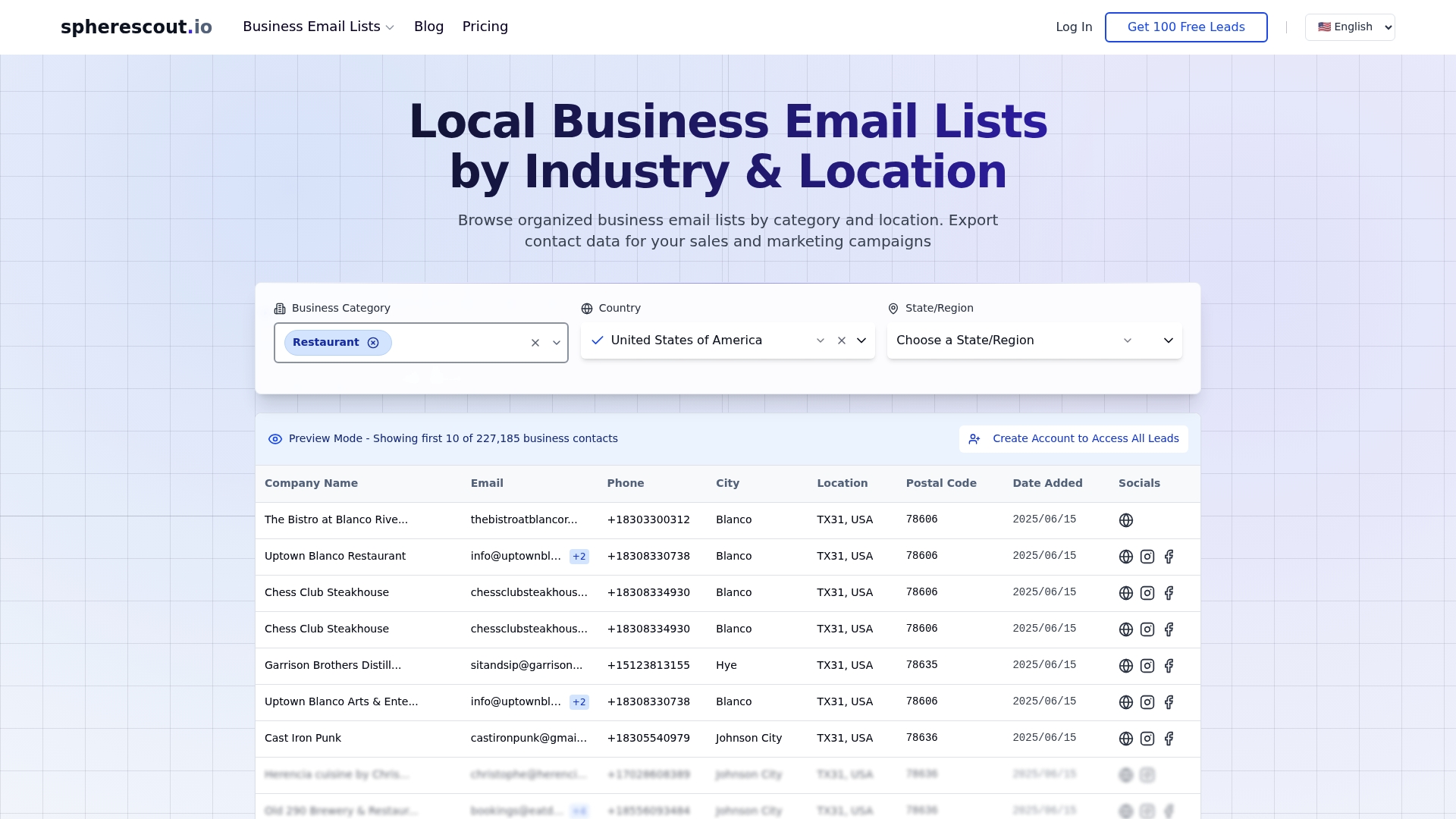
With access to over 30 million contacts, Spherescout lets you filter by industry, city, postal code, and company type to build targeted prospect files in minutes. Every export is formatted for direct CRM import or email marketing integration. You can start with segmented business email lists by industry to match your exact market, or explore lead generation tools designed to help teams scale outreach without sacrificing targeting precision. Free sample leads are available so you can check data quality before committing.
FAQ
What does business contact data include?
Business contact data typically includes a person's name, job title, company, work email, phone number, and work address. Advanced records may also include social media profiles, department, and industry metadata.
Why is business contact data important for marketing?
Accurate contact data enables precise audience segmentation, personalized outreach, and more efficient use of marketing spend. Teams using verified contact data see higher engagement rates and lower cost per qualified lead.
What are the main types of business contact data?
The main types are self-reported data (collected directly from contacts through forms or events) and aggregated data (compiled from B2B databases and professional networks). Each has different strengths in terms of accuracy and scale.
How do you keep business contact data accurate?
Regular deduplication, email verification before campaigns, and a quarterly data review cycle are the core practices. Integrating your contact data into a CRM and assigning clear ownership prevents quality from drifting over time.
Is business contact data subject to privacy laws?
Yes. Even professional contact information qualifies as personal data under EU GDPR rules and similar regulations. Compliance requires a lawful basis for use, clear opt-out options, and defined data retention policies.
Recommended
- Effective ways to find business contacts for B2B lead success | spherescout.io Blog
- How to export contact lists efficiently for B2B outreach | spherescout.io Blog
- Boost B2B outreach: maximize phone numbers for results | spherescout.io Blog
- Why verifying contact information boosts B2B leads | spherescout.io Blog