
MSP lead generation works best as outbound to a defined local market. Pick two or three verticals in your service area, list every business in them, and reach each one by email, phone and LinkedIn over four weeks. Referrals and SEO still help, but they are too slow to carry growth on their own.
In this post, you'll learn:
- How many businesses each MSP vertical holds, nationally and around one city
- Which verticals have a legal reason to talk to you
- How to build the list, and what each method gives you
- A four-week sequence you can copy
- How to run the whole thing from an AI assistant
What works for MSP lead generation in 2026
Winning new clients is now the hardest part of running an MSP. In Kaseya's 2026 State of the MSP Report, 71% of the more than 1,000 MSPs surveyed named it their top challenge.
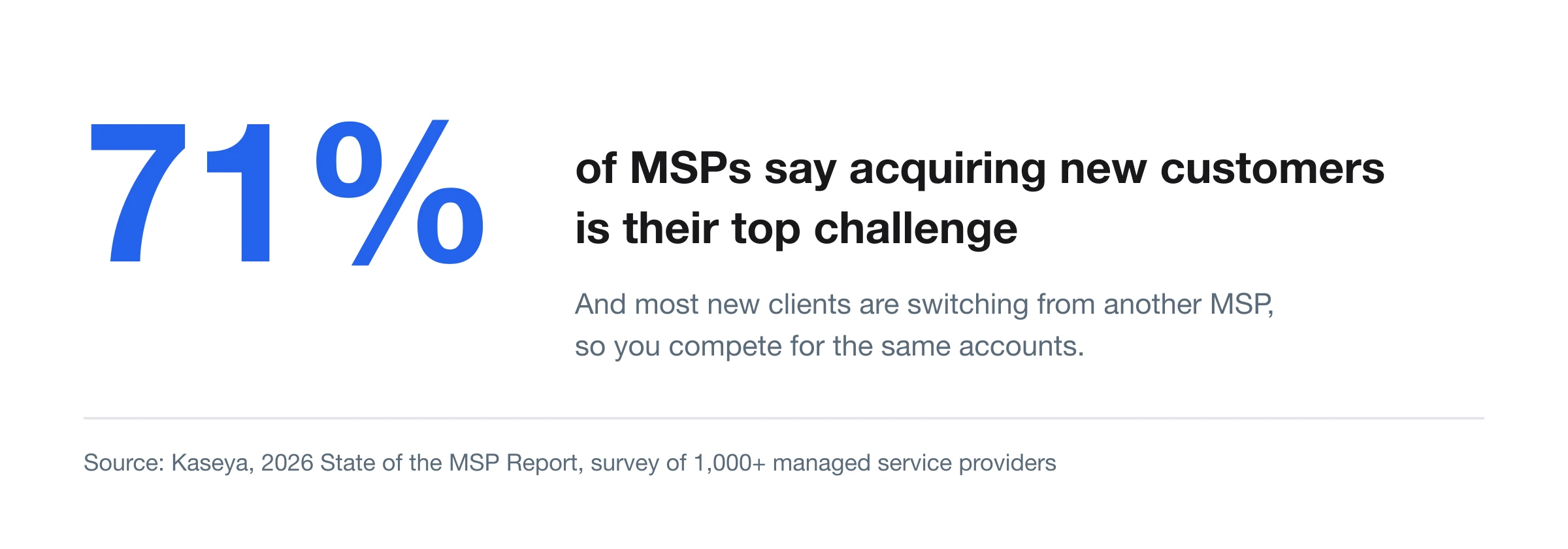
Kaseya also found that most new clients are switching from another MSP. Usually, you are not selling IT to a business that has none. You are replacing someone.
That changes the job. You need to reach the right businesses early and often, long before their current contract comes up for renewal.
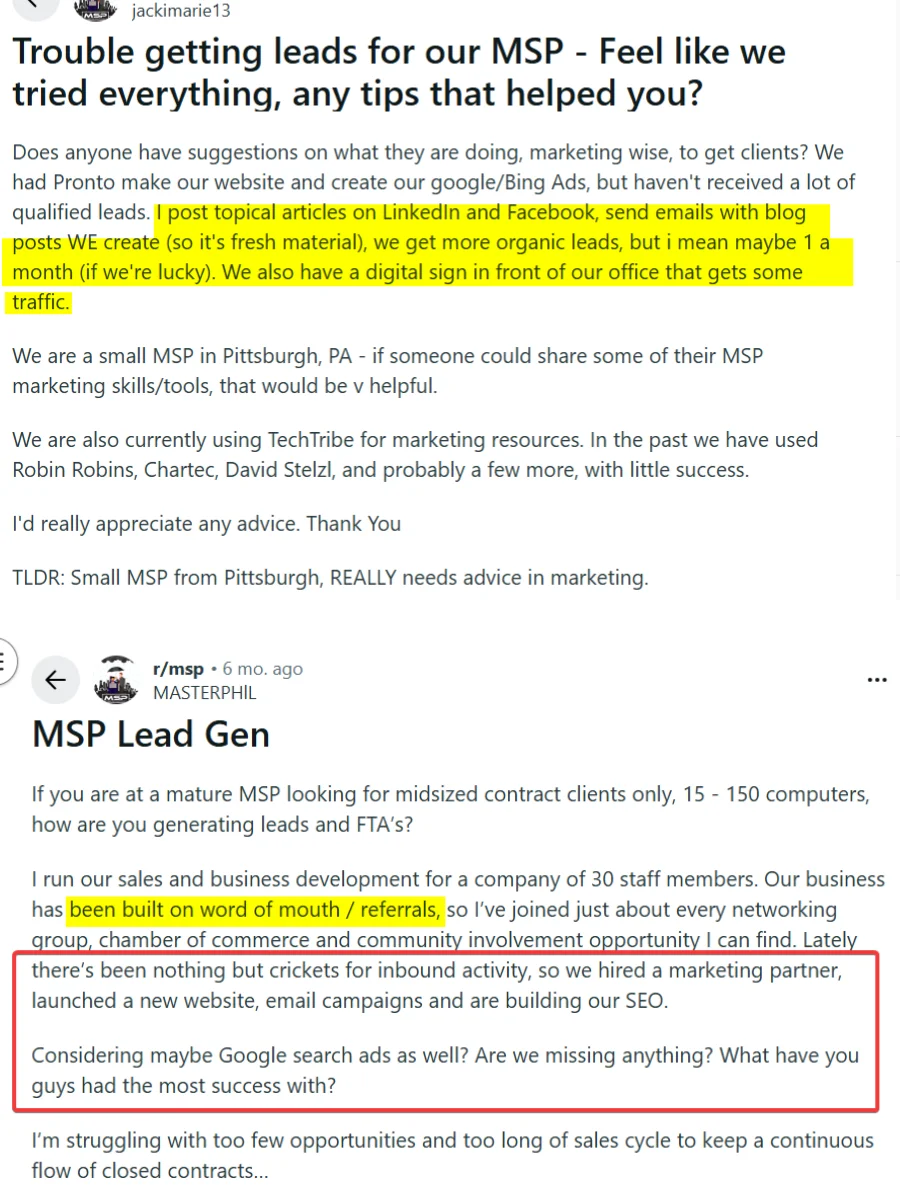
Most MSPs still wait for referrals and inbound leads. Two threads on r/msp describe the usual loop: a new website, Google Ads, LinkedIn posts, and maybe one lead a month.
Here is what each channel really gives you:
| Channel | Time to first meetings | Main cost | Best for |
|---|---|---|---|
| Referrals and networking | Unpredictable | Your time | A steady base you can't scale on demand |
| SEO and content | Months | Writing time | Long-term inbound |
| Google Ads | Days | Budget per click | Buyers already searching for an MSP |
| Cold email | Two to four weeks | Tools and a list | Verticals that publish email addresses |
| Cold calling | Days | Your time | Verticals that rarely publish email addresses |
| Weeks | Your time | Warming up the decision maker | |
| Lead generation agency | Weeks | Monthly retainer | MSPs with nobody to prospect |
For the general playbook across industries, see our guide to B2B lead generation. For MSPs, outbound fixes the timing problem. It starts with knowing exactly who you can sell to:
Size your market before you write a single email
Most MSP guides tell you to "define your ICP" and stop there.
The useful question is more concrete: how many businesses of each type are in your service area, and how can you reach them?
The SBA counts more than 36 million small businesses in the US. You only need a few hundred of the right ones.
Here is the national picture for the verticals MSPs sell to most, from our October 2026 snapshot of public US business listings.
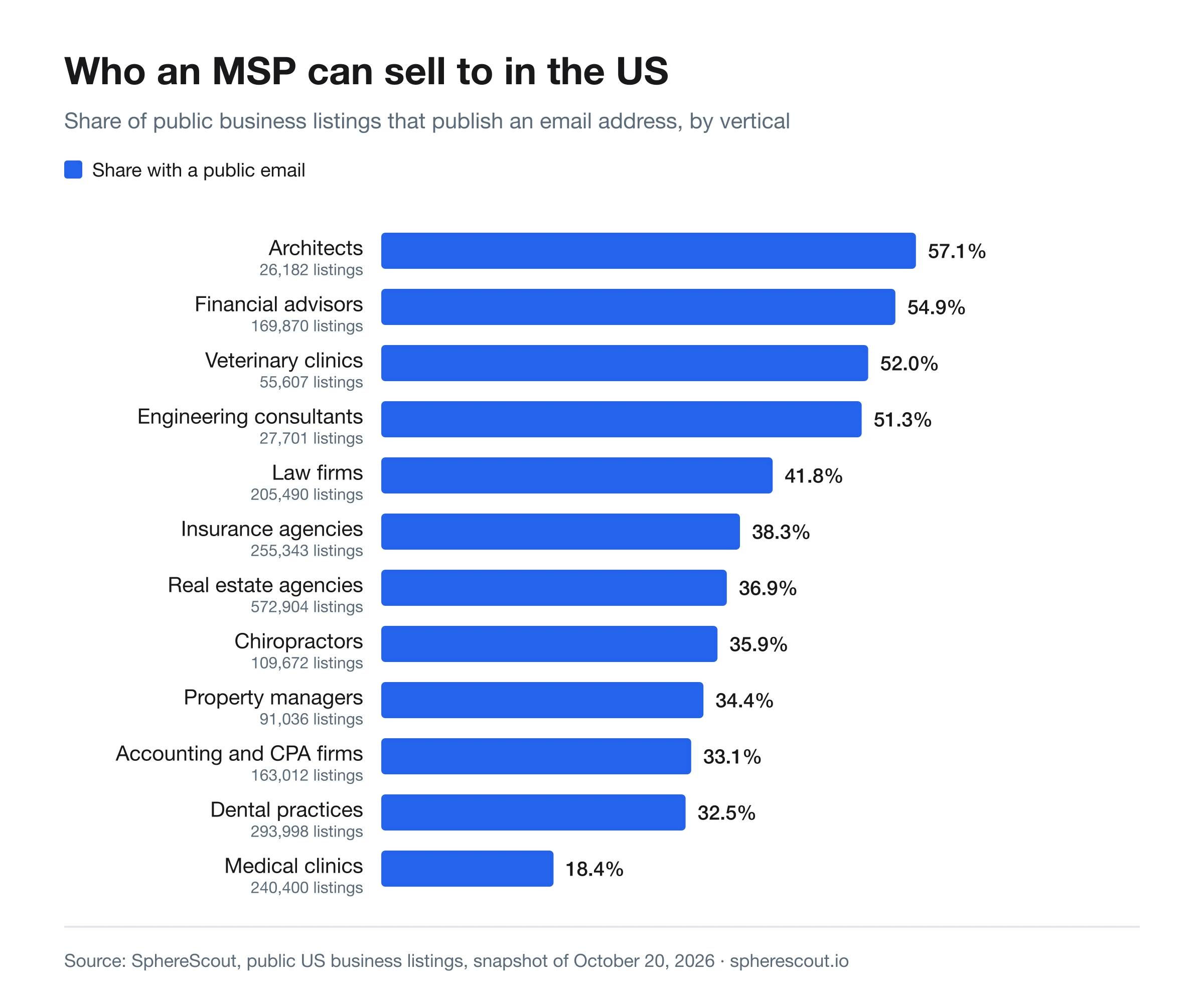
Three things stand out.
The volumes are large. There are 293,998 dental practice listings, 255,343 insurance agencies, 205,490 law firms and 163,012 accounting and CPA firms.
Almost every listing has a phone number: 92% to 98%, depending on the vertical. Email is another story.
Only 18.4% of medical clinics publish an email address. Compare that with 57.1% of architects, 54.9% of financial advisors and 51.3% of engineering consultants. The channel you lead with should depend on the vertical.
A worked example: Denver
National numbers don't sell IT. Your service radius does. Here is what sits within 25 miles of downtown Denver:

There are 2,794 dental practice listings, 2,718 of them with a phone number and 1,131 with an email address. Law firms add 1,934 listings, and about half of them (991) show an email.
Local coverage can beat the national average. In Denver, 40.5% of dental listings show an email, against 32.5% nationwide. Check your own city before you choose a channel.
One caveat: a listing is a public business profile. A large practice can have more than one, so treat these as counts of places to reach, not of companies.
Once you know the volume, choose where to start:
Pick verticals that have to care about IT
Size is not enough. The best verticals carry a legal reason to take security seriously, which gives your first email a better subject than "we do managed services."
| Vertical | Rule that applies | What it asks for |
|---|---|---|
| Dental practices, medical clinics | HIPAA Security Rule | Administrative, physical and technical safeguards for electronic health information |
| Accounting and tax firms | FTC Safeguards Rule | A written information security program, multi-factor authentication, an incident response plan |
| Law firms | ABA Model Rule 1.6(c) | Reasonable efforts to prevent unauthorized access to client information |
For tax professionals, the IRS spells out what that written plan contains in Publication 5708. A firm that can't show one is a concrete opening.
Lead with the obligation, not your stack. A dentist doesn't want "endpoint detection." A dentist wants to know the practice can show its safeguards if something goes wrong.
Other verticals still work without a regulator behind them. Real estate agencies, property managers, veterinary clinics and chiropractors run on shared files, booking systems and email.
With two or three verticals chosen, build the list:
Build the list
There are four ways to get a list of local businesses. They differ mostly on one field: the email address.
| Method | What you get | Email addresses? | Your time |
|---|---|---|---|
| By hand from Google Maps | Name, address, phone, website | Only by visiting each website | Days |
| Google Places API | Name, address, phone, website | No: the API has no email field | Developer time |
| Scraping tools | The same, plus emails found on websites | Yes, where published | Hours, plus upkeep |
| A ready-made list | Name, address, phone, email, website, social profiles | Yes, where published | Minutes |
The Places API is cheap for phones and websites: the tier that includes websites costs $35 per 1,000 requests after the free monthly allowance.
The email is the expensive part, because you still have to crawl every website.
A ready-made list skips that work. SphereScout is a B2B data provider: business email lists of local businesses, collected from the public internet. You pick a business category and a place, and the preview shows how many businesses match and how many have an email, before you spend anything.
Then you export a CSV with names, addresses, phones, emails, websites and social profiles. Our guide to prospecting list columns shows how to map that file into your CRM.
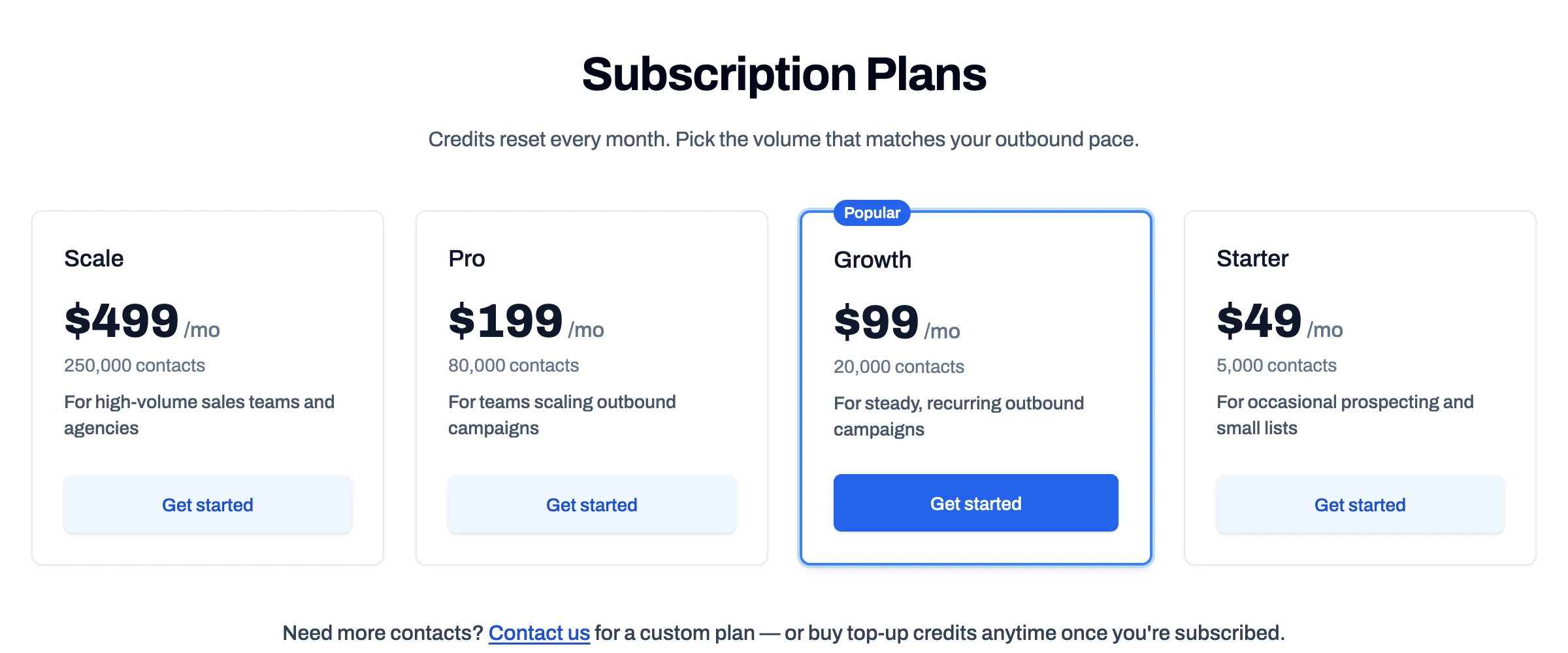
Plans start at $49 a month for 5,000 contacts, and every account gets 100 free contacts to test with. See the current pricing.
Before the first send, run the email column through a verifier. Bounces hurt your sending domain, and a public address can go stale between two updates.
Our post on data enrichment tools covers filling the gaps, such as a missing email or a decision maker's name.
Now the outreach itself:
Reach them: a four-week sequence
This sequence adapts 30 Minutes to President's Club's outbound template, which its author says got him over 20% replies from cold prospects. It mixes seven emails, four calls and three LinkedIn touches over 23 days.
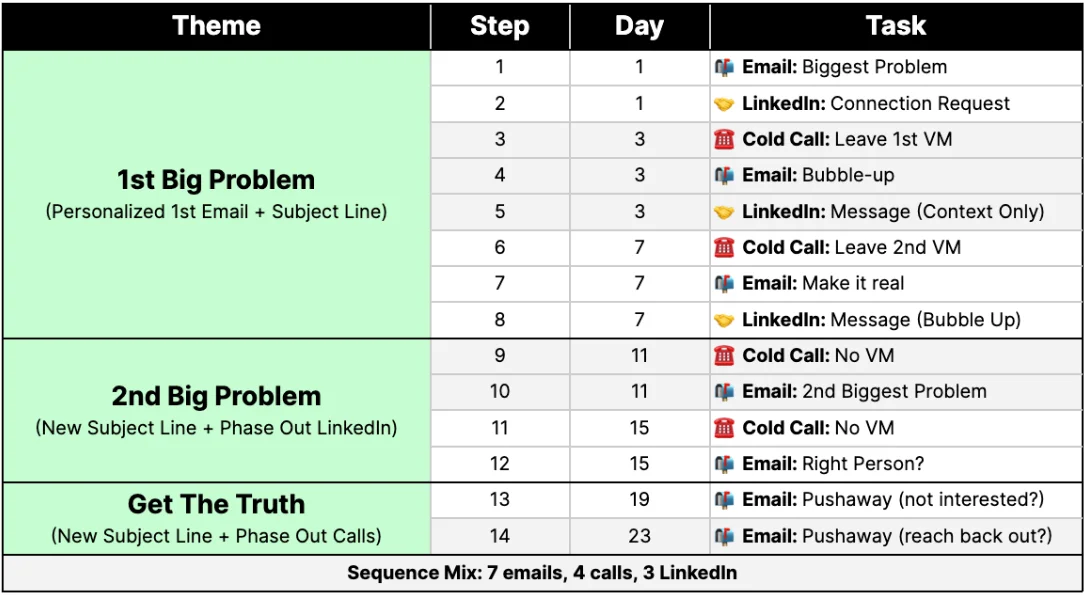
Adjust the mix to the vertical. For medical clinics, where fewer than one in five listings shows an email, open with the call and the voicemail.
For architects or financial advisors, where more than half do, open with the email.
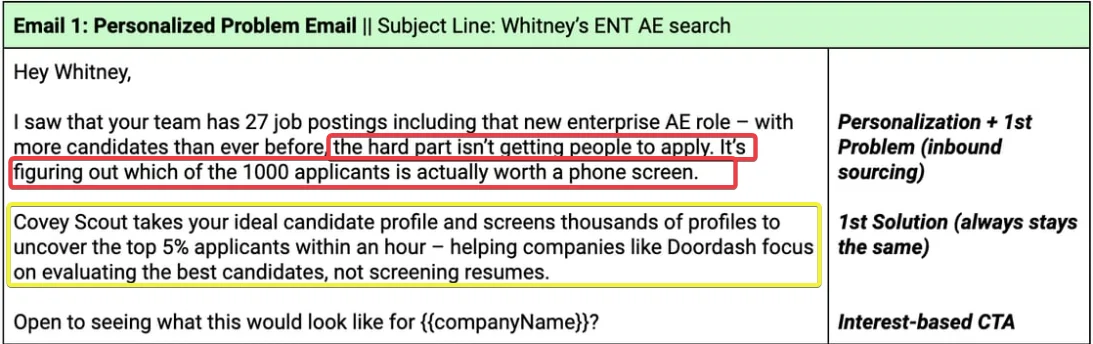
The first email names one problem and one fix. Don't list your services.
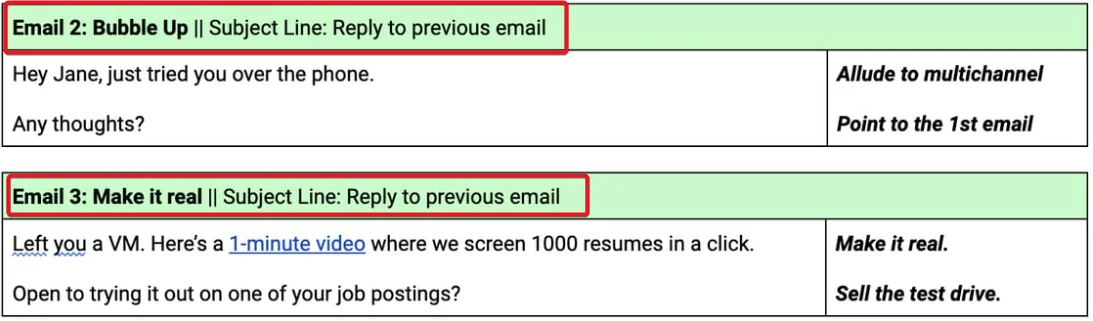
If there is no reply, bubble it up once or twice with a short line such as "any thoughts on this?" Never resend the same pitch.
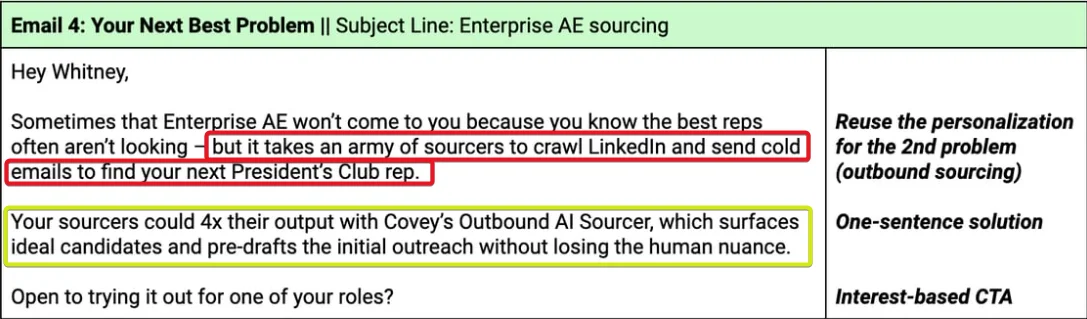
If the first problem doesn't land, switch themes. Use a new subject line and a second problem, such as backups after the compliance angle.
Not sure you reached the right person? Ask. "Is this even your area?" gets quick answers and often a referral to the office manager.

End with a breakup email that says you will stop unless they tell you otherwise. It is often the one that gets a reply.

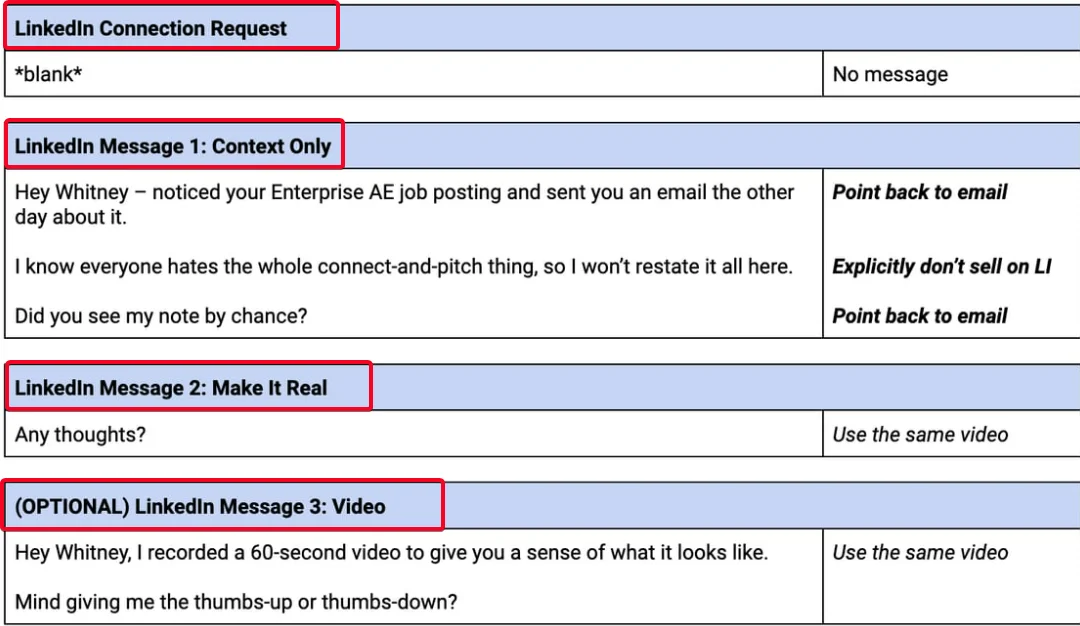
Use LinkedIn to warm people up, not to pitch: connect, engage with a post, then tie your message back to your email.
Two rules keep this legal. Commercial email to businesses falls under the CAN-SPAM Act: accurate sender details, a postal address, and opt-outs honored within 10 business days.
Most business-to-business calls are exempt from the Telemarketing Sales Rule, but its ban on misrepresentations still applies. Calls that sell to employees for their personal use are not exempt.
For tools, see our guides to cold email lead generation and B2B telemarketing.
You can also hand most of the list work to an AI assistant:
Run it from your AI assistant
SphereScout has a remote MCP server, so assistants such as Claude and ChatGPT can search businesses, preview counts and export lists for you. In Claude Code, one command connects it:
claude mcp add --transport http spherescout https://mcp.spherescout.io/mcp
In Claude or ChatGPT, add https://mcp.spherescout.io/mcp as a custom connector and sign in with your SphereScout account. Then ask in plain language:
How many dental practices are there in Denver, Colorado, and how many have an email?
If it's under 1,500, export the ones with an email.
The assistant finds the category and the place, runs the preview for free, and asks before it spends credits on the export. Searching and previewing are free on every plan; exports need a paid plan.
The same workflow runs through the REST API if you want to script it.
Do it yourself or hire an MSP lead generation agency?
Agencies run the same playbook: a list, a sequence, calls and booked meetings, for a monthly retainer. Hire one if nobody on your team can give outreach a few hours every week.
Before you sign, ask four questions:
1. Where does the list come from, and how many businesses in my service area will you contact?
2. Which channels do you use for each vertical?
3. Who owns the list and the replies when the contract ends?
4. How do you handle opt-outs and CAN-SPAM?
If the answers are vague, run the first month yourself. You will learn what your market responds to, and you will brief an agency far better later.
FAQ
What is MSP lead generation?
Finding businesses that need managed IT and starting a sales conversation with them. It combines inbound work, such as SEO, ads and referrals, with outbound outreach by email, phone and LinkedIn to a defined list of local businesses.
Is cold email legal for MSPs in the US?
Yes, if you follow CAN-SPAM. The law applies to business-to-business email too. Use accurate sender details, include a valid postal address, offer a clear opt-out, and honor it within 10 business days.
Can MSPs cold call businesses?
Yes, most B2B calls are exempt from the Telemarketing Sales Rule. The exemption has limits: misrepresentations are banned, and calls selling to employees for personal use are not exempt. Respect any request to stop calling.
Which verticals are best for MSPs?
Regulated small businesses: dental, medical, accounting and legal. Each has a rule that asks for security safeguards, which gives you a reason to call. Pick the ones with enough businesses in your service radius.
How much does MSP outbound cost?
The list starts at $49 a month for 5,000 contacts on SphereScout. Add a cold email tool, an email verifier and, if you call, a dialer. Each has its own monthly price.
Final thoughts
Most MSPs don't lack services. They lack a list of the right businesses and a reason to call each one.
Pick two verticals, count them around your office, and start the sequence this week. You can check the numbers for your city in the US business lists by industry.
No credit card · Export-ready CSV
Writer at spherescout.io. I publish top picks, comparisons, and real-world tests focused on B2B prospecting and data quality.