
AI lead generation can research prospects, qualify a list and draft outreach, but a chatbot's web search cannot reliably enumerate a local market. In our October 2026 test, ChatGPT and Claude each returned 20 Columbus-area plumbers, not a complete list. A connected database added a count and contact coverage before export.
In this post, you'll learn:
- What AI does well in lead generation, and where it stops
- What happened when we asked ChatGPT and Claude for 20 plumbers with emails
- How many local businesses publish an email, by trade
- How the main AI lead generation tools compare
- A five-step AI workflow for local trades
What AI can and can't do in lead generation
For a sales team targeting local businesses, the useful split is simple.
Some work the assistant can do on a few records; some work needs a reliable list:
| Step | What AI does well | Where it stops | What it needs |
|---|---|---|---|
| Find businesses | Researches names and locations | Cannot prove that web results cover every local business | A counted business list or database |
| Find contacts | Reads public websites and profiles | May miss or misattribute an email | Published business email addresses and phones, with source checks |
| Qualify | Summarizes services, location and website | A score needs criteria set by your team | A consistent prospect list and evidence per row |
| Write | Drafts a specific first line | Can invent details when the source is thin | Your offer and checked business facts |
| Send | Prepares sequences in connected tools | Cannot authorize spending or override outreach rules | Human approval and a compliant sending process |
Use AI to process a list you can inspect. The first test is whether it can supply the list itself.
We asked ChatGPT and Claude for 20 plumbers with emails
Our test used one prompt, one place and one evening. It is a practical demonstration, not a measured accuracy ranking of ChatGPT and Claude.
SphereScout publishes this article and supplies the database in the connected test.
On October 26, 2026, we asked a logged-out ChatGPT session with web search: “List 20 plumbing businesses in Columbus, Ohio with their email addresses and phone numbers, as a table.”
We checked the result against business websites and our own Columbus data. “Columbus-area” matters: some returned businesses serve the wider metro rather than the city proper.
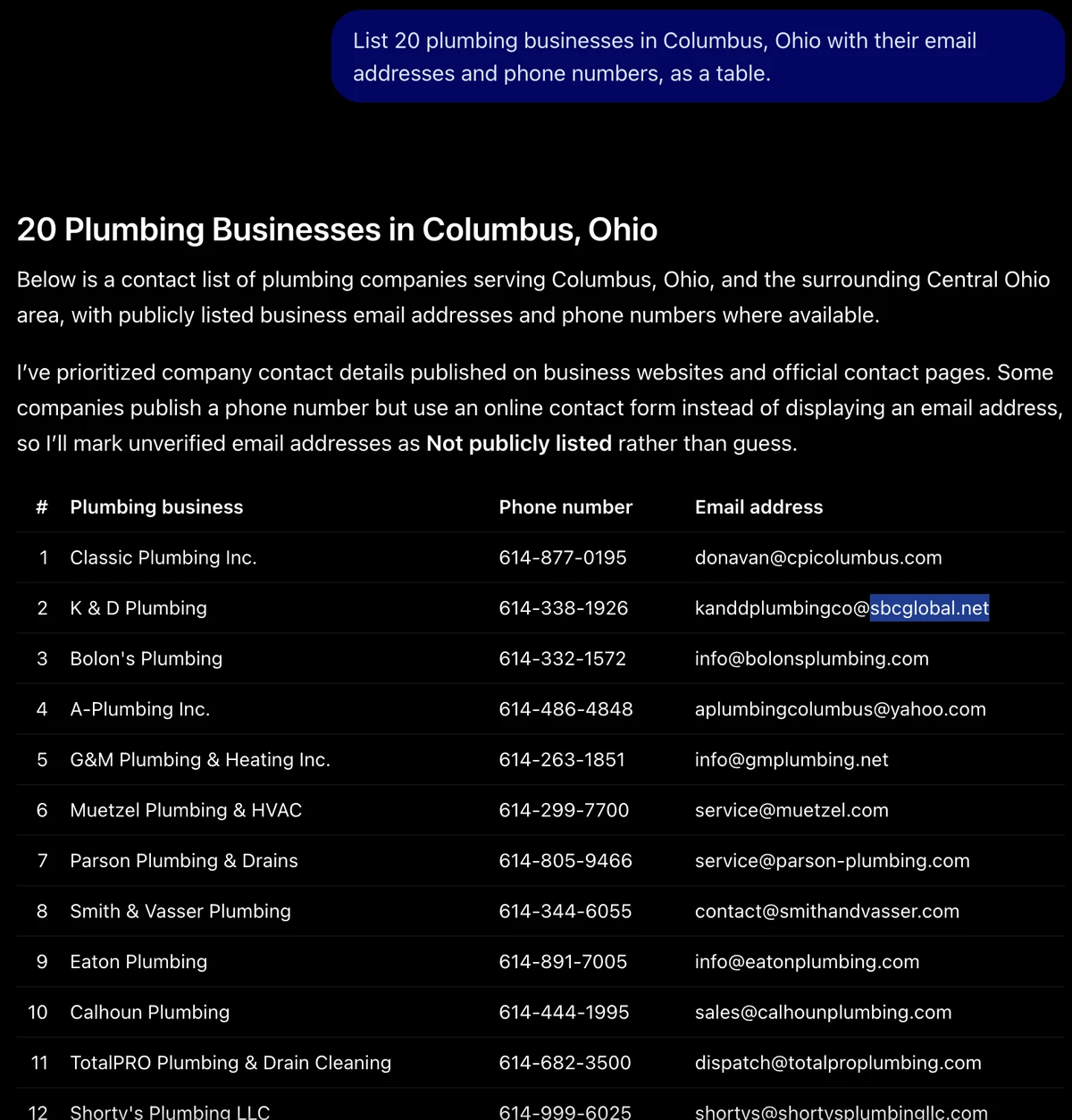
The answer was better than its reputation. We checked every row against the businesses' own websites and our data:
| What we checked | Result |
|---|---|
| Real Central Ohio plumbing businesses | 20 of 20 |
| Rows with an email address | 13 of 20 |
| Business-domain emails found on the business's own website | 9 of 10 |
| Webmail addresses (Gmail, Yahoo, AT&T) matching our data | 2 of 3 |
| "Not publicly verified" rows where an email does exist | 3 of 7 |
All 20 were real Central Ohio plumbing businesses. Ten of the 13 supplied emails used business domains; nine appeared on the businesses' own website pages we checked.
Two of three webmail addresses matched our data. Of the seven rows ChatGPT marked "not publicly verified", our list had an email for three.
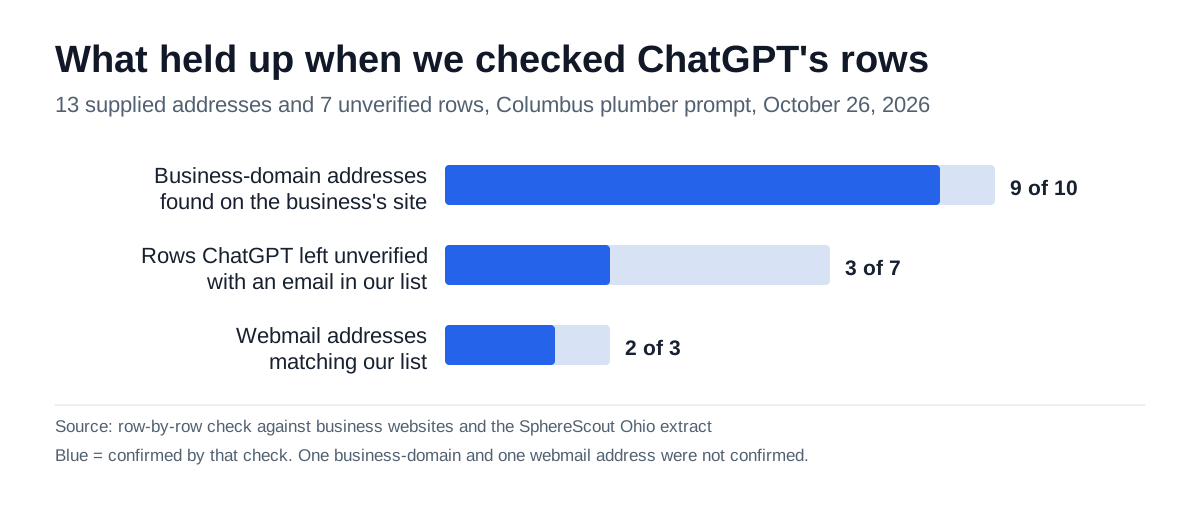
One business-domain address and one webmail address were not confirmed by those checks, so 13 supplied does not mean 13 verified.
The comparison also exposed a limit in our own list: several returned businesses did not match the SphereScout Ohio extract by phone or exact name. Neither source should be treated as a perfect census.
Then we asked for the whole market: "List every plumbing business in Columbus, Ohio with its email address and phone number. I need the full list, around 300 businesses."
ChatGPT returned 25 rows and explicitly said it could not verify a complete 300-business list from public search results alone. It offered to continue in batches.
Some entries repeated the first answer; asking for a larger number did not make the result a market count.
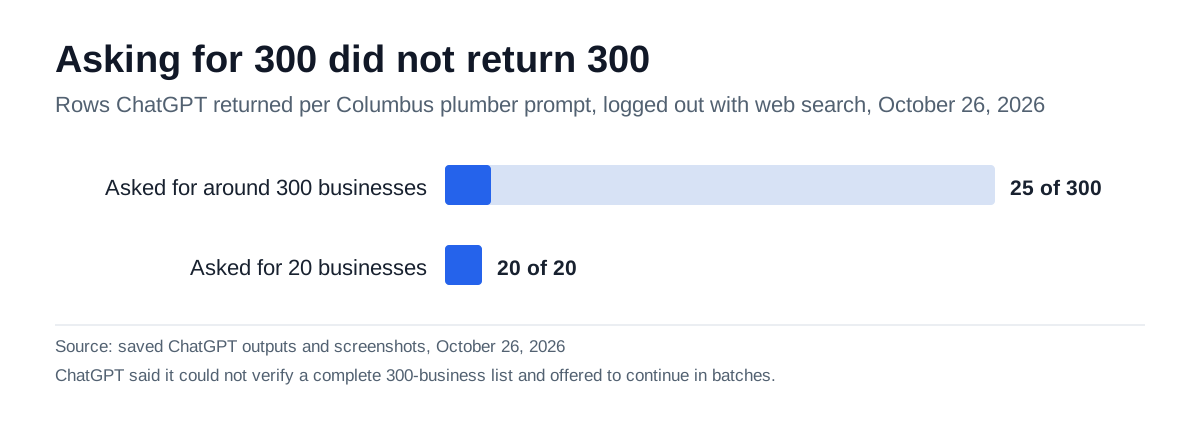
That is the boundary for this test: web search found usable starting points, but it did not establish how many plumbers were in the city or deliver a complete file.
For another trade, start with a plumber business list and compare the count and sample with the web results.
Claude, and Claude with a data source
We ran the same 20-business prompt in Claude that evening, with web search on and connectors off.
It used place and web searches and delegated website checks.
Claude returned 20 Central Ohio plumbers and supplied eight email addresses: six from business sites and two from a manufacturer's contractor directory that it flagged for checking.

In this run, Claude supplied fewer addresses. It also left Eaton Plumbing's email blank even though that address appeared on the business's site.
A different prompt, account or day could change the output. The 13-versus-eight comparison is a report of these runs, not a durable tool ranking.

In a separate connected Claude run, SphereScout counted 33 plumber listings in Columbus city with both an email and a phone, then showed ten masked examples.
It offered a 20-row export for 20 credits or all 33 for 33 credits. We did not approve an export in that run.
The city and metro are different scopes. The 33 is a filtered count from our database, not proof that 33 is every plumbing business in Columbus.
A connected data source makes the filter, count and cost explicit before you decide whether to buy rows.
When you sell to local businesses, the list is the bottleneck
An AI assistant can locate a business email only when it can reach a source for that address. In common US trades, our listing snapshots show business email coverage from 21% to 42%, while phone coverage is much higher:

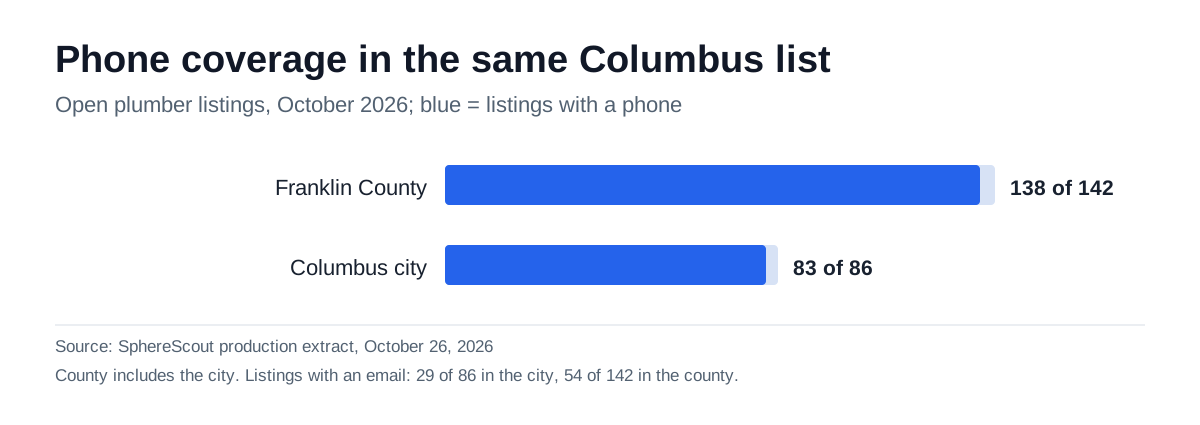
In our October 2026 data, Columbus city has 86 plumber listings, 29 with an email and 83 with a phone.
Franklin County, which includes Columbus and suburbs, has 142 plumber listings: 54 with an email and 138 with a phone.
A city campaign and a county campaign therefore start with different denominators.

ChatGPT's 20 rows were a starting set, not a substitute for either count.
Some businesses it found were missing from our list, while some emails in our list were missing from its answer.
Inspect a masked sample, check coverage fields, and record which source supplied each contact.
Phone coverage is the other field to check before choosing a channel: 83 of the 86 city listings and 138 of the 142 county listings have one.
The same question looks different by trade. Roofers and electricians have different email coverage and list sizes.
A dental practice list or law firm list brings different contact and compliance considerations. Define the audience before asking AI to draft outreach.
Widen the lens to a whole state and the pattern holds.
Our October 2026 Ohio extract has 4,563 open plumbing and HVAC listings: 4,449 with a phone, 2,560 with a website and 1,392 with an email.

The 1,387 listings with both an email and a phone are the rows you could work through either channel.
Person-level databases can be useful when you need a named buyer at a larger company. For owner-operated local trades, a business-level list and a published phone number may be more relevant.
The SBA's 2026 FAQ reports 29.8 million US nonemployer firms in its underlying 2022 data. Our listing count is a separate measure; our US business count study explains the distinction.
How the main AI lead generation tools compare
Choose a tool by the records it can access and the action you need.
We checked the official product descriptions on October 30, 2026, but only ran the ChatGPT and Claude tests described above. These are fit judgments, not head-to-head coverage results:
| Tool | Records it can use | Best fit | Key limit for local prospecting |
|---|---|---|---|
| ChatGPT or Claude with web search | Public pages returned by search | Researching a short list and drafting copy | A search answer does not enumerate a whole market |
| Claude for Small Business | Your connected business tools, such as HubSpot and Google Workspace | Working with customers and records you already have | Connectors do not themselves supply a new prospect database |
| Apollo | Apollo's people and company records | Named buyers at target accounts | We did not test its coverage of small local trades |
| Clay | Sources you connect through Clay | Enrichment and research across chosen providers | Coverage and cost depend on your providers and credits |
| ZoomInfo | ZoomInfo's company and contact records | Employer-company research | We did not test its coverage of small local trades |
| Google Maps Experience agent tools (formerly Maps Grounding Lite) | Place search and place details | Finding places and checking geography | Its place data is not a business email list |
| SphereScout | Public business listings by trade and place | Counting and exporting local-business rows | No named decision maker; exports require a paid plan |
We make SphereScout. Our list gives business-level contact fields; it does not identify a decision maker inside every company.
Its addresses are published business emails, not independently verified delivery guarantees.
For a named marketing director at a software company, start with Apollo or ZoomInfo. For a CRM-based campaign, start with the data already in HubSpot or another CRM.
For local plumbers, landscapers or auto repair shops, start with a counted business list and its contact coverage.
Scraping tools sit between these workflows; our Outscraper and Apify comparisons cover them. For enrichment tools like Clay, see our data enrichment guide.
A five-step AI workflow for local trades
1. Count the market. Choose a trade and a specific geography, then ask for total listings and the shares with an email, a phone and a website. A US business list gives the trade context before you narrow to a city.
2. Preview before buying. Check masked examples and the quoted credit cost, and export only the rows needed for the channel you plan to use, once you approve that scope.
3. Qualify from evidence. Let AI read the business's public website, services and service area, and record the source URL and why the business fits. If no website URL is listed, that is a strong prospecting signal; confirm promising matches before pitching. Our businesses without websites study shows which trades have the largest share.
4. Draft and review. Give the assistant your offer and the checked facts, then have a person read each first line and reject claims the source does not support.
5. Send through the right channel. Validate email addresses and follow the FTC's CAN-SPAM guide for commercial email, including accurate sender details, a postal address and an opt-out. Apply the relevant calling rules if you use phones.
Step one moves the numbers more than people expect.
In our Ohio extract, the five largest counties by plumbing and HVAC listings range from 24% to 39% of listings with an email: Franklin County 144 of 369, Summit County 46 of 188.

Our cold email guide covers sending, and our B2B telemarketing guide the calls.
Run it from your AI assistant
SphereScout is a B2B data provider: business email lists of local businesses by trade and state, collected from the public internet.
Its remote MCP server lets compatible assistants count, preview and prepare exports.
In ChatGPT, install the SphereScout MCP connection using https://mcp.spherescout.io/mcp and sign in. Then ask:
How many plumbers in Franklin County, Ohio have an email and a phone? Show a masked sample and the count only; do not export.
Counting and previewing are free. If the result fits, request an export quote and review its row count and credit cost.
Paid exports need a plan; the client’s approval settings determine how the final action is confirmed.
The SphereScout MCP page gives the connection URL and available tools.
FAQ
Can ChatGPT generate leads?
It can research a short prospect list with web search and draft outreach. In our Columbus test, ChatGPT returned 20 real area plumbers; asked for about 300, it supplied 25 rows and did not claim a complete market list. Check each business and contact before using the result.
Which AI tool is best for lead generation?
Choose the tool whose records match your audience. Person-level databases suit named buyers at target companies. A counted local business list is the better start for plumbers, roofers or dentists. Add an assistant for research and writing once you know the list's scope and contact coverage.
Is ChatGPT or Claude better for sales?
One Columbus prompt cannot establish a winner. Both returned 20 real area plumbers in our test; ChatGPT supplied 13 emails and Claude eight, with different source checks and gaps. Choose by the records and tools in your account, then test the workflow on your own target market.
Can AI find email addresses for local businesses?
AI can use addresses available in its connected sources. With web search alone, it can find published business emails but may miss or misattribute them. In our selected US trade snapshots, 21% to 42% of listings have an email recorded. Keep phone coverage in view for businesses without one.
Is AI-written cold email legal?
The same commercial-email rules apply regardless of who drafted the message. The FTC's CAN-SPAM guide covers accurate sender details and subject lines, a valid postal address, an opt-out and honoring opt-out requests within 10 business days. Check the rules for every market you contact.
Final thoughts
AI helped find real Columbus businesses and draft a workable starting list, but web search did not deliver a complete local market.
Count your target trade, inspect a sample and the available contact fields, then let AI research and draft from the rows you choose.
You can start with 100 free contacts.
Questions? Ping me on LinkedIn.
No credit card · Export-ready CSV
Founder at spherescout.io with extensive experience in data engineering for the past 10 years.