
The SBA's 2026 FAQ reports 36.2 million US businesses using 2022 data. About 6.4 million had employees; 29.8 million did not. Those are firms, not the locations a sales team can find online. We compare the official totals with 24.6 million public listings, then show counts and email coverage for 24 trades, plus state comparisons.
In this post, you'll learn:
- How many businesses the US has, by each official count
- Why those counts disagree, and which one to use
- How many businesses there are in 24 common trades
- How many of them publish an email or a phone number
- Which states have the most businesses
How many businesses are in the US?
The SBA's Office of Advocacy reports 36,207,130 small businesses in its 2026 FAQ. The underlying employer and nonemployer counts are from 2022. There is a small inconsistency in the FAQ's label, explained below.

That's one of five counts you'll find, and each answers a different question:
| Count | What it counts | Number | Data year | Source |
|---|---|---|---|---|
| Small businesses, SBA headline | Firms with employees, plus businesses without employees | 36,207,130 | 2022 | SBA Office of Advocacy |
| Nonemployer businesses | Businesses with no paid employees and at least $1,000 in receipts ($1 in construction) | 31,985,874 | 2024 | Census Nonemployer Statistics |
| Public business listings | Open businesses with a public profile online | 24,580,463 | October 2026 | SphereScout |
| Employer establishments | Locations with at least one paid employee | 8,361,342 | 2023 | Census County Business Patterns |
| Employer firms | Companies with at least one paid employee | 6,395,635 | 2022 | Census SUSB |

The SBA's headline adds two 2022 Census counts: 6,395,635 employer firms and 29,811,495 firms without employees. By 2024, the nonemployer count had risen to almost 32 million.

What counts as a small business
For research, the SBA generally defines a small business as having fewer than 500 employees. By that measure, 99.9% of US businesses are small; they employ 62.3 million people, or 45.9% of private-sector workers.
The FAQ's 36,207,130 total includes all employer firms. The Census 2022 SUSB table shows that 21,041 had 500 or more employees.

Subtracting them gives 36,186,089 small firms under the stated definition. Both totals round to 36.2 million.
For federal contracts, the SBA uses size standards that vary by industry, set by employees or annual revenue. A firm counted as small in general research may exceed its industry's contracting standard.
Why the official totals disagree
The five counts differ for three reasons: what they count, who they leave out, and when.
A firm is a company; an establishment is one of its locations. A pharmacy chain is one firm with thousands of establishments, which is why 6.4 million firms run 8.3 million locations.
Nonemployer businesses include freelancers, sole proprietors and some partnerships and corporations. The Census counts them from tax returns if they earn at least $1,000 ($1 in construction).

The tax records do not show whether these businesses have storefronts, websites or public profiles. A nonemployer count is not a count of prospects you can find online.
Data years differ too. The latest releases are 2022 for firms, 2023 for locations and 2024 for nonemployers, each published one to three years after the year it describes.
So the right number depends on the question:
| If you want to know | Use |
|---|---|
| How many businesses existed in 2022 | SBA FAQ headline: 36.2 million |
| How many companies have staff | Census employer firms: 6.4 million |
| How many locations have staff | Census employer establishments: 8.4 million |
| How many businesses have no paid employees | Census nonemployers: 32.0 million |
| How many open businesses have public profiles | Public business listings: 24.6 million; contact coverage varies |
How many businesses are in each trade?
The Census counts trades by NAICS code, an industry code assigned from tax and survey data. Business listings count by the category shown on each public profile.
Here are both, side by side, for 24 trades:
| Trade | Census employer locations (2023) | Census nonemployers (2024) | Public listings (Oct 2026) | With an email |
|---|---|---|---|---|
| Dentists | 135,665 | 57,079 | 294,026 | 32.5% |
| Doctors | 204,617 | 190,427 | 453,533 | 7.7% |
| Chiropractors | 39,913 | 25,668 | 109,672 | 35.9% |
| Veterinarians | 34,296 | 29,808 | 55,608 | 52.0% |
| Lawyers | 165,491 | 275,815 | 205,497 | 41.8% |
| Insurance agencies | 133,728 | 314,503 | 255,338 | 38.2% |
| Real estate agencies | 163,894 | 819,954 | 572,923 | 36.9% |
| Plumbers and HVAC | 111,207 | 189,085 | 202,334 | 29.7% |
| Electricians | 83,342 | 171,644 | 92,627 | 29.8% |
| Roofers | 25,519 | not published | 105,525 | 38.9% |
| Painters | 38,280 | not published | 61,605 | 26.4% |
| Landscapers | 117,969 | 537,970 | 211,877 | 26.1% |
| Janitorial services | 67,799 | 1,173,265 | 67,600 | 24.4% |
| Hair and beauty salons | 84,176 | 867,242 | 462,135 | 21.9% |
| Nail salons | 34,417 | 318,382 | 100,051 | 19.9% |
| Auto repair shops | 84,859 | 225,471 | 362,524 | 21.1% |
| Gas stations | 96,002 | not published | 165,779 | 3.1% |
| Hotels | 55,895 | 86,202 | 118,088 | 28.4% |
| Fitness centers | 41,556 | 148,543 | 124,767 | 50.1% |
| Day care centers | 82,162 | 537,849 | 126,234 | 36.0% |
| Funeral homes | 15,183 | 12,813 | 28,807 | 52.3% |
| Pharmacies | 41,792 | not published | 102,545 | 12.0% |
| Bars | 40,835 | 30,184 | 51,603 | 21.4% |
| Churches | 186,801 | not published | 471,180 | 35.2% |
Some Census rows are broader than the trade: nonemployer counts for lawyers cover all legal services, for auto repair all mechanical repair, for hotels all lodging and for fitness centers all recreation.
The employer code used for churches also covers other religious organizations. The method note at the end has the codes.
Searches like "how many doctors" or "how many lawyers" usually mean people. The counts here are businesses and offices, not licensed professionals.

Every list page shows its own count, so you can check any of 125 trades on the US business email list page.
Why listing counts differ from Census counts
Listings outnumber Census employer locations in 23 of the 24 trades we compared, up to 5.5 times for hair and beauty salons. Janitorial services are slightly below the employer count: 67,600 listings versus 67,799 locations.

These datasets count different things. The 105,525 roofing listings include public profiles without any employee-size filter; Census records 25,519 roofing locations with staff.
Some public categories cover individual professionals as well as offices. Our 453,533 doctor listings cannot be read as 453,533 separate physician offices; Census counts 204,617 employer locations in that industry.
And categories don't map one to one. A public profile has a listing category, while Census assigns a NAICS code; plumbers and HVAC contractors even share a single code.
In the other direction, listings can fall far below the employer and nonemployer counts added together. Janitorial services have 1,173,265 nonemployers and 67,600 listings.

That gap does not tell us how many cleaners lack a listing. The Census code, public category and reference years differ. It shows why a tax count cannot substitute for a searchable business list.
How many can you actually reach?
A count matters only if you can contact the businesses. In 22 of the 24 trades, 85% to 98% of listings have a phone number. Bars and churches are lower, at 74.6% and 77.0%.

Email is the gap. Across all 24.6 million US listings, 6.2 million (25.1%) show at least one email address, and the share swings widely by trade:

Funeral homes, veterinarians and fitness centers have an email in about half their listings. Gas stations and doctors have much lower email coverage, at 3.1% and 7.7%.
Separately, 37% of listings across 125 trades have no website, as our study of businesses without websites shows.
SphereScout is a B2B data provider: business email lists of local businesses by trade and state, collected from the public internet. Every list page shows the count and the share with an email or phone before you pay:
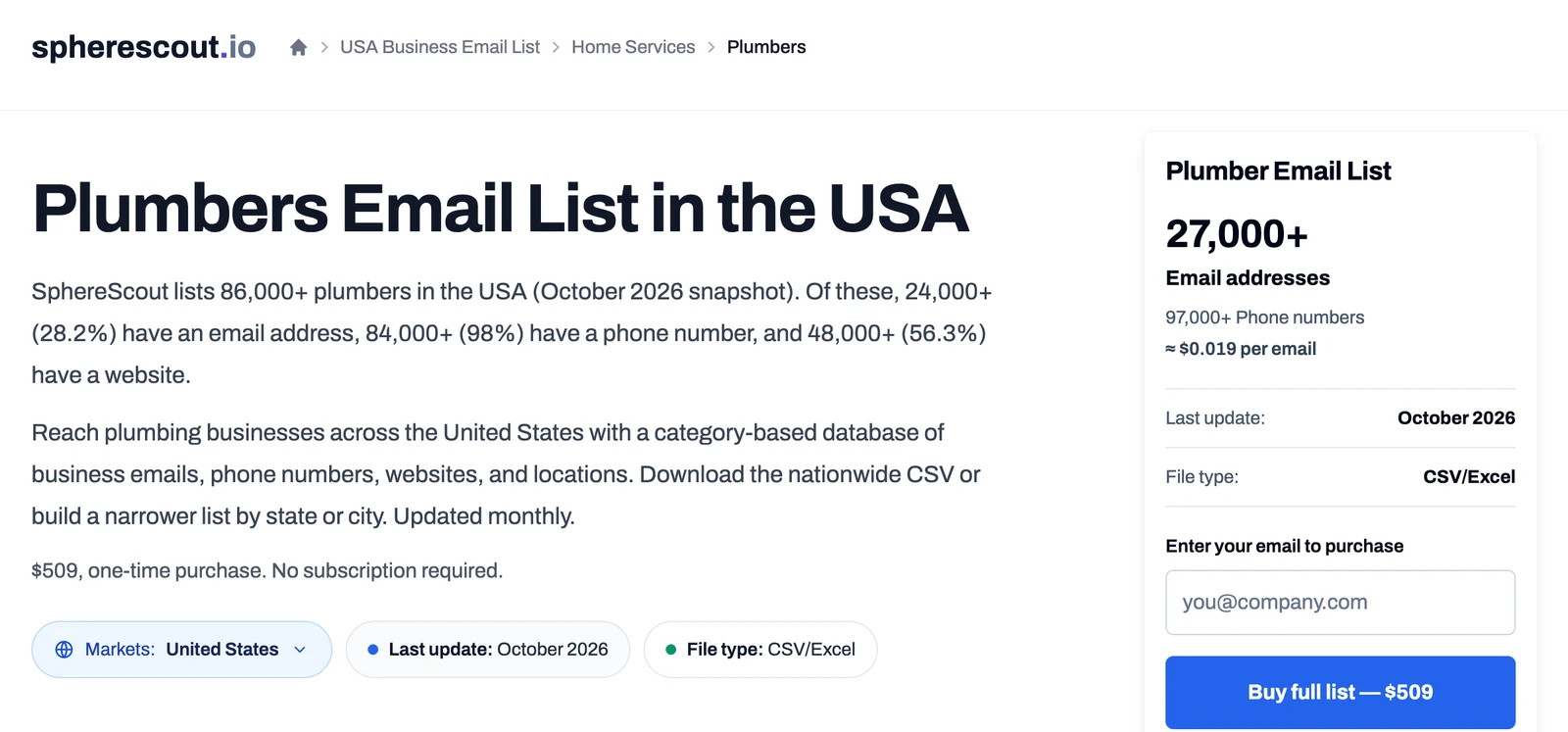
The addresses are collected from the public internet; we did not test deliverability for this article. Check them before a campaign, as our data enrichment guide explains, and read the cold email guide before sending.
Which states have the most businesses?
California tops all three state measures here. It has 1,029,689 employer locations, 3,686,618 nonemployer businesses and 2,450,743 public listings:
| State | Public listings (Oct 2026) | Per 100,000 residents | Census employer locations (2023) | Census nonemployers (2024) |
|---|---|---|---|---|
| California | 2,450,743 | 6,227 | 1,029,689 | 3,686,618 |
| Texas | 1,833,644 | 5,783 | 670,878 | 3,318,535 |
| Florida | 1,689,247 | 7,200 | 645,575 | 3,427,341 |
| New York | 1,292,757 | 6,463 | 541,313 | 2,097,883 |
| Pennsylvania | 845,894 | 6,477 | 307,065 | 1,001,577 |

Per resident, using Census population estimates, the order changes. Wyoming and Vermont lead, followed by Washington, DC; each has more than 9,000 listings per 100,000 residents:

Texas is near the bottom, with 5,783 per 100,000, alongside Nevada and Arizona.

To size one trade state by state, start from its list page: each one shows a count for every state.
Count your own market with ChatGPT
Counting and masked previews are free. To try them in ChatGPT, add SphereScout's MCP server as a plugin at https://mcp.spherescout.io/mcp, sign in and select it with @. Then ask:
Count roofing contractors in Maricopa County, Arizona. How many have an email,
a phone, or both? Show ten masked examples. Do not export a CSV.
In our recorded October 30 test, ChatGPT returned 790 roofing listings: 431 with email, 762 with phone and 428 with both. The count and preview cost zero credits.
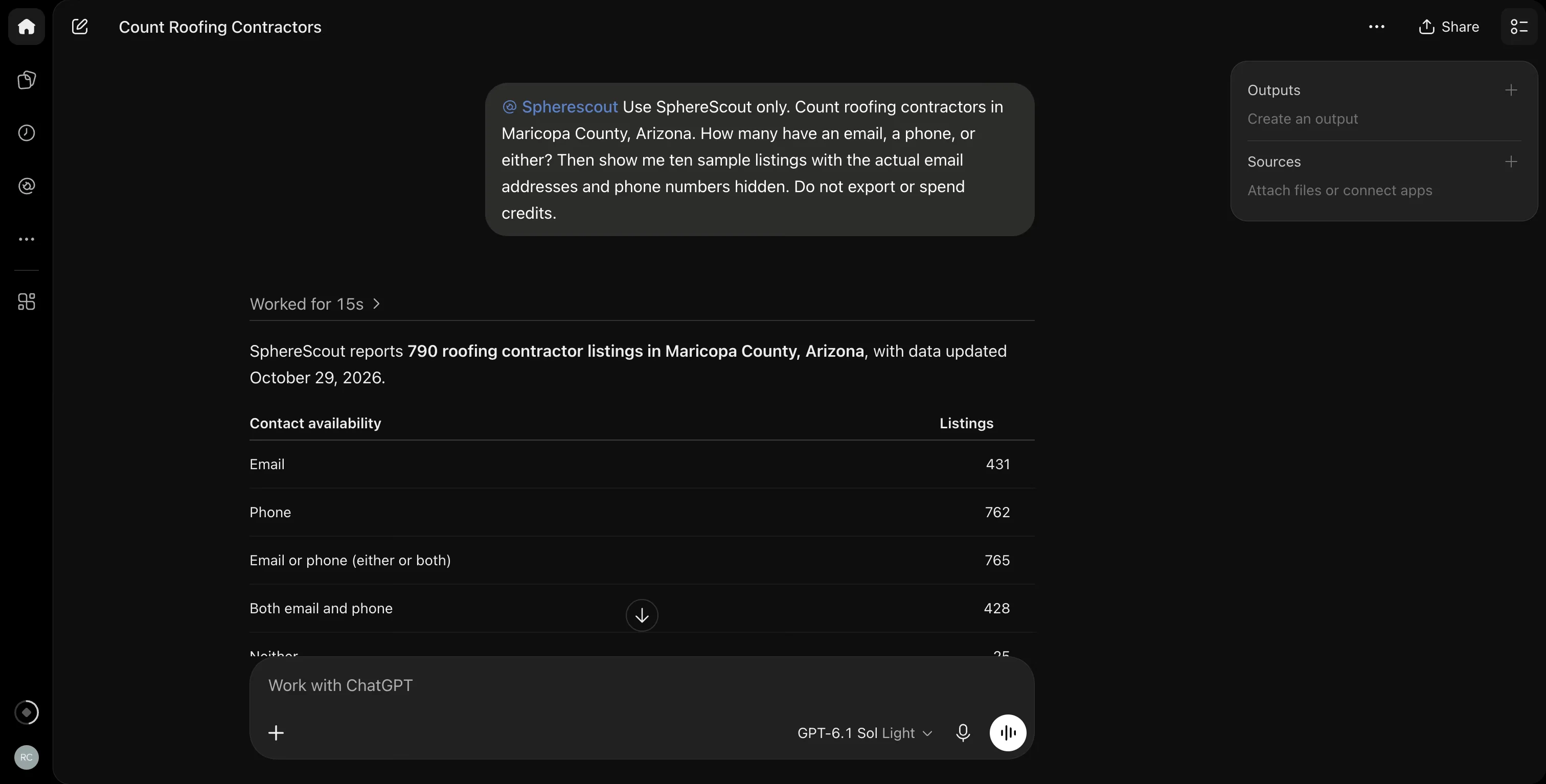
This is one county and one data snapshot, not a national estimate. Exports require a paid plan and cost one credit per row. The REST API can run the same count in code.
FAQ
How many small businesses are in the US?
About 36.2 million using 2022 data. The SBA reports 36,207,130, but its sum includes 21,041 firms with 500 or more employees. Subtracting those gives 36,186,089 under its stated small-business definition.
What percentage of US businesses are small?
99.9% are small, meaning fewer than 500 employees. They employ 62.3 million people, 45.9% of private-sector workers, according to the SBA.
How many businesses have employees?
6.4 million firms in 2022, running 8.3 million locations. The other 29.8 million businesses had no payroll.
How many companies have 500 or more employees?
21,041 firms in 2022, per the Census Bureau's Statistics of US Businesses. That's 0.3% of employer firms.
Which state has the most businesses?
California tops all three state measures here: 1.03 million employer locations in 2023, 3.69 million nonemployer businesses in 2024 and 2.45 million public listings in October 2026.
How we counted
Listings are US business listings in SphereScout's data that are not marked permanently closed, counted by main category in October 2026 (state totals on October 17). Census figures are County Business Patterns 2023 (employer locations in March 2023), Nonemployer Statistics 2024 and Statistics of US Businesses 2022.
Trades are matched to the closest NAICS code. Health and professional trades: dentists 621210, doctors 621111, chiropractors 621310, veterinarians 541940, lawyers 541110, insurance 524210 and real estate 531210.
Home services: plumbing and HVAC 238220, electricians 238210, roofers 238160, painters 238320, landscapers 561730 and janitorial 561720.
Other trades: salons 812112, nail salons 812113, auto repair 811111, gas stations 447110, hotels 721110, fitness 713940, day care 624410, funeral homes 812210, pharmacies 446110, bars 722410 and churches 813110.
Final thoughts
36.2 million is the answer to "how many businesses are in the US". For a sales plan, the useful number is narrower: how many businesses in your trade and area have a public profile and a way to reach them.
Check that count on the list page for your trade before you plan a campaign. You can start with 100 free contacts.
Questions? Ping me on LinkedIn.
No credit card · Export-ready CSV
Founder at spherescout.io with extensive experience in data engineering for the past 10 years.