

Building accurate and usable business contact lists for outbound sales or marketing still means sorting through outdated databases or paying high upfront minimums for unproven leads. Many platforms either force a long-term subscription commitment, limit trial volume to unusably small counts, or deliver lists with little filtering or replacement support if contacts bounce. This guide compares three business contact list providers on data quality, export flexibility, and trial options so you can pick the source that best fits your campaign volume and workflow.
SphereScout
At a Glance
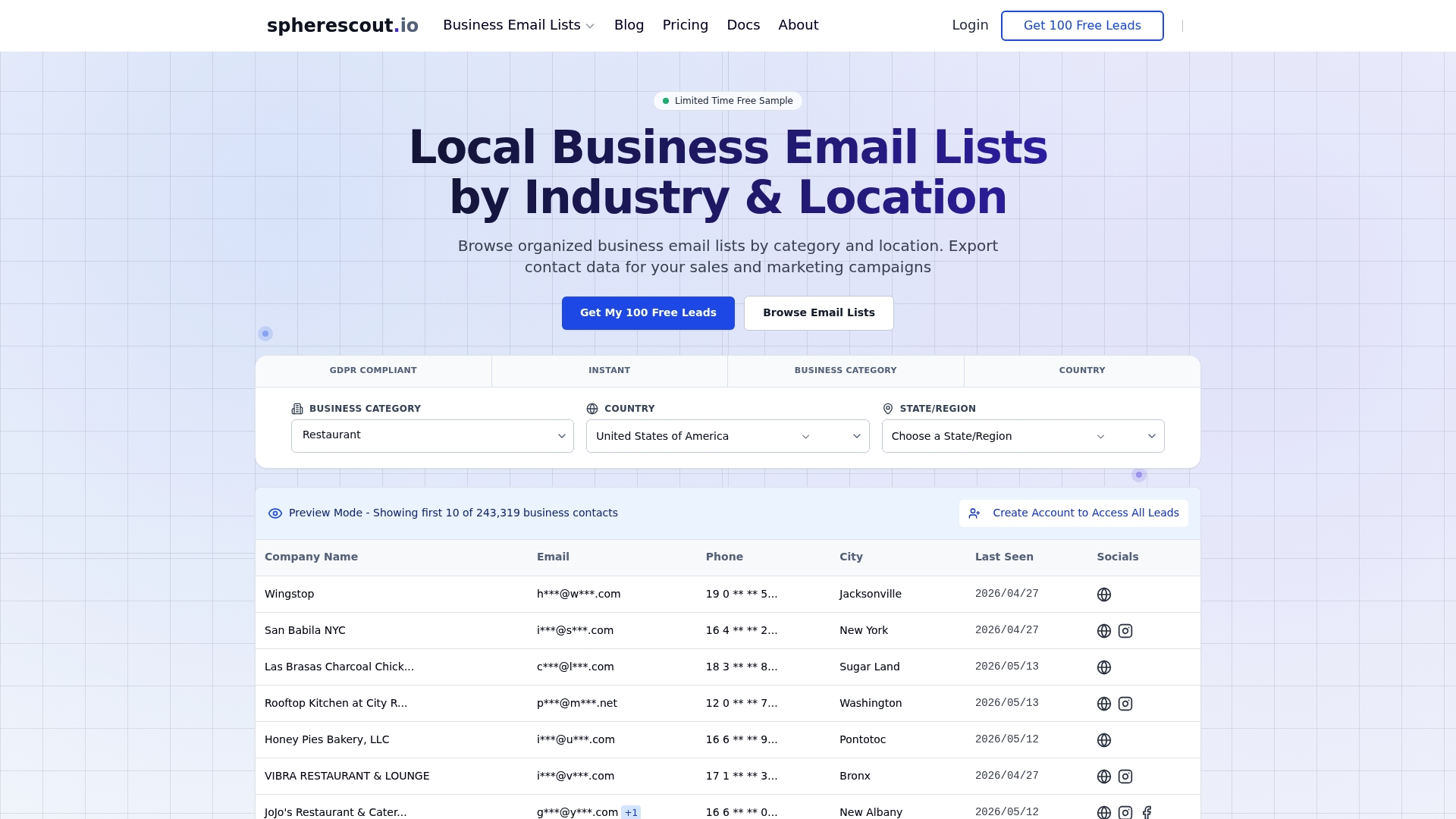
The vendor advertises a database of over 50 million contacts across 20+ countries, available by subscription or one-time purchase. New users can start free with 100 contacts, making quick validation of lists possible before spending.
Core Features
- Instant access to verified business contacts across industries and locations
- Real-time preview of matching contacts so you can inspect lists before export
- One-click CSV export for direct CRM and email marketing imports
- Advanced filters for location, ratings, and social media presence
- Monthly data refreshes to keep prospect lists current and GDPR-compliant
Key Differentiator
SphereScout's standout capability is its focus on local market precision paired with rapid export. The platform combines granular filters by industry and postal code with an immediate preview step so you only export exactly the records you intend to contact.
Pros
- High-volume reach for multi-country campaigns. That database claim above supports continent-spanning local outreach without stitching multiple sources.
- Flexible buying options. You can subscribe monthly or buy one-time lists when needs are intermittent.
- Filters that reduce noise. Location, ratings, and social signals let you target businesses that match campaign criteria.
- Saves cleanup time. Exports arrive ready for CRM import so small teams skip manual normalization.
- 100-contact free trial speeds proof-of-concept tests before committing to a plan.
Cons
- Data still benefits from manual verification before outreach; user feedback often recommends spot-checking records prior to large campaigns.
Who It's For
Sales, Marketing, and Recruiters who run local outbound campaigns and need ready-to-use prospect files. The platform suits teams that want to generate lists fast and push them into CRMs without an analyst on hand.
Unique Value Proposition
Starting free with a usable sample and pairing that with one-click CSV export changes the validation workflow. You can import a trial set into your CRM and run a live test sequence in hours rather than days, trimming the decision cycle for campaign buys.
Real World Use Case
A small sales team builds a list of restaurants in New York using filters for neighborhood and rating, previews the matches, then exports a 2,000-contact CSV. The list imports cleanly into their CRM and a follow-up sequence runs within one business day.
Pricing
Plans start at $49/month for 10,000 contacts on the monthly subscription. The vendor also offers larger volume tiers and one-time list purchases for sporadic campaigns.
Website: https://spherescout.io
Thomson Data
At a Glance
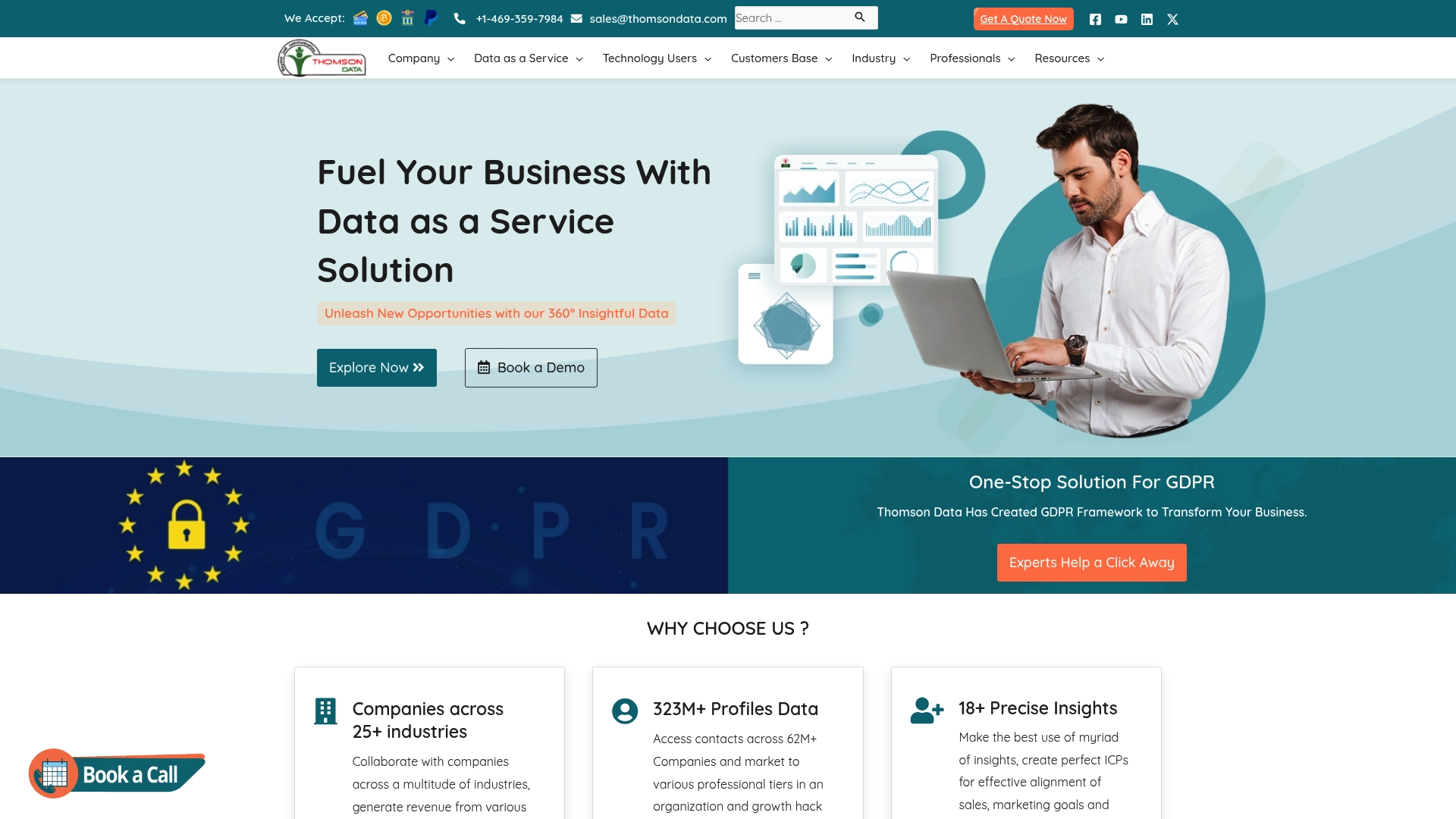
Thomson Data's marketing materials claim data on over 323 million contacts across 62 million companies, a scale aimed at large prospecting lists rather than a single-market sample. That figure signals breadth but does not speak to delivery consistency.
Core Features
- Technographic and healthcare segments for targeted vertical outreach.
- Custom list building with multiple filtering options including industry, role, and firmographics.
- Account profiling that surfaces organization structure and decision-maker details.
- Support for lead generation and market insight reports to shape outreach and messaging.
- A stated process for replacing contacts after hard bounces to keep lists current.
Key Differentiator
Thomson Data leans on two things: deep filtering across technographic and ABM criteria, and a contact replacement policy after hard bounces. That combination suits teams chasing specific tech stacks or buying signals rather than broad city-level lists. Compared to Spherescout, which focuses on local market CSV exports and rapid downloads, Thomson Data targets more granular account and tech-based segmentation.
Pros
- Deliver useful B2B leads and accurate email lists according to users, which helps amplify outbound cadence effectiveness.
- Replacement support for hard bounces reduces list decay and lowers the operational cost of repeated outreach.
- Technographic depth helps you prioritize accounts by stack or tool use rather than by industry alone.
- Custom list building shortens time to a usable prospect file for SDRs and agency teams working on segmented campaigns.
- User feedback frequently highlights strong support and an interface that sales teams adapt to quickly.
Cons
- Multiple user reports indicate deliveries that are far smaller than quoted which can break campaign plans built on promised volume.
- Refund requests are often unresolved in reported cases which raises procurement friction for small buyers.
- Some buyers express concern about the vendor's reliability and legitimacy, prompting additional validation work before sending live outreach.
When It May Not Fit
If you require strict guarantees on delivery volume or have low tolerance for unresolved refunds, Thomson Data is a risky fit. Teams that need single-market, exportable CSVs for hyperlocal outreach may find SphereScout or other local-market providers a better match. Also avoid it when your compliance or vendor vetting process demands transparent third-party audits.
Who It's For
Sales and marketing teams that want technographic signals and ABM-ready lists for targeted outbound campaigns. Good for agencies running segmented plays, and for product teams needing account profiles to refine an ICP. Not ideal if you need guaranteed list volumes or a payback model tied to confirmed deliveries.
Real World Use Case
According to the company, a tech firm sales team used Thomson Data to list CRM users and ran a targeted outreach that increased lead conversions by 15%. In practice this looks like a focused sequence to product managers at companies using a named CRM combined with follow up by an SDR team that already had tailored messaging.
Website: https://thomsondata.com
ZoomInfo

At a Glance
ZoomInfo ships an AI sales agent called Copilot that combines lead prioritization with automated outreach rules, packed alongside real-time intent signals and a large B2B contact database. The vendor advertises customers such as Microsoft, Adobe, and MongoDB.
Core Features
The product bundles a comprehensive contact and company dataset with real-time intent signals for timely outreach and segmentation. It adds automated data enrichment and cleansing to keep CRMs populated and reduces manual lookup work for reps.
A built-in automation layer connects scoring and workflows so leads can be routed and actioned without custom engineering. Chrome extensions and record-level enrichment speed prospect verification at the point of use.
Key Differentiator
ZoomInfo's pitch is an all-in-one AI-powered go-to-market stack that combines contact depth, intent feeds, and workflow automation. That blend aims to let teams discover, qualify, and operationalize signals inside a single system rather than stitching separate tools together.
Pros
- Large depth of contact and company data helps you verify contacts and map buying teams quickly, reducing time spent chasing bad leads.
- Copilot provides automated prioritization so reps see a ranked queue instead of an overflowing list, which improves daily focus.
- Chrome extensions and native enrichment cut copy paste and speed up list building directly from sites and CRMs.
- The platform unifies sales, marketing, and RevOps data into one repository, which can simplify reporting and campaign handoffs.
- The vendor's materials include customer reports of tangible pipeline growth and higher conversation rates after adoption.
Cons
- Data accuracy issues appear frequently in user feedback, with outdated or incorrect contact details reported across large datasets.
- Pricing is high and frequently described as complex, which can make budgeting and ROI calculations difficult for smaller teams.
- The user experience can be uneven; some users report broken features and slow resolution of privacy or support requests.
- Several customers question the value for money when the platform requires heavy tuning or supplemental tools to meet specific use cases.
When It May Not Fit
If you run a small sales team with tight budgets, the platform's high cost and licensing complexity will likely be a poor match. If you need near-perfect contact accuracy out of the box, ZoomInfo's documented data quality gaps will frustrate you.
Also avoid it when you require white glove support for onboarding; reports of slow account management responses suggest slower service for lower-tier customers.
Who It's For
Mid-size to large B2B sales, marketing, and RevOps teams that need deep contact coverage, intent signals, and automation in one place. Best for organizations prepared to invest in configuration and ongoing data hygiene to realize platform value.
Real World Use Case
A sales team uses ZoomInfo to find verified contacts for a targeted vertical, applies Copilot scoring to rank prospects, and triggers enrichment plus outreach sequences. According to the company, customers report measurable pipeline gains and faster deal progression after deployment.
Pricing
Pricing is positioned at the higher end and often described as complex. Expect license tiers, add-ons for advanced features, and enterprise negotiations rather than straightforward per-seat sticker prices, which can complicate procurement for smaller buyers.
Website: https://zoominfo.com
Comparing SphereScout to Its Competitors
Selecting a reliable business contact list provider entails evaluating key factors such as database scale, segmentation flexibility, data quality, and cost-efficiency. SphereScout, Thomson Data, and ZoomInfo each address these aspects with differing strengths and target audiences.
Data Focus and Target Market Precision
SphereScout emphasizes finely-tuned contact targeting. Its feature set allows users to filter by parameters like location and social signals, offering tailored local outreach which is particularly useful for businesses aiming for targeted campaigns at the community or regional level. Thomson Data, meanwhile, targets broader account lists and excels in technographic segmentation, catering to businesses focused on specific technologies or industries. ZoomInfo integrates intent signals and AI-powered scoring, better suiting organizations that require deeper insights into potential customer readiness across industries.
Scalability and Operational Versatility
ZoomInfo boasts a large-scale contact database, advanced reporting capabilities, and integration across entire operational stacks, aligning with larger enterprises focused on middle to end-cycle efficiencies. Thomson Data contributes by allowing account profiling and leads customization, making it quite flexible, albeit less instantly ready than SphereScout's one-click exports. SphereScout shines in providing usable samples upfront, letting smaller teams test before committing resources.
Best Fit For Different Needs:
- SphereScout is ideal for organizations focused on highly localized campaigns and relying on immediate list integrations with CRMs and automation tools.
- Thomson Data suits teams focusing on segmented campaigns needing in-depth account profiling and technographic insights.
- ZoomInfo appeals to mid-to-large scale teams leveraging multi-faceted insights, lead scoring, and operational automation for outbound strategies with a higher budget ceiling.
Our Pick
SphereScout stands out for small to medium sales and marketing teams focusing on quick deployment of locally-focused campaigns. Its unique usability and targeted filtering allow rapid transitions from list generation to outreach enablement. However, businesses requiring extensive technographic filtering or AI-assisted decision support might find Thomson Data and ZoomInfo, respectively, more aligned to their needs.
Business Contact Lists Comparison
Evaluate and choose the most suitable business contact list provider for your specific needs with this side-by-side comparison.
| Provider | Key Differentiator | Best For | Pricing | Notable Limitation |
|---|---|---|---|---|
| SphereScout | Precision local market filtering and one-click CSV export | Sales and Marketing Teams | Starts at $49/month | Requires manual verification for large-scale outreach |
| Thomson Data | ABM-focused technographic and healthcare targeting | Large-scale segmented campaigns | Not disclosed | Reports of incomplete deliveries disrupt campaign planning |
| ZoomInfo | AI-powered go-to-market stack with Copilot automation | Medium to large B2B teams | High, complex pricing | High cost and data accuracy requirements frustrate users |
Discover a Strong Alternative to bluemailmedia.com with SphereScout
When searching for reliable bluemailmedia.com alternatives in 2026, one key challenge is finding a platform that delivers accurate, localized business contact lists ready for immediate use. SphereScout addresses this pain point by providing over 30 million verified B2B contacts across industries and geographic locations with fast CSV exports crafted for smooth CRM integration. Its real-time preview feature lets you verify your prospect lists before download, reducing guesswork and wasted effort.
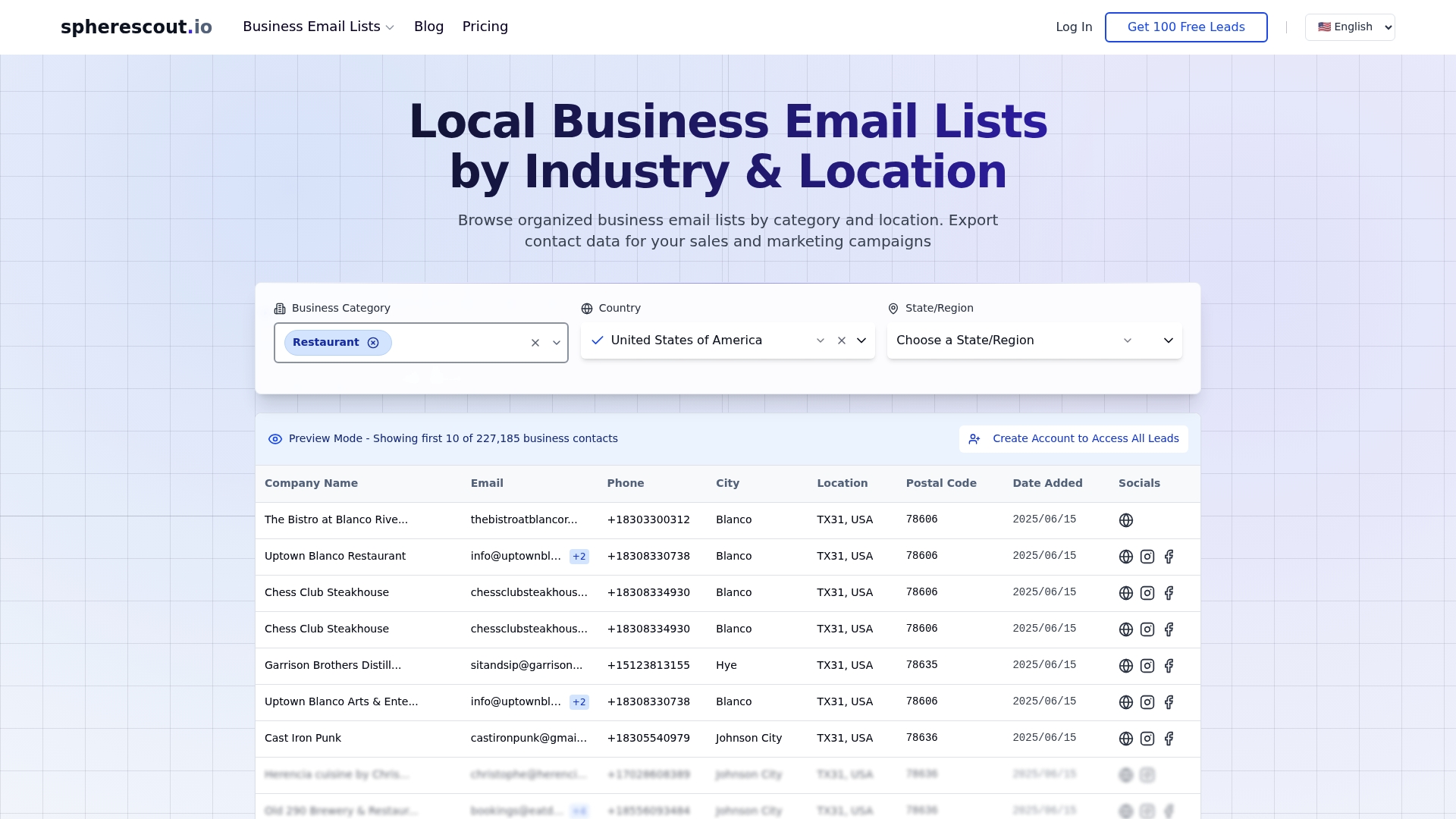
Explore how SphereScout.io empowers sales and marketing teams to target businesses by industry, city, or postal code with tailored contacts designed for rapid outreach. Don’t let list quality slow your next campaign. Visit SphereScout to try a free sample and import your CSV list for a tested, actionable outbound sequence in under an hour.
Frequently Asked Questions
How does Spherescout’s database size compare to its alternatives?
Spherescout offers access to over 50 million contacts across 20+ countries, which supports high-volume outreach. This expansive database is a core feature that ensures you can run continent-spanning local campaigns effectively. New users can quickly validate lists using a free trial of 100 contacts before committing to a subscription.
What is the difference between Spherescout and Thomson Data for targeted email campaigns?
Thomson Data excels in providing deep filtering options for technographics and healthcare segments, making it ideal for teams requiring targeted vertical outreach. In contrast, Spherescout offers superior capabilities for quick exports and local market precision, allowing teams to generate lists rapidly and push them into CRMs without extensive cleanup.
Which platform allows for real-time preview of matching contacts before export?
Spherescout enables users to preview matching contacts in real-time before exporting them. This unique feature allows validation of lists, ensuring that only relevant records are exported for campaigns, thus streamlining the outreach process for users.
Can I expect manual verification support when using Spherescout for large campaigns?
While Spherescout provides a solid database, user feedback indicates it still benefits from manual verification of records prior to outreach for larger campaigns. Therefore, it's wise to spot-check contacts to maintain list quality, even with the streamlined features offered.
What makes Spherescout’s pricing structure stand out?
Spherescout's pricing starts at $49/month for access to 10,000 contacts, offering flexibility for either monthly subscriptions or one-time purchases. This makes it a viable option for teams looking to adjust their spending based on outreach needs, especially with the ability to start with a free trial to test the service.