

Incomplete, messy prospect lists are one of the most overlooked reasons B2B outreach campaigns underperform. You invest in email sequences, personalized messaging, and solid sales collateral, then watch reply rates flatline because the underlying contact data is stale, duplicated, or simply wrong. B2B list aggregation is the practice that fixes this at the source. It combines contact records from multiple data sources into one organized, actionable list. Done right, it expands your reach, sharpens targeting, and feeds your CRM with leads worth pursuing. This guide walks you through every stage, from core definitions to enrichment tactics and ongoing hygiene best practices.
- The B2B list aggregation process: steps and best practices
- Deduplication, normalization, and why field-level decisions matter
- List hygiene: keeping your aggregated list accurate and compliant
- Why automation isn't a silver bullet: the real work behind world-class B2B lists
- Take your B2B list-building further with SphereScout
- Frequently asked questions
Key Takeaways
| Point | Details |
|---|---|
| Aggregation defined | Combining contacts from multiple sources provides the base for quality outreach lists. |
| Process steps | Effective aggregation follows sourcing, normalization, deduplication, enrichment, and suppression. |
| Field-level rules matter | Deduplication and enrichment decisions at the field level can dramatically improve data quality. |
| Ongoing hygiene | List accuracy depends on regular cleaning, verification, and compliance—not a one-time fix. |
| Automation limits | The best results come from blending tools with human oversight and repeatable processes. |
What is B2B list aggregation?
B2B list aggregation is the process of pulling contact and company data from multiple sources and merging it into a single, centralized lead list. Instead of relying on one database or one export from your CRM, you layer sources on top of each other to maximize coverage and contact completeness.
The goal is straightforward: more complete records, wider reach, and better targeting. Here's what that typically looks like in practice:
- Subscription databases: Licensing access to large B2B data vendors that compile company and contact records at scale.
- CRM exports: Pulling historical contact records your team already owns, often with behavioral data attached.
- Web scraping: Programmatically extracting publicly available business contact details from directories, LinkedIn, and company websites.
- Event attendee lists: Conference registrations and webinar sign-ups that represent high-intent prospects.
- Partner referrals: Shared contact lists from strategic partners operating in adjacent markets.
Each source brings something different. A subscription database might cover breadth, while a conference attendee list brings intent signals. Combining them is where the value multiplies.
Raw aggregation is just the starting point. The real ROI comes from what you do with the data after combining it.
Once you understand the B2B lead categories most relevant to your market, it becomes easier to prioritize which sources to pull from and how to weight them. Not every data source belongs in every list, and understanding your ICP (Ideal Customer Profile) makes that filtering much cleaner.
One critical concept to understand early: according to field-level normalization and enrichment methods like waterfall enrichment, aggregated lists require additional processing to fill missing contact fields after the initial merge. Aggregation is the foundation. Quality processing is what turns that foundation into a working asset.
The B2B list aggregation process: steps and best practices
Understanding what aggregation is only gets you so far. The real skill is in executing it systematically. Here's how a well-structured aggregation workflow looks step by step.
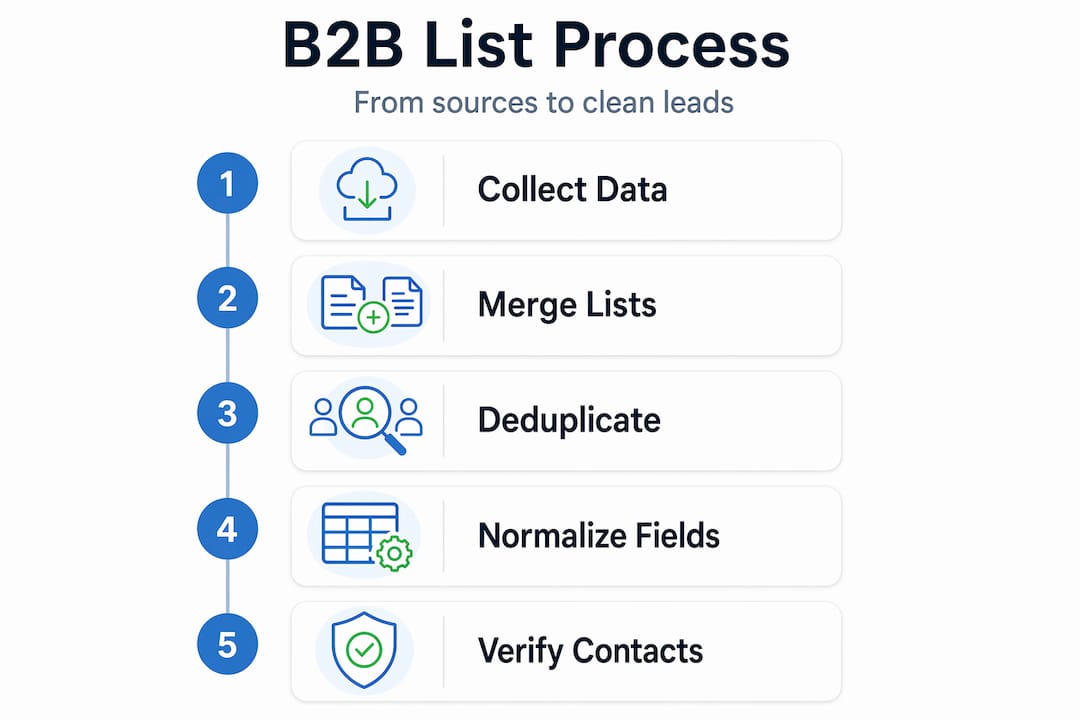
1. Source multiple lists. Pull from at least two or three distinct sources. The more varied the origin, the better your coverage. Avoid relying on a single vendor. Single-source lists plateau quickly in terms of contact completeness.
2. Normalize fields. This is where most teams cut corners. Normalizing means making sure "VP of Sales," "Vice President, Sales," and "VP Sales" all map to the same field value in your CRM. The same logic applies to company names, phone number formats, and geographic fields. Without this step, your automation tools will treat the same contact as three separate records.
3. Deduplicate by explicit rules. Once fields are standardized, run deduplication. Set clear rules for which record wins: the one with the most populated fields, the most recently updated, or the one with a verified business email. Skipping this step leads to reps calling the same contact multiple times from different list segments.
4. Enrich missing data using waterfall methods. Waterfall enrichment means querying multiple data providers in sequence for each missing field and accepting the first verified result. This approach routinely achieves higher match rates than pulling from a single enrichment source. Practical list-building for B2B outreach confirms that verification and deduplication are not optional steps, they are the difference between a working list and a liability.
5. Run compliance and suppression routines. Before any outreach, filter out opted-out contacts, people on your do-not-contact list, and records that fail verification. This protects your sender reputation and keeps you on the right side of data privacy regulations.
6. Treat it as a system, not a project. Ongoing cleaning and refresh are non-negotiable because contact data decays faster than most teams realize. People change jobs, companies get acquired, and phone numbers go dark. A one-time aggregation effort will degrade in accuracy within months.
Pro Tip: Assign ownership of list quality to a specific role or team member. When no one owns it, everyone assumes someone else is maintaining it, and the list quietly rots.
Here's a quick comparison of the two most common approaches to building B2B prospect lists:
| Approach | Speed | Data quality | Maintenance burden | Best for |
|---|---|---|---|---|
| Single-source database | Fast | Moderate | Low | Quick campaigns |
| Multi-source aggregation | Slower initially | High | Medium to high | Long-term pipeline |
| Enriched aggregation | Moderate | Very high | High | Account-based programs |
The table makes the tradeoff clear. Aggregation takes more upfront work, but it produces lists that actually perform. For teams running high-volume outbound or ABM programs, it's the only approach that scales without constant list rebuilds.
You should also integrate list verification best practices into your step-by-step process from the beginning, not as an afterthought. And for email-heavy campaigns, pairing aggregation with B2B email verification tools at step four will dramatically reduce bounce rates before you send a single message.
Deduplication, normalization, and why field-level decisions matter
Simply merging lists creates a new problem: overlapping records that corrupt your CRM and inflate your contact counts without adding real coverage. Let's get specific about how to handle this well.

When two sources both contain a record for "Sarah Chen, Director of Marketing, Acme Corp," but one has her direct phone and the other has her LinkedIn URL, you don't want two rows. You want one clean, complete record. That's what deduplication and field-level merging accomplish.
Here are the most practical master record rules B2B teams use:
- Most fields populated: Keep the record with the highest number of non-empty fields. Simple and often effective.
- Most recent update: Prefer the record updated or verified most recently. Useful when data freshness is critical.
- Verified business email priority: If one record has a verified business email and the other has a personal Gmail, the business email version becomes the master.
- Source hierarchy: Assign a trust score to each source. Records from a premium verified database might outrank records scraped from a public directory.
Duplicates and conflicting attributes are expected when sources overlap. The teams that struggle are those who never define these rules explicitly and end up resolving conflicts manually, contact by contact.
Normalization is equally important. Consider job titles. A single role might appear as "CMO," "Chief Marketing Officer," "Head of Marketing," "VP Marketing," and a dozen other variations. If your segmentation logic targets "VP level and above," inconsistent titles will cause you to miss or incorrectly include contacts. Normalizing these fields before you run any filters is what makes your segmentation actually work.
Pro Tip: Build a normalization dictionary before you run your first merge. Document how every variation of a job title, company size band, or industry label maps to a standard value in your CRM. This saves hours of manual cleanup later.
The payoff for doing this well is significant. According to waterfall enrichment data, field-level enrichment via multiple providers can deliver over 90% match rates for complete records, compared to 50 to 62% when relying on a single source. That gap in match rate translates directly to more contacts you can actually reach.
Investing time in verifying contact data at the field level also improves your deliverability scores, reduces spam complaints, and keeps your outreach sequences from burning through bad emails on the first touch.
List hygiene: keeping your aggregated list accurate and compliant
Building a great aggregated list is not a one-time achievement. The moment you finish, the clock starts on its accuracy. Industry estimates suggest that B2B contact data decays at rates exceeding 20% annually, meaning one in five records becomes outdated within a year. For fast-moving industries, it's even faster.
Here's how to build a hygiene routine that keeps pace:
1. Verify regularly. Run email and phone verification tools on a scheduled basis. Quarterly is a reasonable cadence for most teams. Remove hard bounces and invalid contacts immediately after each verification pass.
2. Scan for new duplicates. As your team adds records from new campaigns or CRM imports, new duplicates will appear. Monthly deduplication scans catch these before they become a volume problem.
3. Maintain an active suppression list. Your suppression list should include opted-out contacts, unsubscribes, active customers (if you're doing prospecting outreach), and anyone marked as do-not-contact. Sync this list across your CRM, email platform, and any outreach tools you use.
4. Refresh records proactively. When you notice a spike in bounces or low reply rates in a specific segment, that's often a signal that the underlying data is stale. Trigger a targeted refresh rather than waiting for a scheduled cycle.
5. Stay compliant with privacy regulations. This includes managing consent data, honoring unsubscribe requests promptly, and documenting your data handling processes. Violations are expensive, and the reputational damage is worse.
List hygiene guidance consistently highlights that verification, deduplication, and suppression management are the three pillars of a compliant and effective list. Skipping any one of them creates gaps that compound over time.
The broader point that ongoing cleaning and refresh makes clear is that list building is a system, not a sprint. Teams that treat it as a recurring process consistently outperform those chasing one-time list buys.
Pair your hygiene routine with solid cold emailing best practices to get the most out of every verified contact, and use list segmentation strategies to route clean records into the right sequences based on firmographic fit.
Why automation isn't a silver bullet: the real work behind world-class B2B lists
Here's a perspective that doesn't get shared often enough: the best aggregation tools and data vendors in the market still can't replace your team's explicit decisions about data rules.
We've seen this play out repeatedly. A sales team buys access to a large B2B database, exports thousands of records, and launches a sequence expecting results. The bounce rates are high, reps complain about bad phone numbers, and leadership wonders why the investment didn't pay off. The platform wasn't the problem. The missing piece was process.
Top-performing outbound teams do something different. They treat list quality as an ongoing operational discipline, not a vendor's responsibility. They define their master record rules in writing. They schedule hygiene cycles before they feel necessary. They layer enrichment sources rather than trusting one provider to have everything.
The uncomfortable truth is that duplicates and conflicting attributes are a structural reality of any multi-source aggregation effort. Every tool that promises "clean data" still delivers records that need human-defined rules to resolve. No algorithm knows which contact field your business values most. That decision belongs to you.
The teams that get outsized ROI from list aggregation are those that build a repeatable quality assurance cycle: collect, clean, enrich, suppress, verify, and repeat. Automation accelerates each step. But the intelligence behind which records to keep, how to merge conflicts, and when to purge segments? That comes from deliberate process design.
The efficiency gains are real when you invest in efficient list export workflows that connect your cleaned lists directly to CRM and outreach platforms. But those gains only materialize if the underlying data has been processed with care. Garbage in, garbage out still applies, no matter how sophisticated the tool.
Take your B2B list-building further with SphereScout
If you've made it this far, you know that building a reliable B2B list takes more than downloading a spreadsheet. It takes structured sourcing, smart deduplication, and a commitment to ongoing hygiene.
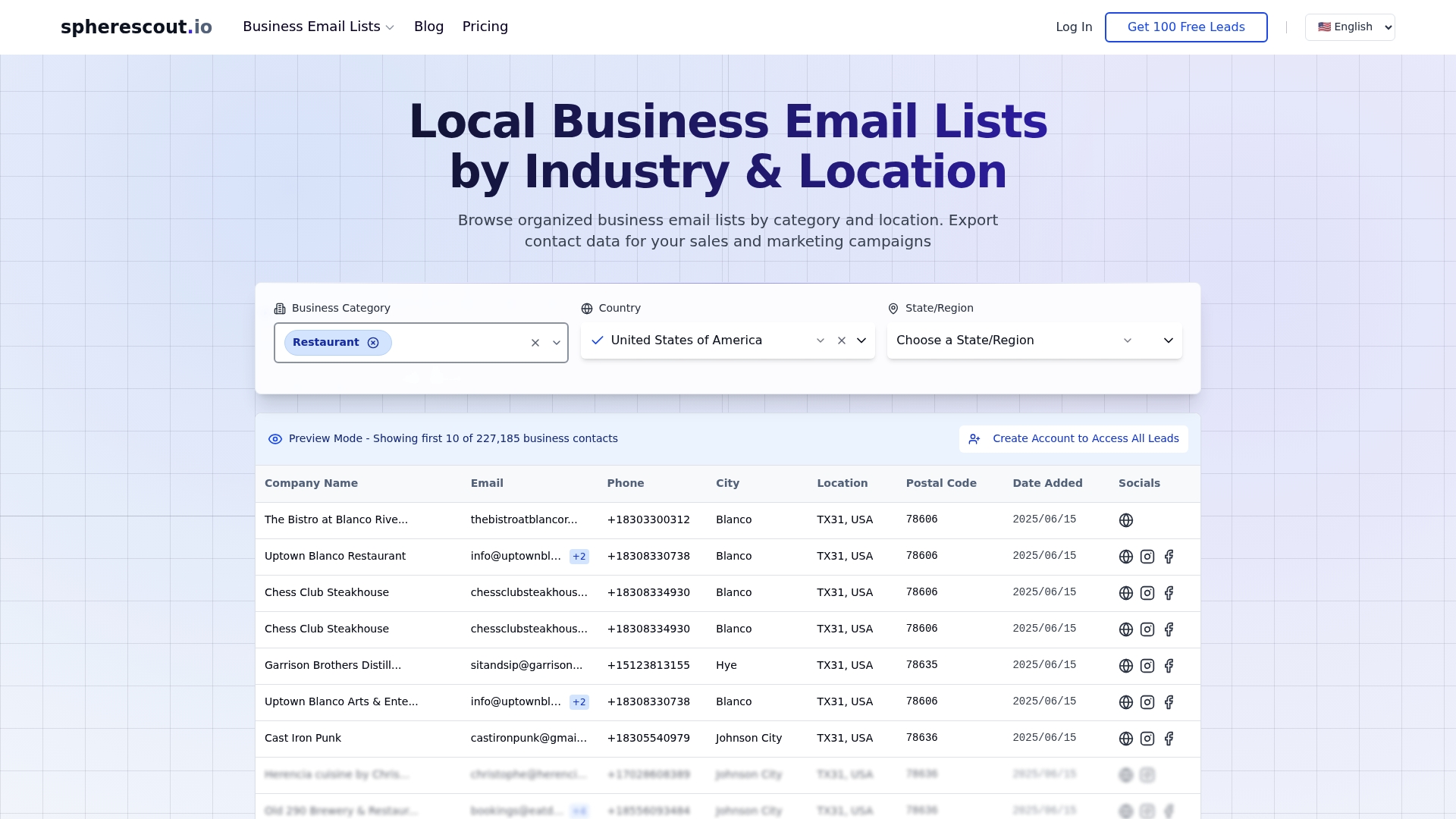
SphereScout is built for exactly this kind of work. With access to over 30 million verified business contacts, you can filter by industry, city, postal code, or category and export a ready-to-use CSV in minutes. Whether you're sourcing B2B email lists by industry or looking for full-funnel lead generation solutions, SphereScout gives you organized, actionable data that skips the manual aggregation grind. Try a free sample list to see the data quality for yourself, then scale up when you're ready to run.
Frequently asked questions
What is B2B list aggregation in simple terms?
It's the process of pulling contact details from multiple sources to create one combined and organized prospect list. According to contact accuracy research, combining sources is the foundation for building lead lists that are both broad in coverage and high in data completeness.
How does deduplication work in aggregated B2B lists?
Deduplication identifies repeated contacts and keeps only the version with preferred or most complete information, according to set rules. Deduplication best practices recommend defining a "master item rule" upfront, such as keeping the most complete record or the most recently updated one, to make the process consistent and scalable.
Why is ongoing list maintenance important?
Contact data decays and changes over time, so regular cleaning and updating keeps your list accurate and compliant. Industry guidance consistently frames list building as a repeatable system with scheduled refresh cycles rather than a one-time aggregation project.
What is waterfall enrichment in list aggregation?
Waterfall enrichment fills missing fields by checking several data providers in sequence, using the first verified result for each field. Research on this method shows it can achieve 90%+ match rates for complete contact records compared to the 50 to 62% typical of single-source enrichment.
Recommended
- Boost lead generation with effective business list segmentation | spherescout.io Blog
- Business list categories: unlock smarter B2B leads | spherescout.io Blog
- B2B Email Marketing Process for Lead Generation Success | spherescout.io Blog
- Email marketing strategies that drive real B2B results | spherescout.io Blog