

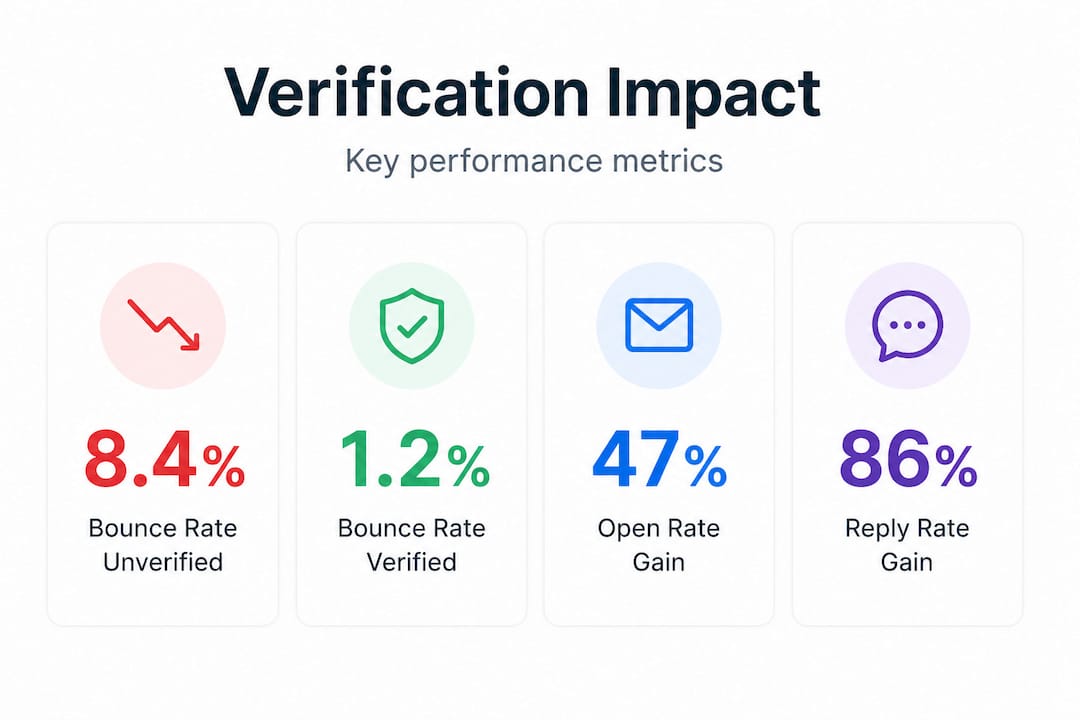
Your cold email campaign just launched. Open rates are dismal. Replies are nearly nonexistent. And your sending domain just got flagged. Sound familiar? The culprit is almost always the same: an unverified email list packed with stale, inaccurate, or invalid contacts. Bounce rate data shows that verification alone reduces bounce rates by 85% on average, lifting inbox placement by 49%, open rates by 47%, and reply rates by 86%. Those aren't incremental improvements. They're campaign-transforming results. This article breaks down the evidence, explains the mechanics, and gives you a practical roadmap for making list verification a core part of your B2B outreach strategy.
- Metrics that matter: Evidence behind verified list performance
- Quality vs. quantity: Why smaller, cleaner lists win
- Practical steps: How to verify and maintain your email list
- Why most B2B marketers still get list verification wrong
- Upgrade your outreach with verified B2B email lists
- Frequently asked questions
Key Takeaways
| Point | Details |
|---|---|
| Verification boosts deliverability | Cleaning your list reduces bounce rates and increases inbox placement dramatically. |
| Quality outperforms size | Verified smaller lists drive higher engagement and campaign ROI than larger unverified data sets. |
| Protects sender reputation | Routine verification prevents reputation decay and ensures consistent campaign success. |
| Compounds ROI over time | Frequent verification saves costs and improves pipeline growth for B2B marketers. |
| Actionable verification steps | Adopt regular list hygiene practices for sustained benefits and outreach accuracy. |
Email list verification: The foundation for effective outreach
Email list verification is the process of checking whether the email addresses on your list are valid, active, and deliverable before you send a single message. At a technical level, verification tools check for formatting errors, validate domain records, ping mail servers, and flag addresses that are likely to bounce or generate spam complaints.
This isn't just a technical cleanup task. It's the difference between your outreach landing in the inbox or disappearing into the void.
Here's what the process typically catches:
- Invalid addresses: Typos, formatting errors, or addresses that simply don't exist
- Disposable emails: Temporary inboxes created just to sign up for something
- Role-based addresses: Generic inboxes like info@ or support@ that rarely convert
- Catch-all domains: Servers that accept all mail, making it impossible to confirm validity without additional checks
- Hard bounce addresses: Contacts with no active inbox at the listed address
When you remove these from your list, the contacts that remain are significantly more likely to receive, open, and respond to your messages. It's not magic. It's just math. You're sending to people who can actually receive mail.
The B2B lead generation insights community has been pushing this message for years, but adoption remains inconsistent. Many teams still treat list-building as a volume game, adding thousands of contacts without ever checking whether those contacts are reachable.
Pro Tip: Think of verification as a filter built into your growth pipeline. Every unverified contact you remove doesn't reduce your opportunity. It increases your signal-to-noise ratio and lets your real prospects stand out.
The bounce rate impact of skipping verification is stark: average bounce rates on unverified lists sit around 8.4%. After verification, that figure drops to 1.2%. That's not just a cleaner list. That's a fundamentally different deliverability baseline that compounds across every campaign you run.

Metrics that matter: Evidence behind verified list performance
Numbers tell the real story here. Let's put the core metrics side by side so you can see what verification actually changes in practice.
| Metric | Unverified list | Verified list | Improvement |
|---|---|---|---|
| Bounce rate | 8.4% | 1.2% | 85% reduction |
| Inbox placement | Baseline | +49% | Significant uplift |
| Open rate | Baseline | +47% | Nearly double |
| Reply rate | Baseline | +86% | Almost doubled |
These aren't cherry-picked results from one campaign. They reflect consistent patterns observed across cold email campaigns at scale.
Now let's talk about the ROI side of the equation, because this is where the argument becomes genuinely hard to ignore.
📊 Statistical callout: Verification generates a documented 29:1 ROI when you factor in reduced bounce costs, preserved sender reputation, improved pipeline velocity from higher reply rates, and avoided compliance penalties.
Here's how those outcomes chain together:
1. Fewer bounces mean better sender reputation. Email service providers monitor your bounce rate closely. A spike in hard bounces signals low-quality practices and can trigger deliverability throttling or blacklisting.
2. Better reputation means higher inbox placement. Once your sender score improves, more of your emails reach the primary inbox rather than spam or promotions folders.
3. Higher inbox placement means more opens. Contacts can't open what they never see. Placement directly drives open rate.
4. More opens lead to more replies. Especially in cold outreach, reply rate tracks closely with the quality of targeting and the baseline of deliverability.
5. More replies mean more pipeline. And more pipeline means revenue.
Each step amplifies the one before it. That's the compounding effect of starting with a verified list. And if you're looking to buy business email database contacts to fuel your outreach, the quality of that data at the point of acquisition matters enormously to how far down this chain you can get.
What often goes unmeasured is the cost of not verifying. Over a 90-day window, inbox placement drops 15 to 22% for senders using unverified lists. That's a slow erosion that most teams don't even notice until it's already serious.
Quality vs. quantity: Why smaller, cleaner lists win
There's a persistent myth in B2B marketing that a bigger list is always a better list. More contacts equal more opportunity, right? In practice, the opposite is frequently true.
Large, unverified lists create multiple problems simultaneously. They inflate your bounce rate, damage your sending reputation, and generate spam complaints from contacts who never wanted to hear from you. They also create a false sense of scale. A list of 100,000 unverified contacts that delivers to 60% of inboxes is significantly less valuable than 20,000 verified contacts with 95%+ deliverability.
"Smaller verified lists outperform large unverified ones due to better deliverability and engagement. Quality hygiene is not just about compliance. It's a growth filter." B2B marketing practitioners consistently emphasize this point when comparing campaign performance at scale.
The benefits of prioritizing quality are concrete:
- Lower spam complaint rates: Verified contacts are real people who exist at those addresses, reducing the chance of hitting spam traps
- Higher engagement per contact: Validated addresses belong to active users, not dormant or abandoned accounts
- Better CRM data integrity: Clean lists feed accurate data into your sales tools, improving segmentation and follow-up timing
- Reduced sending costs: Most email platforms charge by volume. Cutting invalid contacts directly reduces your monthly spend
- Stronger account protection: Repeated high-bounce campaigns risk suspension from your email service provider
If you're working with USA business email lists, you'll notice that the value of a well-targeted, verified set of 5,000 contacts in a specific industry vertical often outperforms a generic list of 50,000 mixed contacts. The precision of targeting combined with verified deliverability creates a compounding advantage that quantity alone can't replicate.
This is especially true in B2B, where your outreach is typically going to decision-makers with limited patience for irrelevant email. One bad send to a VP who wasn't expecting to hear from you can generate a spam complaint that hurts your deliverability for everyone else on the list.
Practical steps: How to verify and maintain your email list
With the case for quality firmly established, here's a practical playbook for building verification into your outreach workflow.
Step 1: Audit your existing list
Before you run any verification tool, segment your list by age and source. Contacts older than six months carry significantly higher risk of being stale. Contacts from low-quality sources, like scraped directories or purchased lists without quality controls, should be prioritized for verification.
Step 2: Run a bulk verification pass
Use a reputable verification tool to check every address for syntax errors, domain validity, and mailbox existence. Most tools return a status for each address: valid, invalid, catch-all, or risky. Remove or quarantine anything flagged as invalid or high-risk before sending.
Step 3: Segment by risk level
Don't treat all verified addresses the same. Valid addresses can go into your primary send. Catch-all addresses warrant a separate, lower-frequency sequence. Risky addresses are best excluded from cold outreach entirely.
Step 4: Set up ongoing suppression hygiene
Every campaign generates data. Hard bounces must be removed immediately. Soft bounces should be watched across two to three sends before suppression. Unsubscribes need to be honored in real time for both compliance and reputation reasons.
Step 5: Schedule periodic re-verification
Even verified lists decay. People change jobs, abandon email addresses, and company domains shift. A list that was clean six months ago may have a 5 to 10% decay rate by the time you use it again.
Pro Tip: Build a quarterly verification cycle into your campaign calendar. Treat it like a routine maintenance event, not a reactive fix. If you manage local business email lists across multiple regions, stagger verification by geography so you're always working with fresh data in whichever market you're targeting next.
Pitfalls to avoid:
- Skipping verification on newly purchased lists: Even fresh data can contain errors. Always verify before your first send.
- Ignoring catch-all domains: These addresses may or may not be valid. Sending to large volumes of them without testing inflates your apparent bounce risk.
- Treating verification as a one-time event: The B2B lead generation blog community consistently reports that teams who verify once and never revisit see reputation decay within two to three campaign cycles.
- Overlooking compliance requirements: Laws like CAN-SPAM and GDPR have specific expectations around contact consent and suppression. Verification is one piece of that broader compliance picture.
The financial case for staying on top of this is clear. Every 90 days of running unverified campaigns costs you 15 to 22% inbox placement. That compounds into real revenue impact over a year.
Why most B2B marketers still get list verification wrong
Here's the candid take: most B2B teams know verification matters. They just don't prioritize it consistently. And the reason is almost always organizational, not technical.
List quantity is easy to measure. You can look at a spreadsheet and say "we have 80,000 contacts." That number feels like progress. Deliverability health is harder to see. It doesn't show up in a single dashboard field. It lives in trends, in sender reputation scores, and in the slow decay of open rates that teams often attribute to bad copy rather than bad list hygiene.
The second issue is timing. Verification feels like overhead before a campaign. Teams are under pressure to launch, and running a verification pass adds a day or two to the process. So it gets skipped. And then skipped again. And three campaigns later, your domain is flagged and you're scrambling to understand why.
The smarter framing is this: list verification is not a pre-send task. It's an ongoing asset-building discipline. The teams that get the most out of their targeted business email lists treat verification the same way they treat data enrichment or CRM hygiene. It's a continuous process that runs in parallel with outreach, not something you bolt on before hitting send.
There's also a hidden cost conversation that most teams never have. When a campaign underperforms, the instinct is to question messaging, offer, or timing. Rarely does the post-mortem point squarely at list quality. But in our experience, poor deliverability driven by bad data is responsible for a substantial portion of underperforming campaigns. The signal was there. The list just wasn't clean enough to let it through.
The fix isn't complicated. It's consistent. Build verification into your process before you need it, not after your domain takes a hit.
Upgrade your outreach with verified B2B email lists
If you've been running campaigns on unverified data, the evidence is clear: you're leaving open rates, reply rates, and pipeline on the table. SphereScout is built to help you fix that, starting with the quality of the contacts you're working with.
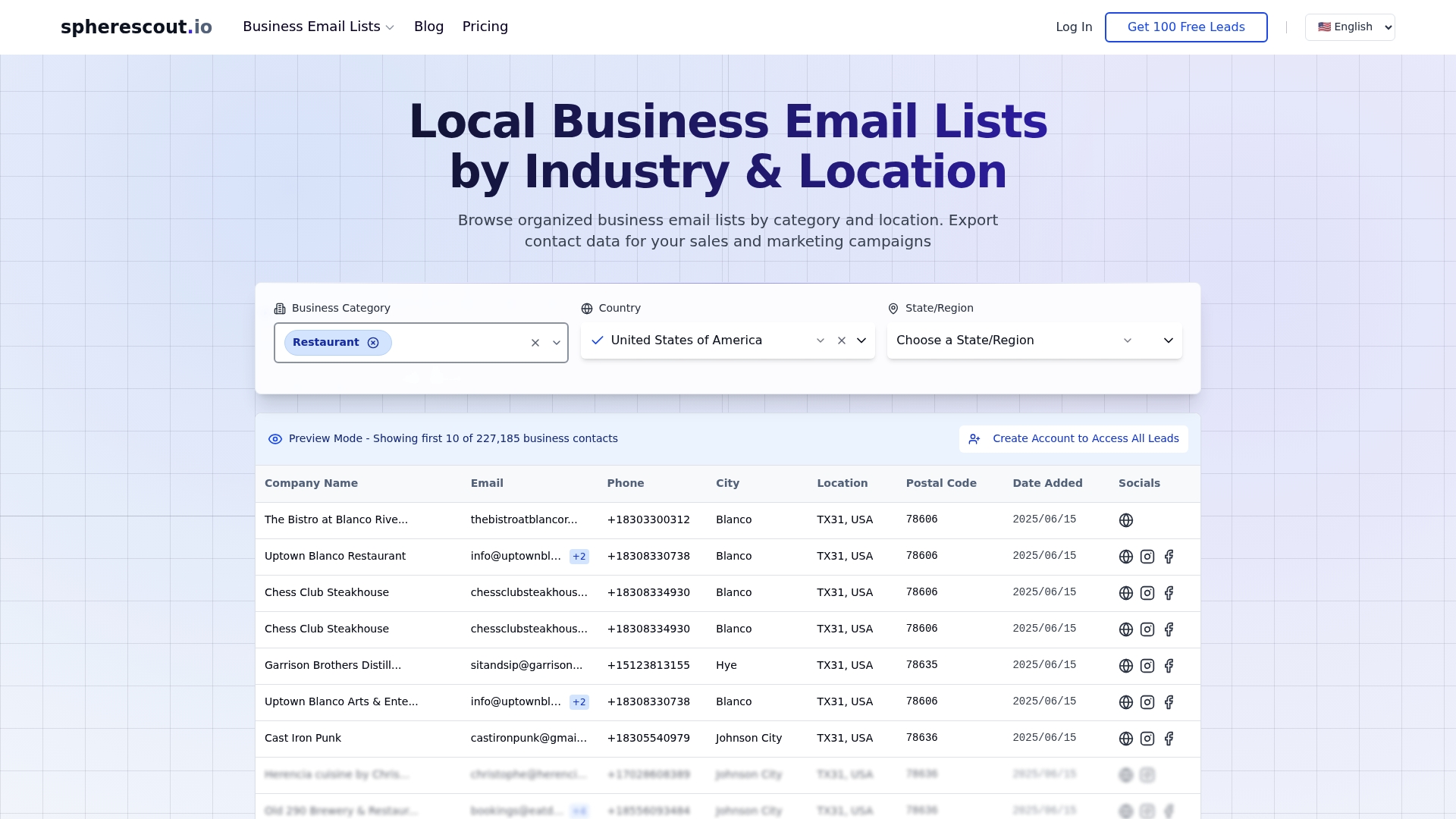
SphereScout gives B2B sales and marketing teams access to industry-specific email lists that are organized, filterable by industry, city, or postal code, and ready to export as CSV files for CRM integration. With over 30 million contacts across industries and geographies, you can build a targeted, precise prospect list without the cleanup burden of scraping raw data yourself. Explore instant B2B email lists or check out the full range of lead generation solutions to find the outreach approach that fits your pipeline goals. Start with a free sample and see the quality difference firsthand.
Frequently asked questions
How often should I verify my email list?
Best practice is to verify your list at least quarterly or before each major campaign, since inbox placement drops 15 to 22% over 90 days with unverified lists in active use.
Does verification really improve open and reply rates?
Yes. Verified lists produce open rate gains of 47% and reply rate improvements of 86% compared to unverified lists in cold email campaigns.
Are smaller verified lists actually better than bigger ones?
Consistently, yes. Smaller verified lists outperform larger unverified ones because higher deliverability and engagement rates drive better outcomes per contact.
What happens if I use unverified email lists in B2B campaigns?
You'll see elevated bounce rates, gradual sender reputation decay, and lower inbox placement, all of which reduce campaign effectiveness and can lead to domain blacklisting over time.
Recommended
- Buy Email Database | Instant B2B Email Lists & Contacts
- Local Business Email Lists by Industry & Location | SphereScout
- Local Business Email Lists by Industry & Location | SphereScout
- Local Business Email Lists by Industry & Location | SphereScout
- Master B2B email marketing process for manufacturers
- cold email lead generation
- email marketing vs cold email
- B2B email marketing process