

Running a bigger contact list rarely translates to more closed deals. Many sales teams still operate on the assumption that volume solves everything, flooding reps with names that were never a realistic fit. The reality is that ABM strategy research shows account creation provides organized databases for multi-stakeholder mapping, personalized outreach, and signal sharing between sales and marketing, effectively reversing the spray-and-pray approach in favor of quality over volume. This article covers the mechanics of effective account creation, the business impact it delivers, common pitfalls to avoid, and practical steps you can take starting today.
- The mechanics: How effective account creation works
- The business impact: Data-driven outcomes of strong account creation
- Common pitfalls and how to avoid them
- Why disciplined account creation will define the next era of B2B sales
- Take the next step with organized B2B account data
- Frequently asked questions
Key Takeaways
| Point | Details |
|---|---|
| Quality beats quantity | Account creation lets you focus on the right accounts instead of spraying emails at the masses. |
| Account creation multiplies ROI | Businesses using mature account creation outperform on deal value, conversion rate, and forecast accuracy. |
| Database hygiene matters | Regular refresh and enrichment of account data are necessary to avoid qualification errors and stay competitive. |
| Automation needs strategy | Automated tools only work when account creation, scoring, and ICP alignment are thoughtfully executed together. |
What is account creation and why does it matter?
In B2B, account creation refers to the deliberate process of building and structuring organized records for target companies before outreach begins. It is not just adding a company name to a spreadsheet. It means capturing firmographic data (company size, industry, revenue), mapping relevant stakeholders, scoring fit against your ideal customer profile (ICP), and enriching each record with actionable contact details.

The rise of account-based marketing (ABM) made this foundational work impossible to ignore. ABM flips the traditional funnel by starting with a curated set of high-value target companies rather than casting a wide net and hoping the right buyers find you. According to organized database research, account creation powers multi-stakeholder mapping and enables precise signal sharing between sales and marketing teams, two capabilities that generic contact lists simply cannot support.
Think of what this means in practice. Without structured accounts, a rep might call three different people at the same target company with three different messages, confusing the buyer and wasting effort. With proper account creation, every stakeholder is mapped, their role in the buying decision is noted, and messaging is coordinated. That is not a minor efficiency gain. It is a fundamental change in how pipeline gets built.
Here is why organized account creation matters so much:
- Personalization at scale becomes achievable when records include context beyond a name and email
- Stakeholder alignment ensures sales and marketing are speaking to the same buying committee with consistent messaging
- Better qualification filters out low-fit targets before reps spend a minute on them
- Predictable pipeline is easier to build when your targeting criteria are explicit and repeatable
"Account creation transforms contact data from a passive list into an active strategic asset. The difference between a list and an account is the difference between broadcasting and genuine selling."
Good business list segmentation practices sit at the core of this process. Segmentation lets you group accounts by shared characteristics so that outreach can be both targeted and scalable.
The mechanics: How effective account creation works
Having defined account creation's strategic role, let's examine the actual mechanics step by step. The process sounds straightforward, but each stage has failure modes that can quietly drain pipeline quality if you skip or rush them.
Step-by-step process:
1. Define your ICP using firmographics (company size, industry, annual revenue, geography), technographics (what software tools they use), and behavioral signals (hiring trends, funding rounds, recent product launches). ABM account plans research confirms that combining all three data types produces far sharper targeting than firmographics alone.
2. Source and select accounts that match the ICP from databases, intent data providers, or industry directories. At this stage, volume should be intentional, not arbitrary.
3. Score each account based on fit and readiness. A simple scoring model might weight industry at 40%, company size at 30%, and behavioral signals at 30%.
4. Enrich records by appending verified contact details, including direct emails, phone numbers, and LinkedIn profiles for key stakeholders. Verifying contact information at this stage prevents wasted outreach downstream.
5. Tier the accounts to guide resource allocation.
6. Import to CRM with clean, consistent field mapping so automation and reporting work as intended.
7. Assign to sales with full context, including company notes, buying signals, and mapped contacts.
Account tiering comparison:
| Tier | Fit level | Outreach style | Resource investment | Example action |
|---|---|---|---|---|
| Tier 1 | Highest fit | Fully custom, multi-touch | High | Executive direct mail, personalized video |
| Tier 2 | Strong fit | Semi-custom sequences | Medium | Personalized email plus LinkedIn |
| Tier 3 | Moderate fit | Automated sequences | Low | Template-based email nurture |
Tiering is not about ignoring lower-fit accounts. It is about being honest about where your reps' time creates the most return. A Tier 1 account might receive a handwritten note from a sales director, while a Tier 3 account enters an automated nurture track. Both are served, neither is neglected, and resources align with actual revenue potential.
For teams targeting specific buyer types, lead generation for buyer types offers additional context on tailoring account structures to different purchasing behaviors.
Pro Tip: One of the most common ICP errors we see is building your ideal customer profile purely from closed-won data. This introduces survivorship bias. Include churned customers and lost deals in your analysis to identify characteristics that correlate with long-term retention, not just initial conversion.
The business impact: Data-driven outcomes of strong account creation
Now, let's quantify the effect of organized account creation with evidence-backed results. The numbers here are not incremental improvements. They represent category-level differences between teams that invest in account creation and those that rely on raw volume.
Performance benchmarks: ABM vs. traditional lead generation
| Metric | Traditional lead gen | ABM/account-based | Uplift |
|---|---|---|---|
| Average contract value (ACV) | Baseline | 171% higher ACV | +171% |
| ROI | Baseline | 200% higher | +200% |
| Customer acquisition cost (CAC) | Baseline | 50% lower | 50% reduction |
| Revenue forecast accuracy | Variable | Within 10-15% | Highly predictable |
| Win rate uplift (ICP use) | Baseline | 68% higher win rates | +68% |
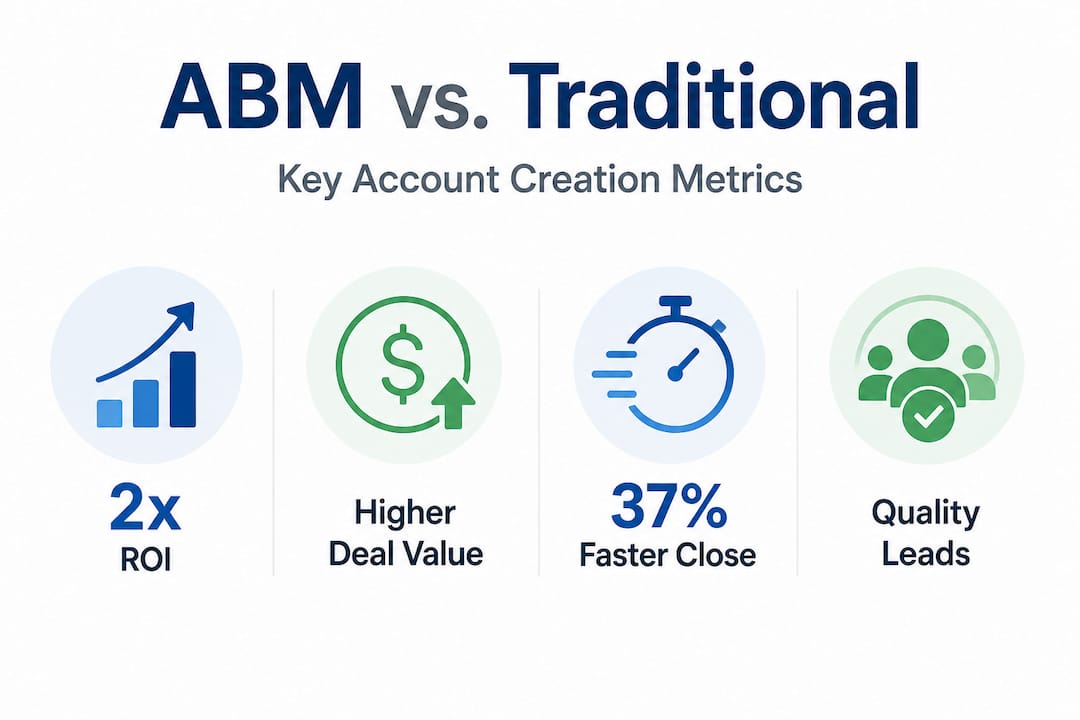
Those figures are not outliers from a single optimistic report. They reflect the compounding effect of focused targeting over time. When every rep knows exactly which accounts to prioritize, less effort leaks into unqualified leads, and more resources concentrate on deals that are actually winnable.
There is another important data point worth highlighting. B2B benchmark research shows that leads with strong ICP and account fit convert three times faster than generic leads. Speed-to-close matters enormously for pipeline health because slower-converting leads tie up rep capacity and distort revenue forecasting.
What disciplined account creation looks like in practice:
Consider two hypothetical SaaS teams, both targeting mid-market financial services companies.
- Team A buys a bulk contact list, imports it raw, and assigns reps to call through it. Their MQL-to-SQL conversion sits around 8%, and reps spend 40% of their time disqualifying contacts that never matched the ICP.
- Team B builds a structured account database, tiers the list, enriches records with verified B2B contact data, and maps buying committees before assigning accounts. Their MQL-to-SQL conversion runs at 24%, and reps focus almost entirely on active opportunities.
The difference is not headcount or budget. It is process. Team B's email marketing process is also more effective because every message is sent to a validated contact with a verified role. Bounces drop. Engagement goes up. Revenue becomes more predictable.
Here is what strong account creation does for sales and marketing alignment specifically:
- Shared account lists mean marketing campaigns target the same companies sales is actively working
- Signal sharing allows marketing to alert sales when a target account visits the pricing page or opens a sequence email
- Unified scoring prevents the classic disconnect where marketing celebrates MQL volume while sales complains about lead quality
Common pitfalls and how to avoid them
Despite the clear benefits, most teams fall into avoidable traps. Here is how to steer clear of the most damaging ones.
The statistics are sobering. Research on B2B lead conversion shows that without proper account creation, pipeline leaks from misaligned efforts, and typical MQL-to-SQL conversion rates sit between just 13% and 21%. Top-performing teams that combine automation with structured account alignment achieve conversion rates above 30%. That gap represents a massive amount of wasted rep time and marketing spend.
The most common pitfalls:
- Misaligned ICPs built on gut feel rather than data. If your ICP was defined in a one-hour whiteboard session years ago, it needs revisiting.
- Stale databases that contain outdated job titles, wrong emails, or companies that have been acquired or shut down. B2B data decays at roughly 25 to 30% per year. What was accurate 18 months ago is now a liability.
- Over-automation without human oversight. Automation sequences built on bad account data amplify the problem at scale. Sending 10,000 irrelevant emails is not more efficient than sending 100. It is more damaging.
- No continual enrichment process. Account creation is not a one-time project. Accounts need to be enriched as companies grow, hire, or shift priorities.
- Skipping tiering and treating all accounts as equally worthy of rep time. This is how high-potential deals get neglected while reps chase low-fit contacts.
Applying lead segmentation best practices consistently is one of the strongest defenses against these pitfalls. When accounts are segmented by fit and intent, prioritization becomes objective rather than instinctive.
For teams managing large databases, building a reliable efficient list export workflow ensures that only current, validated records move into active outreach sequences, reducing bounce rates and protecting sender reputation.
Pro Tip: Schedule a quarterly database review as a recurring calendar event for both sales ops and marketing ops. During each review, remove records that have gone cold, update firmographic data for accounts that have been enriched by new intent signals, and re-score accounts that have had significant changes in fit. This takes two to three hours per quarter and prevents months of misaligned outreach.
Why disciplined account creation will define the next era of B2B sales
Here is a candid take, shaped by watching hundreds of sales teams either thrive or stumble: the B2B industry has developed an unhealthy obsession with tools. Every year brings a new AI-powered prospecting platform, a better intent data provider, or a more sophisticated engagement sequence builder. Teams rush to adopt them, and then wonder why pipeline quality does not improve.
The uncomfortable truth is that tools do not fix process problems. A sophisticated CRM populated with poorly structured accounts is just an expensive spreadsheet. An AI-driven outreach tool sending sequences to the wrong ICP is just a faster way to burn your sender reputation.
The teams that consistently outperform their peers are not necessarily using better software. They are more disciplined about the foundational work. They define ICPs using real data rather than assumptions. They build tiered account structures that align with actual revenue potential. They treat database hygiene as a strategic function, not a cleanup task. And critically, they revisit their account structures when market conditions shift.
There is also a compounding effect at work that rarely gets discussed. When account creation is done well over multiple quarters, the database becomes progressively more accurate and more valuable. Scoring models improve as win/loss data feeds back into ICP definitions. Signal detection gets sharper as historical engagement data accumulates. The database essentially gets smarter over time, and that is genuinely difficult for competitors to replicate quickly.
Automation is valuable, but it only amplifies what is already there. If your ICP is tight and your account structures are clean, automation scales your best process. If your account data is a mess, automation scales the mess. Lead generation for different buyer types reinforces this point well: the same outreach motion does not work across all segments, and the only way to differentiate at scale is through structured, well-maintained account data.
The next era of B2B sales will not be won by whoever has the most contacts. It will be won by whoever has the most accurate understanding of their target market, backed by account structures that make that understanding actionable.
Take the next step with organized B2B account data
Everything covered in this article points to one clear need: access to clean, structured, and segmented business contact data that you can actually use. Building disciplined account creation workflows from scratch is far more difficult when you are starting with raw, unvalidated contacts.
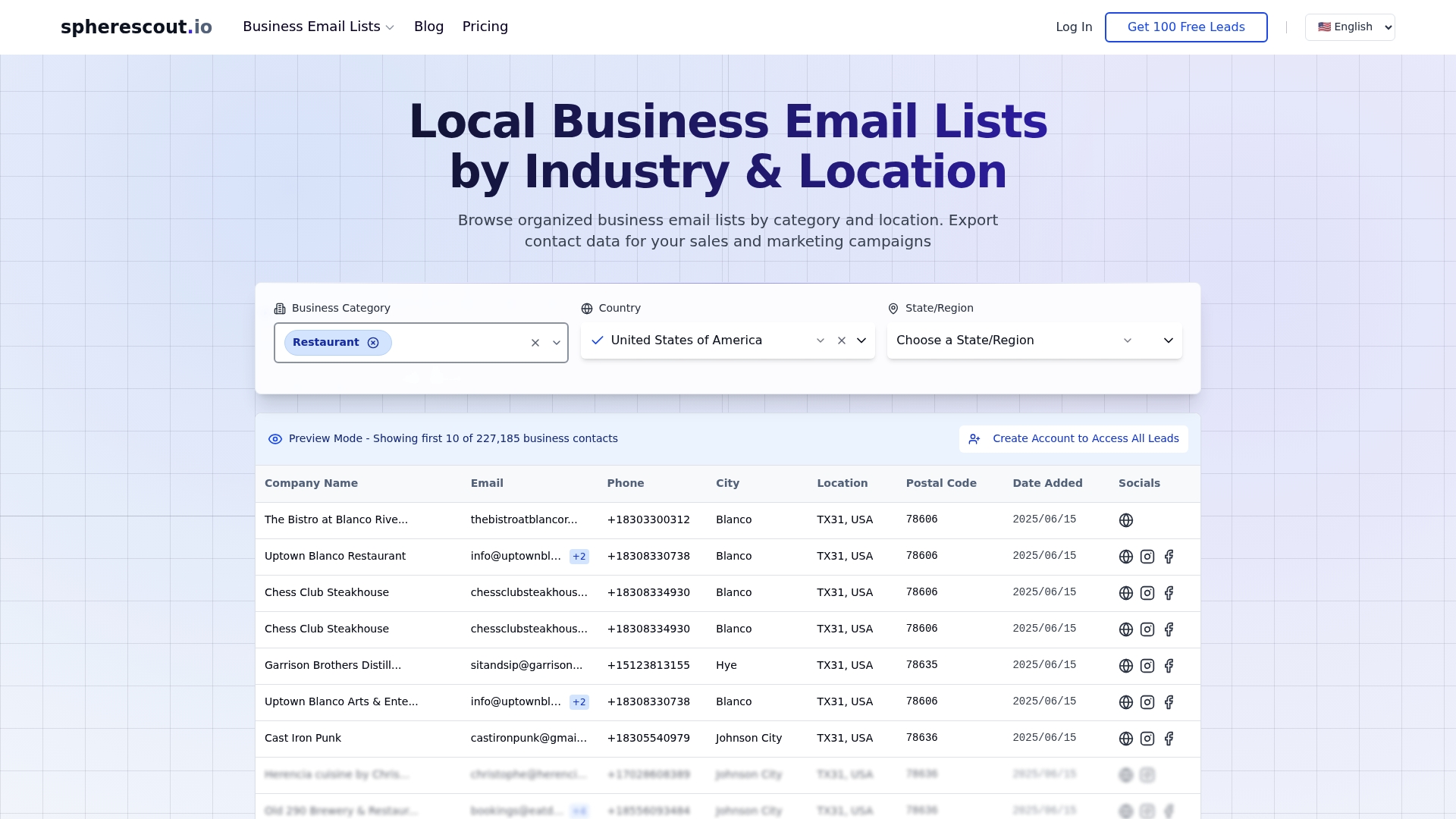
SphereScout.io is built specifically to solve this problem for B2B sales and marketing teams. With a database of over 30 million verified contacts, filterable by industry, city, postal code, and business category, you can build targeted account lists in minutes rather than days. Export directly to CSV for CRM integration, access free sample leads to validate fit before committing, and start your B2B lead generation workflow with data that is already structured for prospecting. Create your account today and see how organized contact data changes what your pipeline looks like next quarter.
Frequently asked questions
How does account creation differ from simple list buying?
Account creation involves structuring, enriching, and segmenting data for sales and marketing alignment, not just purchasing names, making it a strategic process rather than a transactional one. Organized account databases enable multi-stakeholder mapping and coordinated outreach that a raw purchased list simply cannot support.
What's the ROI of investing in disciplined account creation?
ABM-focused account creation leads to 171% higher deal value and 200% ROI increases compared to traditional lead generation approaches. These gains compound over time as account scoring models improve with real win/loss feedback.
How often should B2B databases be refreshed?
B2B databases should be reviewed and updated at least quarterly to avoid errors and ensure accurate qualification. Ongoing maintenance is necessary to counter firmographic inference errors and keep trigger-based prioritization reliable.
What's a common pitfall in account creation that reduces pipeline performance?
A major pitfall is poor ICP alignment, leading to wasted rep time and lower conversion rates across the pipeline. Research shows that misaligned account qualification drives MQL-to-SQL conversion as low as 13%, while top teams exceed 30% through disciplined account structures.
Recommended
- B2B Email Marketing Process for Lead Generation Success | spherescout.io Blog
- Boost lead generation with effective business list segmentation | spherescout.io Blog
- Why verifying contact information boosts B2B leads | spherescout.io Blog
- Email verification: A complete B2B outreach guide | spherescout.io Blog
- B2B newsletters: 5 best practices for real growth
- Optimisez votre workflow de génération de leads agences - Vamyr Studio