

Wasted outreach is expensive. When your sales team spends hours chasing contacts who were never going to buy, you're burning budget, energy, and morale all at once. 67% of lost sales trace back directly to poor lead qualification, which means the problem isn't usually your pitch or your product. It's who you're pitching to. This guide walks you through practical frameworks, step-by-step filtering processes, and common pitfalls so your team can stop spinning its wheels and start closing deals that actually count.
- Top lead qualification frameworks
- Step-by-step: How to set up and execute your lead filtering process
- Common mistakes and how to troubleshoot them
- How to measure and optimize your filtered leads over time
- A practitioner's take: Why most lead filters fail and what really works
- Power your lead filtering with the right data
- Frequently asked questions
Key Takeaways
| Point | Details |
|---|---|
| Quality over quantity | Focusing on well-qualified leads dramatically increases conversion rates and reduces wasted sales effort. |
| Match frameworks to process | Choose qualification frameworks like BANT or MEDDIC based on sales complexity for best results. |
| Speed matters | Responding to filtered leads within one hour can multiply your conversion chance by seven. |
| Iterate for improvement | Continuously tracking and refining your criteria is essential to optimize results over time. |
Why filtering business leads matters
Let's start with a hard truth: volume is not your friend if you haven't filtered first. Many B2B teams still chase raw lead counts as a vanity metric, filling the pipeline with contacts who lack budget, authority, or any real need for what you're selling. The result? Bloated pipelines, frustrated reps, and conversion rates that make leadership nervous.
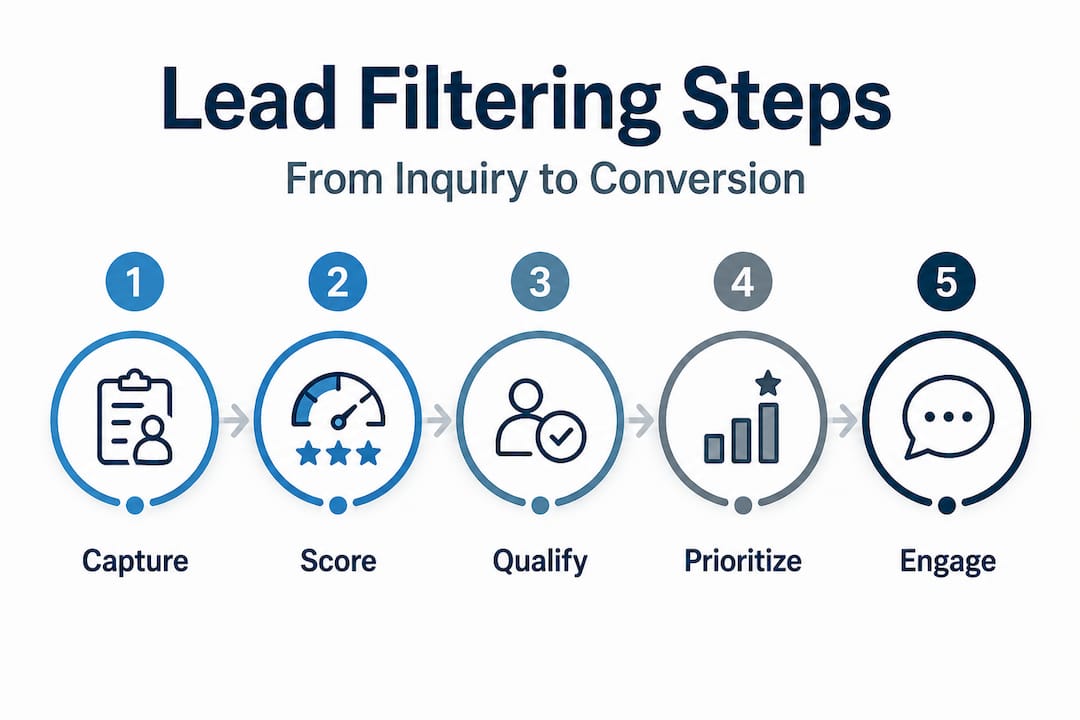
The data tells a clear story. Properly qualified leads convert at 40%, while unqualified leads hover around 11%. That's nearly a four-times difference in output from the same amount of rep effort. If you have 100 leads in your pipeline and skip filtering, you might close 11 deals. Add a structured filtering step, and that same batch could yield 40. Same team. Same time investment. Radically different results.
Here's what poor filtering actually costs you in practice:
- Reps wasting discovery calls on prospects with no decision-making authority
- Marketing burning budget on retargeting contacts who never matched your ICP
- CRM pollution from low-quality contacts that skew your reporting
- Forecast inaccuracy because unqualified deals sit in the pipeline too long before dying
Effective lead filtering essentials fix this by creating a structured gate between raw inquiries and your active pipeline. When your marketing-qualified leads (MQLs) are properly evaluated before becoming sales-qualified leads (SQLs), your MQL-to-SQL conversion rate climbs and your cost-per-closed-deal drops. Good filtering isn't just a nice-to-have; it's the foundation of a scalable B2B revenue operation. Following best practices for lead acquisition ensures you're building on solid ground from the start.
| Metric | Unfiltered leads | Filtered leads |
|---|---|---|
| Conversion rate | ~11% | ~40% |
| Cost per closed deal | High | Significantly lower |
| Rep satisfaction | Low | Higher |
| Pipeline accuracy | Poor | Reliable |
Top lead qualification frameworks
Knowing the stakes, here's how structured frameworks sharpen your filter. The three most widely used frameworks in B2B sales are BANT, MEDDIC, and GPCTBA. Each has a distinct purpose, and choosing the right one for your context matters a lot.
BANT (Budget, Authority, Need, Timing) is the oldest of the three and still effective for transactional, high-volume sales. You're asking: does this prospect have the money, can they make the decision, do they have a clear need, and are they ready to act soon? It's fast to apply and easy to train new SDRs on.
MEDDIC (Metrics, Economic Buyer, Decision Criteria, Decision Process, Identify Pain, Champion) goes much deeper. It's designed for complex, multi-stakeholder deals where a single contact rarely controls the buying decision. MEDDIC forces your team to understand the organizational dynamics before investing too heavily in a deal.

GPCTBA (Goals, Plans, Challenges, Timeline, Budget, Authority) bridges the gap. It's conversational and works well for consultative sales where you're co-creating a solution with the buyer. GPCTBA excels at surfacing intent because it starts with the prospect's goals rather than your qualification checklist.
According to BANT, MEDDIC, and GPCTBA comparisons, BANT suits high-volume scenarios while MEDDIC and GPCTBA are better suited to complex buying cycles. If you explore BANT vs. MEDDIC methods for different industries, you'll find that the most successful teams today use hybrid approaches, layering elements from multiple frameworks depending on deal size and complexity.
| Framework | Best for | Key signal | Weakness |
|---|---|---|---|
| BANT | High-volume, transactional | Budget + timing | Misses intent and complexity |
| MEDDIC | Complex, enterprise deals | Organizational dynamics | Time-intensive |
| GPCTBA | Consultative sales | Goals and challenges | Requires skilled reps |
Why are hybrid approaches now the norm? Because no single framework captures every dimension of a modern B2B buying decision. For instance, you might use BANT to do a quick initial screen, then layer MEDDIC criteria before scheduling a demo. AI in advanced qualification is also starting to automate parts of this scoring, helping teams flag high-potential contacts before a human even touches them.
Pro Tip: If you're running a fast-growth startup with a small SDR team, start with BANT for quick first-pass filtering. Introduce MEDDIC criteria only when deal value justifies the extra discovery investment.
You can find additional lead qualification insights that break down how different industries apply these frameworks in practice, which is worth reviewing before you finalize your team's approach.
Step-by-step: How to set up and execute your lead filtering process
With a framework in hand, let's walk through the actual process. Building a lead filtering system doesn't have to be complicated, but it does need to be deliberate.
1. Define your ideal customer profile (ICP). This is step one, and it's non-negotiable. Your ICP should include firmographic data (company size, industry, revenue), technographic data (tools and platforms they use), and behavioral signals (what actions indicate intent). Without a clear ICP, every other step in your filtering process is guesswork.
2. Map the qualification data you need. For each lead, identify what information signals fit, intent, and timing. Fit is about whether the company matches your ICP. Intent is about whether they're actively looking for a solution like yours. Timing is about whether they're in a position to act now. Not all three need to be perfect, but you need at least two to move a lead forward.
3. Build a progressive scoring model or rules-based filter. Assign point values to actions like downloading a case study, visiting your pricing page, or attending a webinar. Combine these with firmographic data to create a composite score. When a lead crosses a threshold, it moves from MQL to SQL. This removes subjectivity and keeps your pipeline clean. Reviewing lead generation workflows can give you practical templates for building this scoring architecture.
4. Integrate automation tools. Your CRM and marketing automation platform should do the heavy lifting on scoring and routing. Tools like HubSpot, Salesforce, or Marketo allow you to set automated triggers based on lead score thresholds, reducing manual review time significantly. Pairing good tooling with strong content strategies to improve engagement also increases the quality of the leads you're pulling in at the top of the funnel.
5. Test with your SDR/BDR team and refine quickly. No scoring model is perfect on day one. Run your first batch of filtered leads through your SDR team and track outcomes. What percentage of SQLs actually convert to meetings? What percentage of meetings convert to opportunities? Use those numbers to recalibrate your scoring thresholds within the first 30 to 60 days.
6. Prioritize speed-to-lead. This one surprises people. Speed-to-lead under one hour boosts conversion rates sevenfold. The filtering step shouldn't create a bottleneck. Automate as much of the initial scoring as possible so that high-fit, high-intent leads get contacted fast.
A lead that scores highly but sits uncontacted for 24 hours is already cooling off. Your filtering process needs to be fast, not just accurate.
Pro Tip: Set up a Slack or CRM alert that fires the moment a lead crosses your SQL threshold. Give your SDR team a one-hour response window as a team standard. Track adherence to that standard weekly.
Common mistakes and how to troubleshoot them
Even the best filters need regular checks. Here's how to spot and fix weaknesses before they cost you pipeline.
The most common mistake is not enforcing qualification criteria consistently. One rep lets a lead through because "they sounded interested." Another disqualifies a lead because the company is smaller than ideal but has a real budget. Without a shared standard, your filter becomes subjective and unreliable.
Here are the mistakes we see most often, and how to address them:
- Letting unqualified prospects into the pipeline. This inflates your pipeline value on paper while diluting real opportunities. Fix it by requiring mandatory qualification fields in your CRM before a lead can move stages.
- Ignoring timing signals. A prospect who matches your ICP perfectly but just renewed with a competitor is not a current opportunity. Build timing signals into your scoring model, not just fit.
- Skipping regular scoring audits. Your ICP evolves. Your market shifts. A scoring model built 18 months ago might now be rewarding the wrong signals. 67% of lost sales trace back to weak qualification, and a stale scoring model is a major contributor.
- Overcomplicating the filter. Fifty scoring variables sound thorough but actually create confusion. Focus on quality criteria over volume. Three to five strong signals beat twenty weak ones every time.
- Not looping in sales feedback. Your SDRs know which leads are actually good. Build a simple feedback loop where they can flag false positives and false negatives monthly.
A great source for clean, targeted contacts to start with is SphereScout's business email lists, which are pre-organized by industry and location so your filtering process starts with structured, relevant data rather than noise.
Pro Tip: Run a monthly "pipeline autopsy" on deals that stalled or died. Trace back to when they entered the pipeline and why they were qualified. Pattern recognition here is gold.
How to measure and optimize your filtered leads over time
Once your process is running, here's the ongoing measurement piece. Good filtering isn't a one-time setup. It's a system you tune continuously based on real performance data.
The three core KPIs every B2B team should track are:
- Lead-to-MQL rate: What percentage of raw leads qualify as marketing-qualified? If this is too high, your top-of-funnel targeting is too broad.
- MQL-to-SQL rate: Average MQL-to-SQL conversion sits at 13 to 15%, while top-performing SaaS teams in the top quartile reach 25 to 35%. If you're below 10%, your MQL criteria may be too loose.
- SQL-to-Win rate: This is the ultimate proof point. If your SQL-to-Win rate is low, either your filter is still too permissive or there's a gap in your sales execution.
| KPI | Average benchmark | Top quartile (SaaS) |
|---|---|---|
| Lead-to-MQL | 20–25% | 30%+ |
| MQL-to-SQL | 13–15% | 25–35% |
| SQL-to-Win | 20–25% | 30%+ |
How do you know if your filter is too wide or too narrow? A filter that's too wide lets in too many weak leads. You'll see a high MQL volume but a low MQL-to-SQL rate. A filter that's too narrow cuts out real opportunities. You'll see a high SQL-to-Win rate but a low lead volume overall, meaning your team is closing well but not enough.
Conduct quarterly reviews of your filtering criteria. Bring together marketing, sales ops, and sales leadership to look at the data together. Adjusting your ICP definition, updating scoring weights, or adding new intent signals are all common tuning actions. Leveraging targeted lead databases can also help you benchmark whether your ICP is realistic given the available market size in a given region or industry.
A practitioner's take: Why most lead filters fail and what really works
Here's the real issue we see after working with dozens of B2B sales teams: most filters are built around what's easy to measure, not what actually predicts conversion. Firmographics are easy. You can filter by company size, industry, and geography in five minutes. So that's where most teams stop.
But firmographic fit alone is a weak predictor of conversion. A mid-market SaaS company in your target vertical might look perfect on paper, but if they just completed a major tech overhaul and have no budget cycle opening until next year, they're not a current opportunity. Filtering them in wastes a rep's time. Filtering them out entirely wastes a future opportunity.
What actually works is a layered signal approach: intent, fit, and timing. Intent signals tell you whether a prospect is actively researching solutions in your category. Fit tells you whether they match your ICP. Timing tells you whether they're in a position to act. When all three align, you have a genuine high-priority lead.
The uncomfortable truth is that rigid frameworks miss high-intent buyers. A prospect who doesn't match your company-size filter but has visited your pricing page four times and downloaded two case studies is showing you more intent than a perfectly-sized company that stumbled onto your website once. Your filter needs room to recognize that.
Automation handles the scale piece, but real conversations still close the gaps. Have your SDRs ask open timing questions early. "What's driving your interest in solving this now?" surfaces more useful qualification data than any form field. Apply advanced qualification tactics that layer behavioral signals on top of firmographic criteria. Then audit your filter quarterly to make sure it's still rewarding the right signals as your market evolves.
Power your lead filtering with the right data
Your filtering process is only as good as the data it starts with. If you're working from incomplete, outdated, or poorly segmented contact lists, even the best framework won't save you.
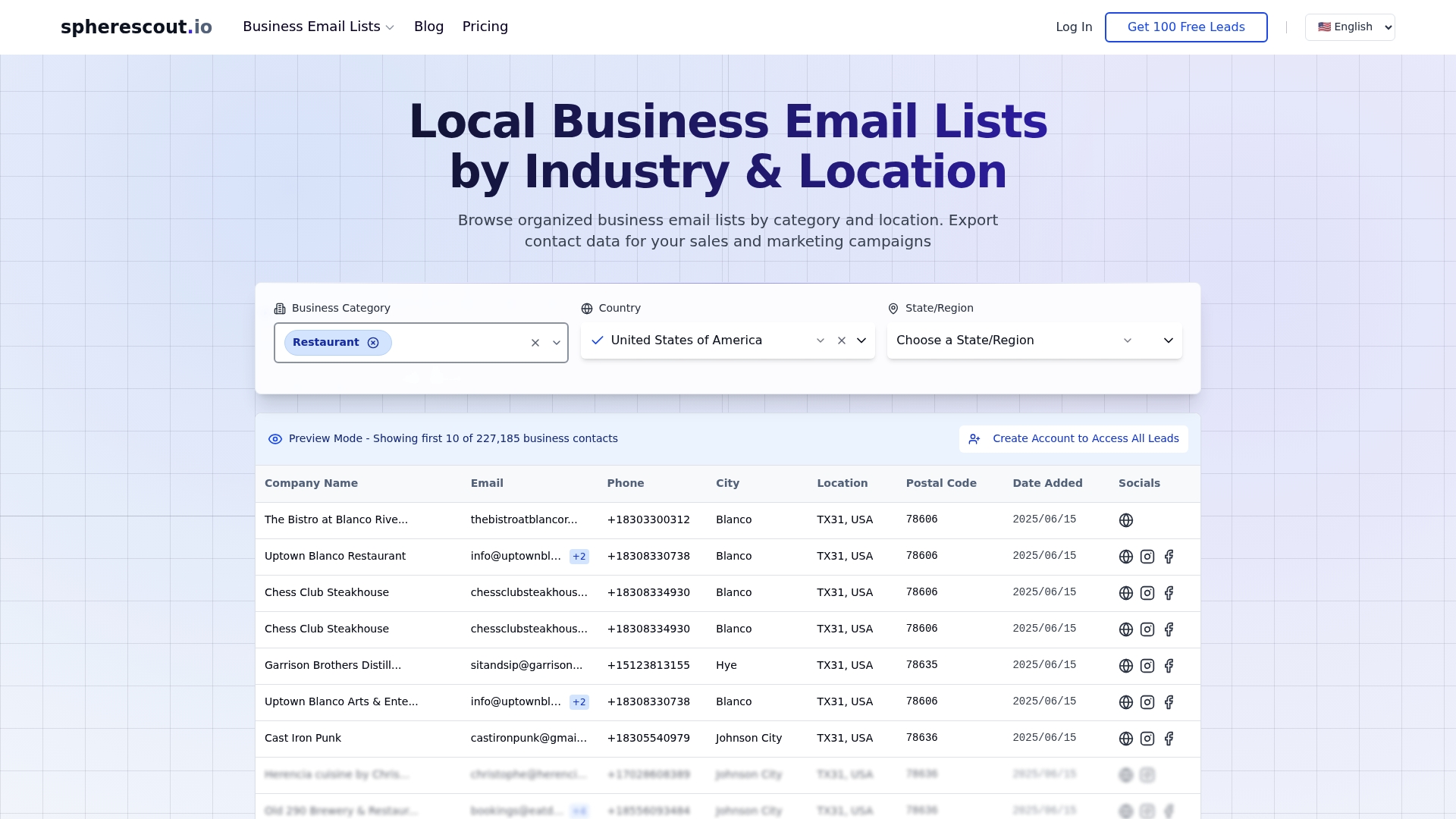
SphereScout makes it easy to start with structured, targeted B2B contact data organized by industry, location, and business category. Instead of spending hours scrubbing raw lists, you can pull pre-segmented USA business email lists that already align with your ICP criteria. Need to target a specific city or postal code? Browse business lists by location and export a CSV ready for your CRM or email tool in minutes. With access to over 30 million contacts, SphereScout gives your team quality at the foundation, so your filtering work actually pays off.
Frequently asked questions
What are the top criteria for filtering business leads?
The most effective filtering criteria are intent, fit, and timing, which consistently outperform firmographic or demographic filters alone. Combining all three gives your team the clearest signal of which leads are worth pursuing now.
How quickly should leads be filtered and contacted?
Filtering and first contact within one hour of capturing a lead can increase conversions sevenfold. Speed matters as much as accuracy, so automate your initial scoring to avoid bottlenecks.
Which qualification framework should my sales team use?
Use BANT for high-volume, transactional leads and MEDDIC or GPCTBA for complex or multi-stakeholder deals. Most high-performing teams use a hybrid approach tailored to deal size.
What's a good MQL-to-SQL conversion rate to aim for?
Aim for 13 to 15% as a solid baseline; SaaS top-quartile teams reach 25 to 35%. If you're consistently below 10%, your MQL qualification criteria likely need tightening.