

Business lists aren't simple spreadsheets packed with random emails. They're structured databases organized by detailed classification systems that determine how useful those contacts actually are for your sales pipeline. At the core of this structure is the 6-digit NAICS hierarchy, a system that breaks every business into precise sectors, subsectors, and industry groups. If you're prospecting without understanding these categories, you're likely wasting budget on contacts that will never convert.
- How NAICS categories drive targeting and segmentation
- Expert nuance: Which categories matter most for B2B sales?
- Applying business list categories to real B2B prospecting
- A fresh perspective: Data structure beats quantity every time
- Next steps: Get structured business lists for your team
- Frequently asked questions
Key Takeaways
| Point | Details |
|---|---|
| NAICS enables precision | Using NAICS categories lets you filter business lists for targeted B2B prospecting. |
| Filter beyond industry | Add company size and location to create high-conversion lead lists. |
| Pick updated categories | Choose NAICS over SIC for superior detail and better sales alignment. |
| Structured lists boost results | Well-segmented data outperforms large, generic lists every time. |
Understanding business list categories
Most B2B teams think of a business list as a name, a phone number, and maybe a job title. In reality, a well-structured list layers in industry classification, company size, geographic location, revenue ranges, and more. These dimensions allow you to move from blasting a generic audience to surgically targeting the exact companies that fit your ideal customer profile (ICP).
The two main classification systems you'll encounter are NAICS (North American Industry Classification System) and the older SIC (Standard Industrial Classification) system. Understanding both helps you ask better questions when sourcing or filtering lists.
NAICS uses a 6-digit hierarchical structure across five levels:
- 2-digit sector: Broad economic groupings (e.g., 23 for Construction, 31-33 for Manufacturing, 62 for Healthcare)
- 3-digit subsector: Breaks sectors into more specific categories
- 4-digit industry group: Further narrows the classification
- 5-digit NAICS industry: Industry-specific definitions
- 6-digit national industry: The most granular level, used for precision targeting
SIC, by contrast, tops out at 4 digits and hasn't been officially updated since 1987. It's still floating around in older databases, but it lacks the depth and relevance for modern targeting.
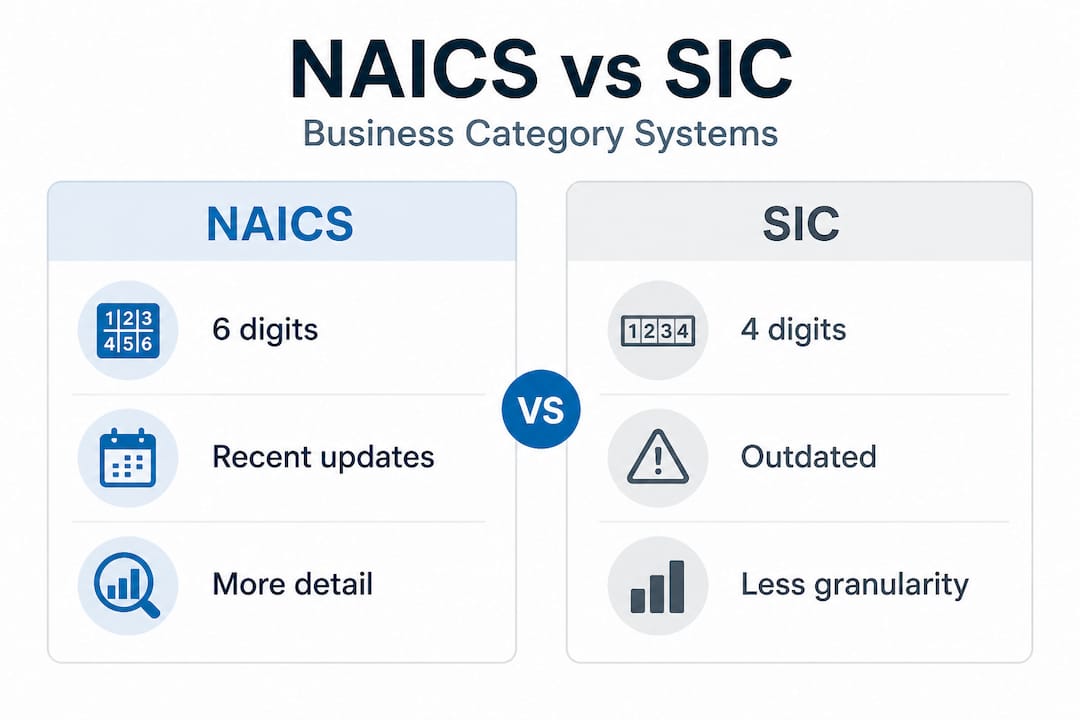
Here's a quick comparison to put the two systems side by side:
| Feature | NAICS | SIC |
|---|---|---|
| Digit depth | 6 digits | 4 digits |
| Last updated | Every 5 years | 1987 (static) |
| Number of categories | 1,000+ industries | ~1,000 (less granular) |
| Best for | Modern targeting, ABM | Legacy database matching |
| Government adoption | U.S., Canada, Mexico | Largely phased out |
| Precision level | Very high | Moderate |
The bottom line: if you're building industry email lists for a modern campaign, NAICS is the system to prioritize. SIC data can cause misclassification, meaning you could target a software company when you meant to target a hardware manufacturer.
Categories also do more than classify. They enable you to segment by multiple attributes at once. A list filtered to NAICS code 5112 (Software Publishers) with 50-200 employees in Texas is dramatically more useful than a raw list of "tech companies." That precision is what separates high-performing outreach from noise.

How NAICS categories drive targeting and segmentation
Now that you see the frameworks, let's look at how NAICS categories translate directly into targeting decisions. The real power of these codes is that they don't operate in isolation. You stack them with firmographics to build a layered filter that narrows a broad list down to exactly the right segment.
According to business list filtering research, NAICS codes enable filtering by industry (e.g., 23 for construction, 62 for healthcare) combined with firmographics like company size, revenue, and geography for ICP matching in lead generation.
Here's a practical example. Say you're selling commercial HVAC equipment. Your ICP is mid-size commercial construction firms in the Midwest. Here's how you'd layer the filters:
1. Start with NAICS sector 23 (Construction)
2. Drill to subsector 236 (Construction of Buildings)
3. Add company size filter: 50-500 employees
4. Add revenue filter: $5M-$50M annual revenue
5. Geographic filter: Illinois, Indiana, Ohio, Michigan, Wisconsin
6. Export the filtered list to CSV for CRM upload
That workflow is entirely category-driven. Without NAICS, you'd be guessing.
Here's a sample of how sectors map to real targeting use cases:
| NAICS Sector | Code | Sample Segment | Typical ICP Use Case |
|---|---|---|---|
| Construction | 23 | Commercial contractors | Equipment, materials, software |
| Healthcare | 62 | Outpatient clinics | Medical devices, billing software |
| Manufacturing | 31-33 | Metal fabricators | Machinery, ERP, industrial supplies |
| Professional services | 54 | Consulting firms | HR tech, CRM, training |
| Retail trade | 44-45 | Specialty retailers | POS systems, inventory tools |
| Finance/Insurance | 52 | Regional banks | Compliance tools, fintech |
When you buy an email database without NAICS filtering built in, you're getting noise. With it, you're getting signal. The difference in response rates is not marginal. Sales teams using structured category filters routinely report far stronger engagement metrics because they're reaching people who actually need what they're selling.
Pro Tip: Applying NAICS codes alongside firmographic filters can reduce your total list size by 80-90%. That sounds like a loss, but it's actually a win. You're eliminating unqualified contacts before they ever hit your sales sequence, which means lower bounce rates, less wasted outreach, and better conversion numbers overall.
There are several lead generation strategies that depend on category precision. Account-based marketing (ABM) in particular requires you to define a very narrow target universe. NAICS gives you the vocabulary to describe and filter that universe consistently, whether you're pulling data from a platform, handing off a brief to a data vendor, or segmenting your CRM.
Expert nuance: Which categories matter most for B2B sales?
Here's where the conversation gets more nuanced. Not all categories are created equal for B2B purposes. The right category system depends on your go-to-market strategy, your data sources, and how you plan to use the list.
NAICS is almost always the better choice for forward-looking campaigns. It's updated every five years (most recently in 2022), covers modern industries like cloud computing, gig economy platforms, and green energy, and offers the six-digit granularity that SIC simply can't match. For local email lists built around a specific metro area or zip code, NAICS codes combined with location data give you the tightest targeting possible.
SIC still has a role in legacy CRM matching and historical industry benchmarking. Some older government databases and procurement systems still reference SIC codes, so if your buyer is in government contracting or regulated industries, you may still encounter it. But for ABM, intent-based outreach, or any modern lead generation workflow, SIC is a step backward.
"Filtering a list to NAICS-matched ICP criteria can reduce the total contact pool by 80-90%, but the remaining contacts convert at significantly higher rates because they represent true fit." — Industry data analysis, true-naics.com
When should you use NAICS versus SIC? Here's a clear breakdown:
Use NAICS when:
- Building ABM target lists for modern industries
- Filtering by industry for digital outreach campaigns
- Sourcing data from platforms that use standardized classification
- Matching your ICP against a large database (30M+ contacts)
- Integrating with CRM systems that support field-level industry tagging
Use SIC when:
- Matching contacts from legacy CRM records
- Working with government or public-sector procurement databases
- Cross-referencing historical industry data for benchmarking
- Dealing with third-party vendors who only support SIC codes
The practical advice here is to default to NAICS for all new prospecting work. If you inherit SIC-coded data, map it to NAICS before building new segments. Crosswalk tables are publicly available and the mapping process, while tedious, pays off in targeting accuracy.
One mistake we see consistently is teams choosing categories based on what feels right rather than what their conversion data actually shows. If your top ten closed deals all fall in NAICS 5415 (Computer Systems Design), that's your primary filter. Don't dilute it by also pulling 5411 (Legal Services) because someone on the team has a hunch about lawyers needing your software.
Applying business list categories to real B2B prospecting
Now let's put this into practice. Building a category-based list isn't complicated, but it does require a clear process. Here's a step-by-step workflow you can run with your team today.
Step 1: Define your ICP using NAICS codes
Start by identifying the NAICS codes that match your existing best customers. Pull your closed-won data, look at the industry classifications, and rank by frequency and deal size. The top two or three codes should anchor your list criteria.
Step 2: Layer in firmographic filters
Company size (employee count or revenue band), geographic territory, and ownership type (private vs. public, franchise vs. independent) all sharpen your targeting. According to B2B industry filtering research, combining industry codes with firmographics like company size, revenue, and geography is how you achieve true ICP alignment.
Step 3: Select your data source
Not all list providers apply NAICS consistently. Some aggregate data from multiple sources with inconsistent classification. Look for platforms that let you filter by NAICS code directly and show you the distribution of results before you export.
Step 4: Filter by location using industry and location filters
If your territory is regional, add city, state, or postal code filters on top of your category and firmographic filters. Location stacking can further reduce your list to only the accounts your reps can realistically work.
Step 5: Export and load into your CRM
A clean CSV export with consistent field naming (industry code, company name, contact name, email, phone, address) makes CRM upload fast and error-free. Tag each record with its NAICS code so you can segment campaigns at the field level later.
Step 6: Build sequences by category
Don't send the same message to a construction contractor and a healthcare billing manager. Customize your outreach by NAICS sector. The problem you're solving, the language you use, and the social proof you reference should all match the category.
Pro Tip: Combining industry code, employee size, and city into a single filter often reduces a 100,000-record database to under 5,000 records. That's not a bug. That's exactly the signal-to-noise ratio you want before launching a high-touch sales sequence.
The teams that execute this process consistently see shorter sales cycles because they're starting every conversation with strong context. When your opening email references a challenge specific to NAICS 2362 (Nonresidential Construction), you immediately signal that you understand the buyer's world.
A fresh perspective: Data structure beats quantity every time
Let me be direct about something most lead generation content won't say clearly: the obsession with list size is a distraction. I've seen sales teams celebrate getting access to a 500,000-contact database as if volume alone would solve their pipeline problem. It doesn't. It usually makes things worse.
Here's what actually happens with a massive, uncategorized list. Reps spend the first two weeks sorting through irrelevant contacts. Email deliverability tanks because bounce rates spike when you're reaching businesses in the wrong industry. Your domain reputation takes a hit. And by the time anyone realizes the data quality is the problem, the campaign is already labeled a failure.
The uncomfortable truth is that most B2B professionals use business list categories the wrong way, as a one-time filter they apply at the start rather than as an ongoing framework for segmentation, personalization, and performance analysis. Category discipline isn't a setup step. It's a continuous practice.
Structured data, when applied correctly, creates compounding returns. When you tag every contact in your CRM with its NAICS code, you can run conversion analysis by category. You can see that NAICS 5415 converts at 4.2% while NAICS 7225 converts at 0.8%. You can reallocate budget accordingly. That's the kind of insight that drives sustainable pipeline growth, not sheer list size.
The teams winning at B2B prospecting in 2026 aren't the ones with the biggest lists. They're the ones who understand their data structure deeply enough to build precise, personalized outreach at scale. Category mastery is what separates them from the noise.
Next steps: Get structured business lists for your team
Category knowledge is only valuable when it's backed by accurate, well-organized data. If you're ready to put NAICS-based targeting to work, the right list source makes all the difference.
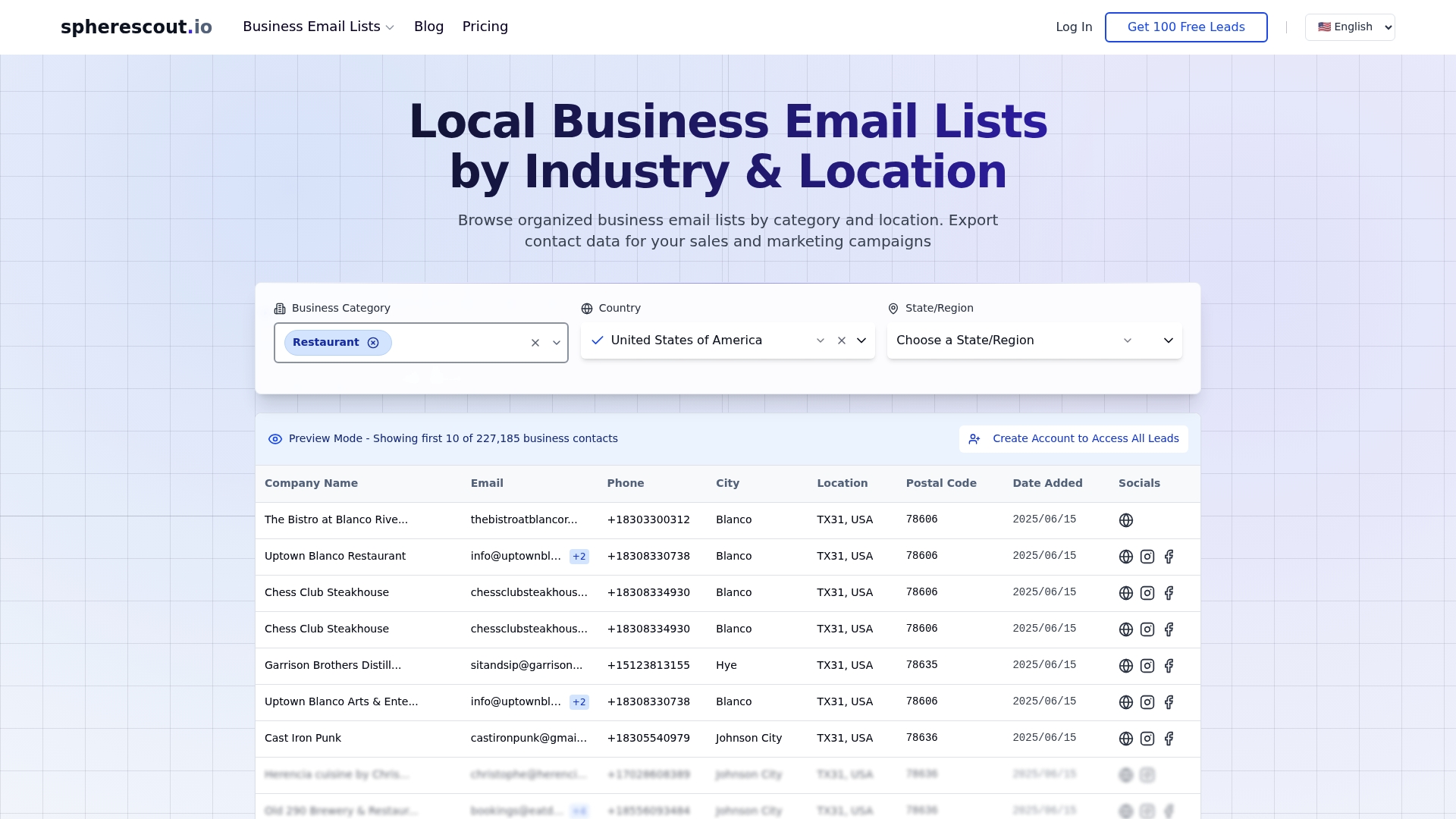
SphereScout.io gives B2B sales and marketing teams access to over 30 million structured business contacts, all filterable by industry category, company size, location, and more. You can purchase business email lists segmented by NAICS code, export them to CSV for CRM upload, and start your outreach the same day. Whether you're running an ABM campaign targeting healthcare providers or a regional push into Midwest construction firms, the platform's lead generation tools are built around the category-driven workflow this article describes. Start with a free sample, see the data quality firsthand, and scale from there.
Frequently asked questions
What are business list categories?
Business list categories organize contacts by industry, company size, and location to enable targeted B2B prospecting. According to B2B marketing research, these categories enable filtering by NAICS codes combined with firmographics like revenue and geography for ICP alignment.
What is the NAICS system used for?
The NAICS system classifies businesses into detailed sectors to streamline targeting for sales and marketing teams. Its 6-digit hierarchical structure covers 20 top-level sectors and over 1,000 granular national industries.
Why are NAICS codes preferred over SIC for targeting?
NAICS codes offer more detail and are updated every five years, making them far better suited for modern lead generation and ABM strategies. Expert analysis shows NAICS filtering reduces lists by 80-90% to ICP matches, which drives higher conversion rates than SIC-based segmentation.
How do I use business list categories for prospecting?
Combine industry categories with company size and location filters to refine your lead list and boost conversion rates. Research confirms that stacking NAICS codes with firmographics like revenue and geography creates the most precise ICP alignment for B2B outreach.