TLDR
- I reviewed top-ranking articles on B2B telemarketing failure.
- I filtered the insights I gathered using 4 criteria: impacts the sales process, actionable by a telemarketing team, common across campaigns, and tied to measurable outcomes.
- After narrowing it down, I found 3 root causes: calling the wrong people, saying the wrong things, and stopping too soon.
- And also how to fix all the failure points and how to do b2b telemarketing properly.
Research from LinkedIn shows that less than 2% of cold calls result in a meeting.
Another study from Baylor University found it takes 209 calls to book a single appointment or referral.
When you look at how few of those appointments really result in deals, the actual conversion rate falls even more.
In this guide, I reviewed the key reasons why B2B telemarketing fails, and how to fix each one.
But first, let’s talk the basics.
What Is B2B Telemarketing?
B2B telemarketing is when a company calls other businesses to sell them products or services.
It includes lead generation, qualifying prospects, setting appointments, and building long-term relationships through targeted outreach.
How is it different from B2C telemarketing?
Here’s a quick look at how B2B and B2C telemarketing are different.
|
Aspect |
B2B Telemarketing |
B2C Telemarketing |
|
Audience |
Other businesses and decision-makers |
Regular people (consumers) |
|
Sales cycle |
Takes longer, with more steps |
Quick, often on the spot |
|
Goal of Call |
Start relationships, set up meetings |
Make fast sales or sign-ups |
|
Message Style |
Helpful and focused on business problems |
Emotional and focused on benefits |
|
Data Needed |
Detailed info about companies and roles |
Basic consumer info |
|
Success Measured By |
Booked meetings and leads |
Sales and responses |
|
Sales Style |
Build trust and show value |
Focus on price and quick deals |
Types of B2B Telemarketing
Typically there are 2 main types of B2B telemarketing campaigns;
- Inbound
- Outbound
Let me break them down for you real quick.
Inbound Telemarketing
Inbound telemarketing focuses on responding to calls initiated by potential customers.
These inquiries usually come from people responding to marketing, looking for solutions, or wanting more info about a product or service.
The primary goal is to answer questions, qualify leads, and guide prospects further down the sales funnel.
This approach depends on quick responses and good product knowledge to turn warm leads into opportunities.
Because, responding to leads within 5 minutes can boost your chances by up to 100×.
Outbound Telemarketing
Outbound telemarketing involves proactively reaching out to potential clients who haven’t expressed prior interest.
It typically includes cold calling, follow-up outreach, or nurturing existing prospects.
The objective is to generate interest, schedule appointments, and create new sales opportunities.
Success here depends on volume, persistence, and the ability to deliver personalized, relevant messaging that resonates with the target audience.
Let me give you a quick comparison table, adopted from leadatscale on the key differences between inbound and outbound telemarketing.
|
Aspect |
Inbound Telemarketing |
Outbound Telemarketing |
|
Lead Source |
Marketing-generated (ads, forms, events) |
Self-sourced through prospecting |
|
Lead Type |
Warm leads |
Cold or lightly warmed leads |
|
Approach |
Reactive, respond to inquiries |
Proactive, initiate contact |
|
Daily Activity |
Handle ~15 leads |
Make 40–50 calls & 10–40 emails |
|
Main Focus |
Qualifying and nurturing leads |
Generating interest and appointments |
|
Key Metrics |
Response time, conversion rate, lead-to-opportunity rates |
Outreach volume, connect rate, meetings booked |
|
Pipeline Contribution |
~44% of total pipeline |
~53% of total pipeline |
|
Strength |
High-intent, efficient follow-up |
Scalable, creates new demand |
|
Limitation |
Limited by marketing volume |
Requires consistent effort & data quality |
One thing about Inbound telemarketing is, it relies on factors you can’t fully control, like SEO, ads, budget, or if someone’s searching today. And that’s kind of uncertain.
But with outbound telemarketing, you decide who to reach, when to reach them, and exactly what message they hear.
In addition it stabilizes the pipeline when inbound volume drops.
That’s why in this blog, we’re focusing on outbound telemarketing. Because I believe it can give you a predictable, and scalable B2B pipeline.
Let me give you a few data points to show you it’s worth focusing on:
According to curchbase’s study, organizations that don’t cold call experience 42% less growth than those that do. And 69% of buyers have accepted cold calls from new providers.
You might think that buyers are tired of hearing from sales reps.
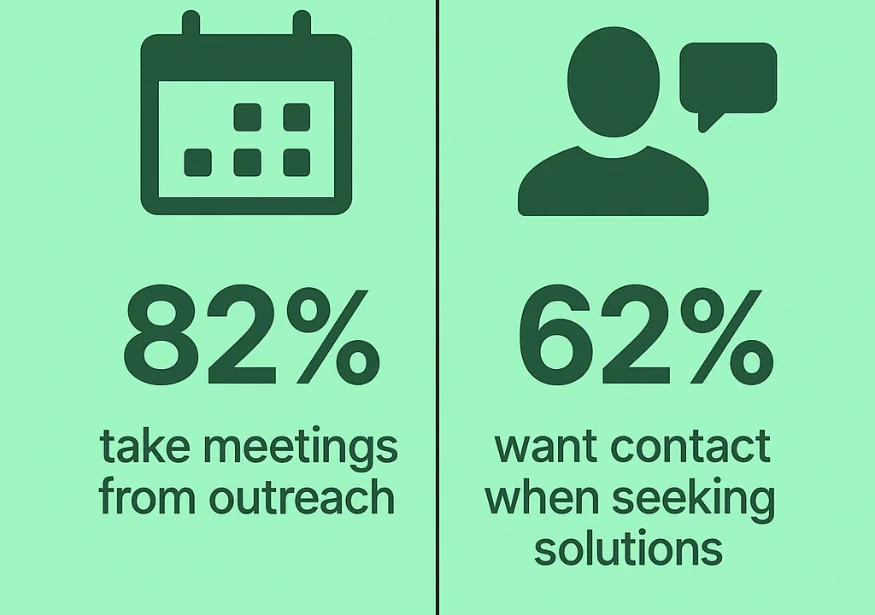
But the truth is 82% of buyers say they’re willing to meet with sellers who take the initiative to reach out.
So if buyers are this open to having conversations, what are the reasons that most b2b telemarketing fails?
Why is your B2B telemarketing not working?
I reviewed the top-ranking articles on Google about why B2B telemarketing fails.
While many offer valid insights, not all reasons directly affect the telemarketing process itself.
For example, some reasons are more about operational or structural issues.
Things like outsourcing to the wrong vendor, hiring low-cost agencies, or lumping sales and marketing teams together.
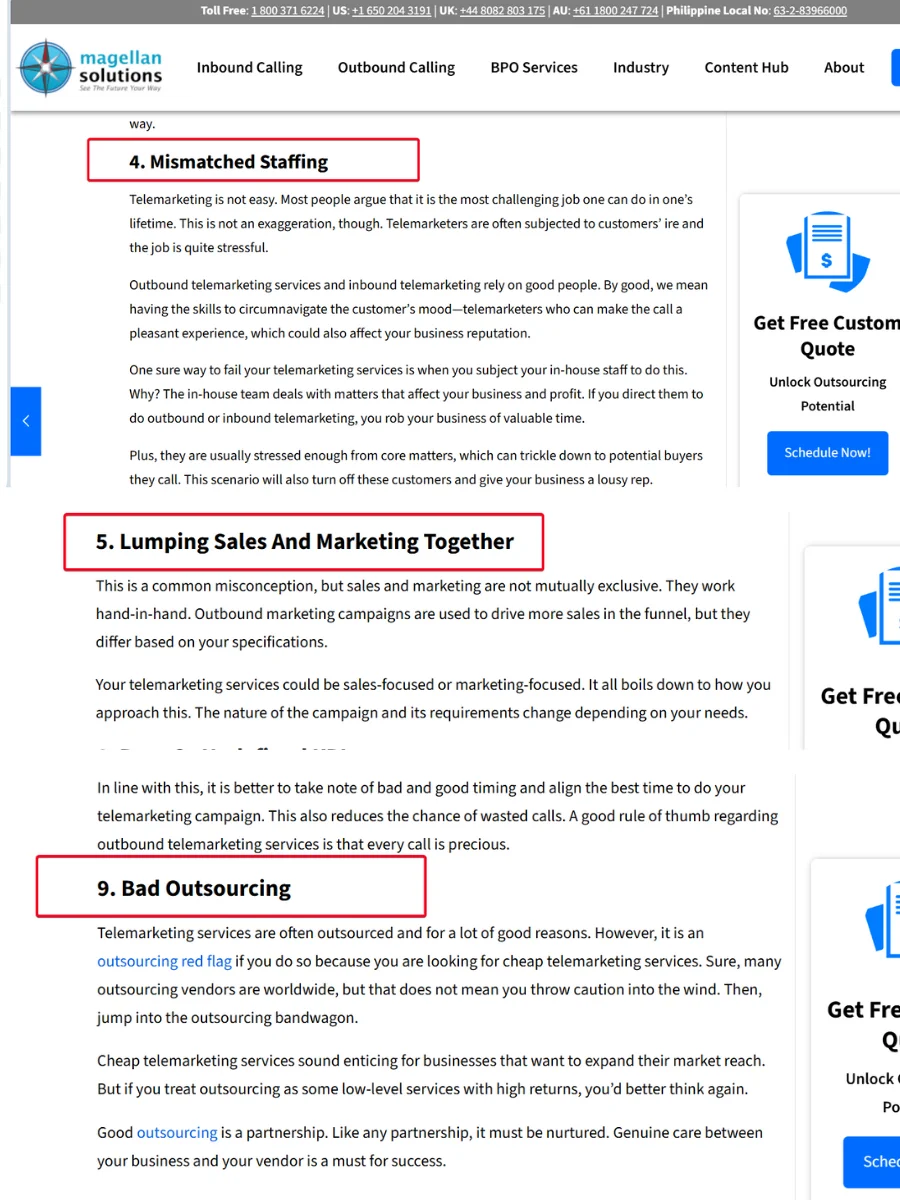
The same goes for issues like mismatched staffing, which is more about internal operations than call strategy.
These factors might impact performance in certain companies, but they don’t address the actual execution of telemarketing itself.
So after digging through dozens of high-ranking articles and analyzing every reason I could find, I narrowed the list down using four filters:
- Sales Process Relevance: Does the reason impact the actual process of prospecting, contacting, or converting leads in B2B telemarketing?
- Directly Actionable: Can this be fixed or optimized through training, tools, or process changes by someone running a telemarketing team?
- Universally Applicable: Does the issue apply broadly across most B2B telemarketing campaigns?
- Measurable Outcomes: Is the reason linked to conversion rates, engagement metrics, or pipeline performance?
Based on that, I boiled it down to three failure points:
- Calling the wrong people
- Saying the wrong things
- Stopping too soon.
Let’s fix them, one by one.
1. You're calling the wrong people.
So what’s going wrong here?
Your lead list is too broad or built without a clear strategy. You’re spending time calling businesses that either aren’t a good fit, or have no need for what you offer.
In fact, sales teams waste up to 50% of their time on unproductive prospecting because of poor data quality.
What you need is a better list, one that’s focused, and aligned with your target market.
Let me show you how to build one.
Build a Targeted Lead List
It starts by narrowing your scope and creating a lead list based on your Ideal Customer Profile (ICP).
An ICP is a detailed profile of the perfect customer for your product or service. It includes:
- Industry
- Company size
- Location
- Role/title of decision-maker
- Common pain points you solve
But what if you don’t have an ICP yet?
Start by looking at your best existing customers.
What do they have in common? Consider their industry, company size, location, and what problem your solution solves for them.
Once your ICP is defined, start sourcing contacts from reliable business databases and industry-specific directories.
For example, if you’re targeting financial services, look for verified directories of banks or insurance firms. And for legal clients, try bar association databases.
You can also use LinkedIn Sales Navigator to filter prospects by company size, title, and geography.
You can also use Lobstr.io to pull LinkedIn Sales Nav leads and enrich them with real, verified emails.
There are plenty of B2B data vendors out there too, here’s an article you can check out;
👉 19 Best B2B Data Providers and Vendors of 2025
But for this guide, let’s keep it simple.
Here’s the minimum you need to start building a usable list:
- Contact info (phone, email, website)
- A business category
- A location or city
I know…you can find these for free using Google Business listings or map searches. But let's be honest, it would take forever.
So what can get you this kind of data without burning your wallet?
You can use spherescout
What is Spherescout?
Spherescout is a B2B lead generation platform. It gives you access to millions of local business leads pulled from Google Maps and other sources.
It allows you to filter local businesses by industry and location.
It can also help you extract emails, phone numbers, websites, and social profiles, saving hours of manual research.
For example, let's say your potential clients are lawyers in Tennessee.
Instead of digging through Google one by one, you just open SphereScout , type in “Lawyer” as the category, and set the location filter to ‘Tennessee’. (If you want or any region you like)
Pricing
- 100 free leads to try it out
- $3 per 1000 contacts
Limitations
SphereScout currently works only in the US and France.
If you're targeting other regions, consider Scrap.io, it covers more countries but is about 5x more expensive.
Spherescout filters out fake data and refreshes its database every month, but it doesn’t offer email validation, at least not yet.
Ok, once you get your leads, It's a good idea to enrich your leads.
What is lead enrichment?
Lead enrichment means adding missing context like direct dials, LinkedIn URLs, and decision-maker roles, so you can personalize outreach.
If you want to dig deeper into lead enrichment tools, I’ve compared five of them for you here.
👉 5 Best Data Enrichment Tools for Local Lead Generation
That’s how you stop calling the wrong people. Now let’s see how to say the right things.
2. You’re saying the wrong things
Generic pitches are the common failure points I saw while reviewing articles. Too many reps open calls with vague, self centered pitches.
But the thing is, a great message starts with a problem your prospect actually faces.
How to do that?
Start with the big problem and describe it in a way that paints a clear picture of a frustrating situation they’ve likely faced before and want to avoid again.
People act faster to solve pain than chase potential benefits. That’s why your messages must be sharp.
For example, Saying “tracking software licenses is a headache” is a start, but it’s too generic to get attention.
You sharpen the message by adding who it’s about, what’s causing the problem, when it’s worst, and how it makes them feel.
Each detail adds clarity, relatability, and emotional weight, which is what makes someone actually listen.
Buyers feel the same way, 53% say they’re more likely to listen if the call is relevant to their needs.
Once you’ve nailed the problem, your solution should be short, and focused.
The magic formula is:
“We do X so that the problem goes away,”
Where X is your single biggest differentiator that allows you to solve the problem.
Here’s an example of how the one-sentence solution attaches to the big problem:
The big problem: Most IT Directors at mid-sized retail companies say it’s absurd that they risk six-figure fines from software vendors just because one outdated license slipped through during a new store launch.
One Sentence Solution: We give IT teams a real-time license tracking dashboard that flags risks automatically, so they avoid compliance issues even during large-scale store openings.
And don’t ask for a meeting right away. Just ask if they’re open to hearing more. It feels lighter and more respectful.
Your prospect didn’t expect your call, and that’s okay. A low-pressure ask gives them room to engage without feeling cornered.
Instead of pushing for time on their calendar, invite curiosity. You're not trying to sell, you're trying to start a real conversation.
Try something simple, like:
“I know I caught you out of the blue, would you be open to learning more sometime?”
Or, “Does any of that even loosely resonate?”
These kinds of questions lower resistance and open the door for another conversation.
But don’t make the mistake most reps do next.
Stop giving up too soon. Following up is where the real pipeline gets built.
Now let’s talk about how to follow up the right way.
3. You’re stopping too soon.
This was another common theme I saw while reviewing expert articles: most reps give up too early.
Most reps quit after two attempts, but 80% of deals need between 5 to 12 contact attempts before closing.
The truth is, follow-up is where the real pipeline gets built.
Fewer than 8% of salespeople make more than five follow-up touches, even though most sales require five or more.
So how do you follow up without sounding repetitive or pushy?
Let’s break it down.
Use Multi-Channel, Multi-Touch Sequences
Telemarketing works best when it's part of a multi-touch sequence, not a one-off cold call.
Start with a 30-day sequence, a phone call, then follow up with an email or LinkedIn message.
Use email, LinkedIn, and phone. Spread out 10 to 14 touches so you don’t look desperate.
Want a full breakdown of outreach sequences? Check out the framework below, based on 30MPC’s Perfect Outbound Sequence.
👉 How to Do MSP Lead Generation in 2025: A Complete Guide
Track Everything
An important part of doing this right is making sure every outcome is logged.
Whether they answer, send you to voicemail, or ask you to call again next week, it all goes into your CRM.
Tools like HubSpot or Pipedrive make it easy to spot follow-up windows, identify promising leads, and avoid dropping the ball.
And the best way to stay consistent on your calls? Use cold calling software.
What Exactly Does Cold Calling Software Do?
> Cold calling software helps automate and manage outbound calls and follow-ups.
The software auto-dials numbers and connects reps only when someone picks up, saving time on manual dialing.
It also logs calls, syncs with your CRM, and often includes tools like call recording, voicemail drop, and analytics.
If you want to explore deep on cold calling tools, check out this article.
👉Best Cold Calling Software? I Reviewed 40+ Dialers to Pick Top 7
Here’s a quick recap of the tools covered in the post.
|
Dialer |
Rating |
Price |
Best features |
Drawbacks |
Best for |
|
4.8 |
$69/user/month |
AI dialers, voice agents, 100+ integrations |
Call drops, UI issues |
SMBs needing AI-driven calling + best CRM sync |
|
|
4.7 |
$195/user/month |
High connect rate, built-in CRM, multi-channel outreach |
Expensive, US/Canada only |
Reps in US/Canada focused on best connect rates |
|
|
4.5 |
$210/user/month |
130+ integrations, call recording, AI conversation intelligence |
International call and conference call issues, pricey |
Call centers, and medium sized teams |
|
|
4.4 |
$35/user/month |
Power dialer, AI transcription, live coaching, analytics |
Weak support, expensive with add-ons |
Teams needing AI-driven coaching + analytics |
FAQ
1. What makes B2B telemarketing effective in 2025?
B2B telemarketing works best when it's targeted, personalized, and persistent.
It’s all about building a qualified lead list, delivering relevant messaging, and using multi-touch follow-ups to stay on the radar.
List building data providers and cold calling software play a major role in improving results.
2. What’s the difference between inbound and outbound B2B telemarketing?
Inbound telemarketing responds to leads already showing interest (like filling out a form), while outbound involves proactively reaching out to cold or lightly warmed prospects. Outbound is more scalable and predictable, especially for consistent appointment setting.
3. Why is lead quality more important than call volume?
Because calling the wrong people wastes time. Up to 50% of sales reps’ time is lost on poor prospecting. Using a solid lead qualification process and targeting the right Ideal Customer Profile (ICP) leads to better conversion rates with fewer calls.
4. What’s the difference between high-quality leads and just a long lead list?
A high-quality lead fits your Ideal Customer Profile (ICP), has decision-making power, and is more likely to convert. A long lead list without targeting just increases your rejection rate. B2B telemarketing success depends more on lead quality than lead volume.
5. How many follow-ups should I make before moving on?
80% of sales need 5 to 12 touches. A consistent telemarketing strategy should include multi-touch, multi-channel sequences across calls, emails, and LinkedIn.
6. How does cold calling software help B2B telemarketing?
It automates dialing, tracks outcomes, syncs with your CRM, and improves call efficiency. Tools like CloudTalk or PhoneBurner help scale outreach.
7. How does B2B telemarketing contribute to the sales pipeline?
Telemarketing creates top-of-funnel opportunities by generating awareness and qualifying leads early. A structured outreach process helps move leads into nurture or handoff stages faster.
Combined with email marketing and CRM tracking, it plays a direct role in growing the pipeline and maintaining deal flow.
8. What’s the role of a calling script in B2B telemarketing?
A calling script helps keep your messaging clear, consistent, and focused on the prospect’s problem. But the best scripts aren’t read word-for-word, they act as a guide.
The goal is to sound natural, not robotic. Use a script to frame the conversation, personalize the opening, and keep your value prop tight.
Conclusion
That’s a wrap on this guide on how to do b2b telemarketing in 2025. If there’s something else you want me to dig into around telemarketing or outreach, ping me on Linkedin.