If you're researching BookYourData alternatives, you're probably frustrated with high pricing, complex workflows, or features you don't actually need. Maybe you've looked at ZoomInfo, Apollo.io, Lusha, or other sales intelligence platforms and realized they're all built for the same thing: reaching individual decision-makers at mid-market and enterprise companies.
But what if that's not what you need?
Here's the reality: if you're targeting local businesses, SMBs, or need verified contacts at scale without enterprise pricing, BookYourData might be overkill. That's where SphereScout comes in—a fundamentally different approach to B2B lead generation that prioritizes simplicity, volume, and affordability for teams targeting small businesses and local markets.
This comprehensive comparison breaks down everything: data quality, pricing models, targeting capabilities, email verification standards, CRM integrations, and most importantly, which tool actually matches your sales team's workflow. No affiliate bias, no corporate marketing speak—just the facts you need to make a smart buying decision.
What You Actually Get: Contact Data and Information Quality
BookYourData: Premium B2B Contact Database
BookYourData positions itself as a high-quality data provider with verified contacts across 30+ million companies. The platform's core value is depth—each contact record includes 100+ data fields covering everything from basic contact information to advanced firmographic and technographic data.
What's included per contact:
- Individual's full name and job title
- Verified email address (work email)
- Direct dial phone number
- LinkedIn profile URL
- Management level and department
- Company information (name, industry, size, revenue)
- Technographic data (what sales tools and marketing platforms the company uses)
- Firmographic details (company type, employee count, location)
This level of detail is valuable for specific B2B sales scenarios. If you're selling enterprise software and need to reach the VP of Sales at a SaaS company using HubSpot with 200-500 employees, BookYourData's data enrichment capabilities can build that exact list.
The contact data comes from multiple sources—business directories, public records, LinkedIn profiles, verified databases, and proprietary collection methods. BookYourData emphasizes real-time data validation at the moment of download, which supports their 97% email deliverability guarantee (more on accuracy guarantee below).
The positioning: BookYourData competes with providers like ZoomInfo, Apollo.io, Lusha, Cognism, and UpLead in the premium B2B data space. It's cheaper than ZoomInfo's enterprise plans but more expensive than high-volume alternatives like SphereScout.
SphereScout: Local Business Contact Information
SphereScout takes a completely different approach. Instead of mining corporate directories for individual employees, it pulls verified business contacts directly from Google Maps, Google Business Profiles, and similar public listings.
What's included per lead:
- Business name
- Primary contact email (often the owner or general business email)
- Phone number (direct business line)
- Physical address with full location details
- Website URL
- Social media links (Facebook, Instagram, LinkedIn when available)
- Google Maps rating and review count
Notice what's missing? Individual employee names and specific job titles. A SphereScout record isn't "Sarah Johnson, Marketing Director at ABC Corp." It's "ABC Plumbing Services" with the business contact information.
Why this actually works: When you're targeting small businesses—contractors, restaurants, dental practices, law firms, retail stores—the generic business email IS the decision-maker's email. The owner checks info@theirbusiness.com. There's no corporate hierarchy to navigate. You're not trying to bypass gatekeepers at a Fortune 500 company; you're trying to reach the person who owns the business, and that person checks the business email and phone.
The data source advantage: Because SphereScout pulls from Google's ecosystem (which businesses actively maintain to attract customers), the information stays current. Businesses update their Google Business Profiles regularly because it directly impacts their visibility. This creates a natural data refresh cycle that many traditional B2B data providers struggle to maintain.
The Fundamental Difference
BookYourData sells you contacts at companies. SphereScout sells you company contacts.
For enterprise B2B sales, that distinction matters enormously. For local business outreach and SMB prospecting, the distinction barely matters—and sometimes the simpler approach works better because you're not overthinking who to contact at a 6-person electrical company.
Targeting and Filtering: Advanced Search vs. Simple Segmentation
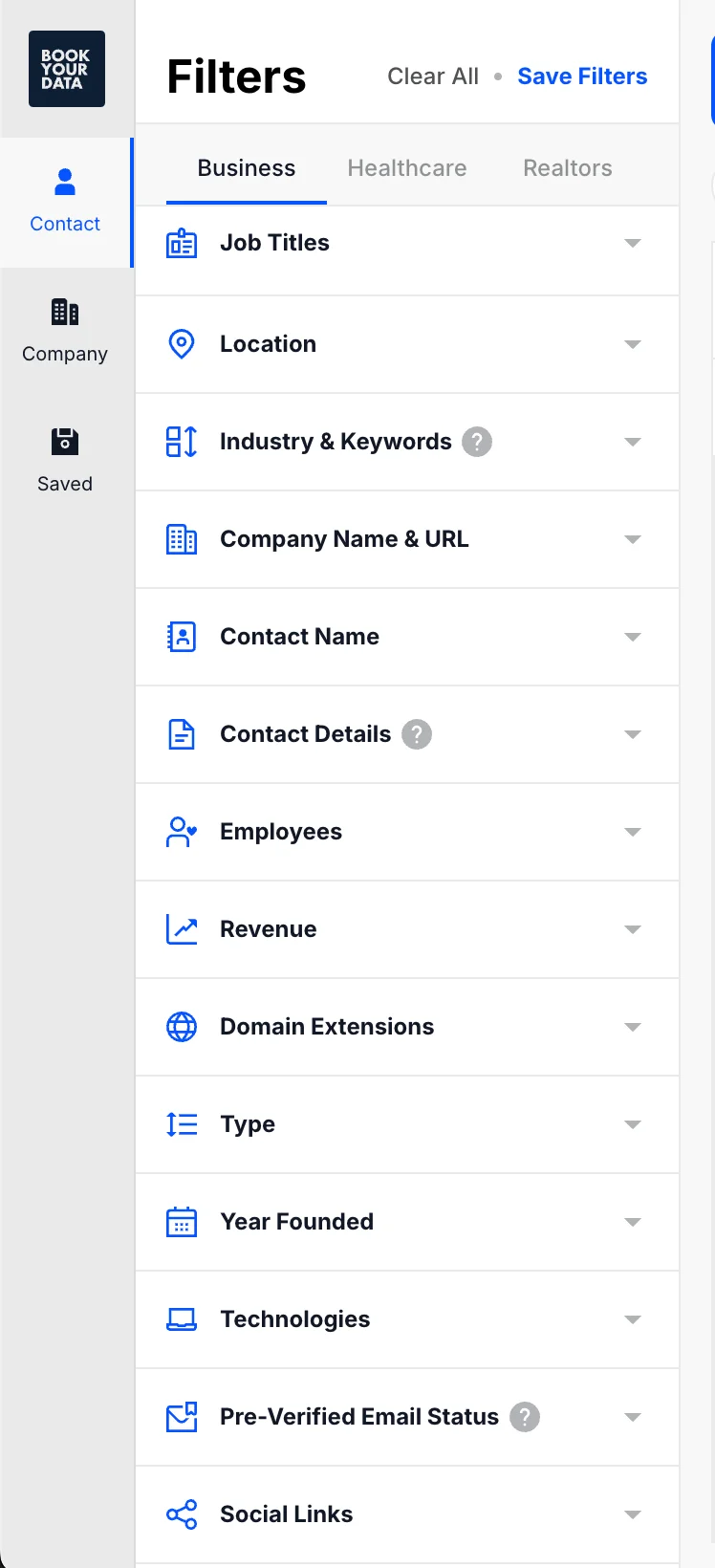
BookYourData's Advanced Filters and Search Capabilities
BookYourData built its reputation on granular targeting. The platform offers over 100 search filters through its Prospector prospecting tool, enabling laser-focused segmentation for sales teams and marketing teams.
Available filter categories:
- Job criteria: Job titles, job function, seniority level, management level, department
- Company attributes: Industry, company size (employee count), revenue range, company type (public/private)
- Geographic: Country, state, city, postal code
- Technographic: What sales tools, CRM integrations, marketing platforms, automation software companies use
- Firmographic: Funding stage, growth indicators, parent company relationships
- Contact validation: Email verification status, phone number availability
The system understands job title variations and synonyms. Search for "Chief Marketing Officer" and it automatically includes "CMO," "VP Marketing," "Marketing Director," and international equivalents. This matters more than it sounds—miss a title variation and you're excluding qualified prospects from your outreach campaigns.
Example targeting scenario: You're selling HR automation software specifically to mid-market healthcare companies. You can filter for:
- Industry: Healthcare
- Company size: 200-1,000 employees
- Job titles: "VP of HR" OR "CHRO" OR "Director of People Operations"
- Technographic: Companies NOT currently using Workday or BambooHR
- Location: United States, specific states
This query would return a highly specific list of decision-makers at companies that match your ideal customer profile and likely have budget for your solution.
The workflow investment: This level of control requires understanding your buyer personas and knowing which filters matter. For sales teams with dedicated sales intelligence resources or marketing teams running account-based strategies, this precision is invaluable. For solo founders or small sales teams, it can feel like overkill.
SphereScout's Practical Simplicity
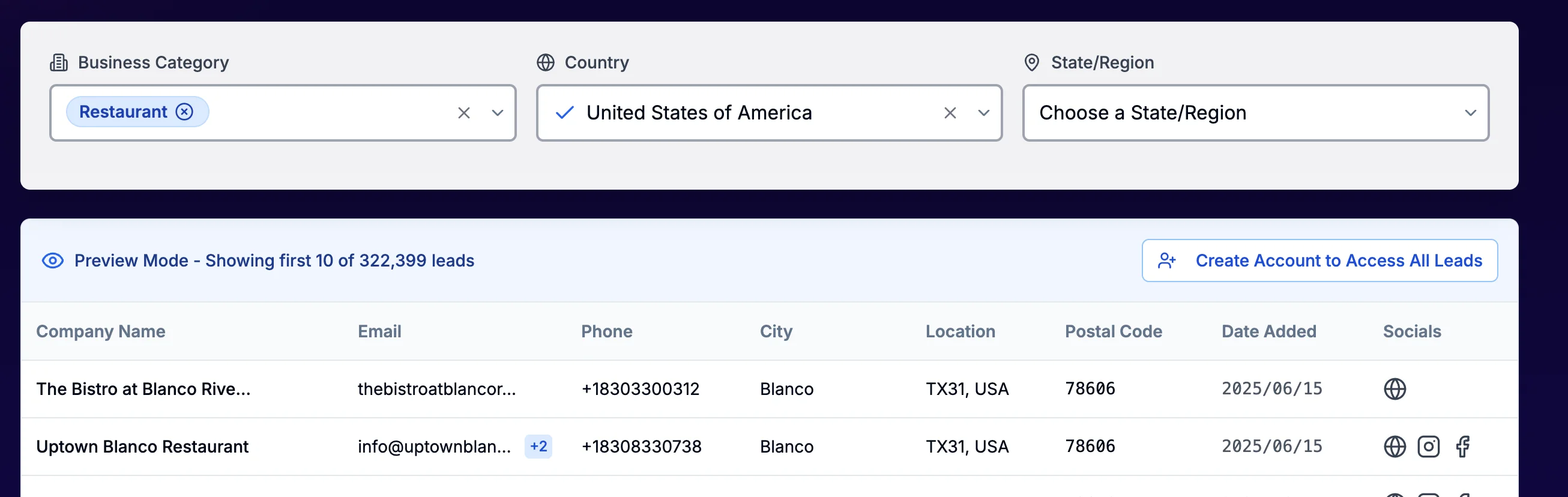
SphereScout intentionally limits complexity. The targeting options are streamlined to two primary dimensions: what type of business and where they're located.
Primary filters:
- Business category (Restaurants, Dentists, Law Firms, Contractors, Real Estate Agents, etc.)
- Location (Country, State/Region, City, County)
Additional filters for paid plans:
- Must have email address
- Must have phone number
- Must have website
- Minimum Google Maps rating (e.g., only 4+ star businesses)
- Exclude businesses without complete contact information
That's the entire filtering system. No job titles, no revenue ranges, no technographic segmentation.
Why minimal filtering works for this use case:
If you're a payments provider trying to sign up restaurants in California, you don't need advanced search capabilities to segment by the CFO's LinkedIn profile. You need restaurants in California. If you're an agency selling Google Ads management to dentists, you need dentists, preferably with decent reviews so you know they're legitimate businesses.
The simplicity is strategic. For local business outreach, broad coverage beats narrow precision. You're playing a numbers game—reach 2,000 businesses in your target category and convert 2-5%, rather than trying to identify the "perfect" 100 businesses that might not respond anyway.
Real workflow example: Need leads for HVAC contractors in Texas? Type "HVAC" in the search box, select "Texas," optionally toggle "minimum 4-star rating," and hit download. Thirty seconds later you have 1,500 verified contacts ready for outreach. No 20-minute filter configuration, no testing different job title combinations, no wondering if you're excluding good prospects with overly narrow criteria.
Targeting Philosophy: ABM vs. Volume
BookYourData enables account-based marketing and strategic prospecting. You define a narrow ideal customer profile and extract exactly those prospects. This works when your product/service has high deal values and longer sales cycles that justify the time investment in precision targeting.
SphereScout enables volume-based prospecting. You cast a wide net across your target business category and let response rates determine which prospects are qualified. This works when you're doing high-velocity outreach to SMBs where speed and coverage matter more than perfect targeting.
Geographic Coverage and Market Reach
Both platforms claim global coverage, but the nature of that coverage differs significantly.
BookYourData's International Database
BookYourData's contact database spans over 200 countries with emphasis on developed B2B markets. The company advertises particularly strong coverage in North America, Europe, and Asia-Pacific regions, claiming the "richest deliverable email dataset in the U.S. and the most complete data in Europe and Asia."
International capabilities:
- Multi-language support for job titles (search "Directeur Général" in France, "Geschäftsführer" in Germany)
- Local phone number formats
- Region-specific company data
- GDPR-compliant data handling for European contacts
- Understanding of international business structures
The coverage quality varies by market maturity. In the U.S., U.K., and Western Europe, you'll find extensive records for mid-market and enterprise companies. In emerging markets, coverage may be thinner or skew toward larger multinational corporations with established online presence.
What's covered well: Established companies with formal organizational structures, corporate websites, public filings, and professional LinkedIn presence. These are companies that appear in business databases, maintain marketing platforms, and have clearly defined sales teams and decision-makers.
What's covered less well: Very small businesses, family-owned local operations, businesses without strong online presence, and companies in less digitized markets.
SphereScout's Global Local Business Network
SphereScout leverages Google's business directory infrastructure, which means theoretical coverage of any business with a Google Business Profile anywhere globally. The platform claims access to 200+ million local businesses across the planet.
Geographic advantages:
- Coverage of businesses at street level in any location
- Works as well in Paris, Tokyo, or Sydney as it does in New York
- Captures businesses that don't have corporate websites or LinkedIn pages
- Includes single-location and multi-location small businesses
- Data quality depends on Google's local market penetration
The practical reality: in markets where businesses actively use Google Business Profiles (most developed and developing markets), SphereScout's coverage is excellent. A marketer in France can pull "boulangeries in Lyon" as easily as a U.S. user can pull "auto repair shops in Phoenix."
What's covered well: Local service providers, retail businesses, restaurants, professional services (law, accounting, medical), contractors, real estate agencies, and any business that relies on local search visibility.
What's covered less well: Large enterprise companies with complex org charts, businesses that don't maintain online listings, and companies that operate primarily B2B without consumer-facing locations.
Geographic Verdict
Both platforms work globally. Your choice depends on company size and business type, not geography. BookYourData excels for targeting established corporate entities across countries. SphereScout excels for targeting local businesses and SMBs in any geographic market.
Email Deliverability and Data Accuracy: The Critical Factor
Data quality determines ROI. A cheap database full of invalid emails costs more than a premium database with verified contacts—bad data wastes your sales team's time, damages sender reputation, and kills marketing campaigns before they start.
BookYourData's 97% Accuracy Guarantee
BookYourData's headline feature is its 97% email deliverability guarantee backed by credit refunds. This isn't marketing fluff—if more than 3% of your downloaded emails bounce, they refund credits for invalid contacts.
How they achieve high accuracy:
Real-time email verification: When you download a contact, BookYourData verifies the email at that exact moment. Not from a cached list that's months old—active verification at point of purchase. The system checks if the email exists, if the mail server accepts messages, and whether it's a catch-all address that might cause deliverability issues.
8-step validation process: Each email goes through multiple verification layers:
- Syntax validation (proper email format)
- Domain verification (domain exists and accepts mail)
- Mail server validation (MX records confirm server)
- Mailbox existence check (email account is real)
- Catch-all detection (identifies risky catch-all addresses)
- Disposable email detection (filters temporary addresses)
- Role-based email detection (flags info@, sales@, etc.)
- Historical bounce tracking (checks against bounce databases)
Quality flags: Before spending credits, you see each email's status: Deliverable (verified working), Undeliverable (will bounce), or Risky (might have issues). You can choose to skip questionable contacts entirely.
Pay-for-deliverable model: Credits are only deducted for verified, deliverable emails. If the system can't verify an email, you don't pay for it.
User-reported accuracy: BookYourData users consistently report bounce rates under 5%, typically in the 2-3% range. For cold email campaigns using platforms like Instantly, Smartlead, or Lemlist, these low bounce rates are essential for maintaining sender reputation and inbox placement.
The 97% guarantee reflects confidence in data freshness. BookYourData isn't selling static lists from 2022—they're pulling and validating current contact data in real-time.
SphereScout's Verified Business Contacts
SphereScout approaches validation differently because the data source is fundamentally different. Since contacts come from public business listings that businesses actively maintain, verification focuses on ensuring businesses are real, active, and reachable.
Verification methods:
Monthly data refreshes: The entire database updates monthly to remove closed businesses, add new listings, and refresh changed contact information. This prevents the "dead business" problem that plagues older list providers.
Active contact validation: SphereScout validates that emails and phone numbers are functional before including them in the database. While specific validation methodology isn't as detailed as BookYourData's, the results suggest effective processes.
Business status verification: Listings are checked against Google's business status (open, temporarily closed, permanently closed) to filter out defunct operations.
User-reported results: Customers report solid deliverability, with particularly high success on phone numbers. One Trustpilot review mentioned calling 400 SphereScout leads and getting high connection rates—"my phone didn't stop ringing"—indicating the phone number accuracy is strong.
The honest assessment: There's no formal percentage guarantee like 97%. When pulling from public listings, you'll inevitably encounter some outdated business emails or generic addresses that get less attention. Expect bounce rates in the 10-15% range for emails—higher than BookYourData, but still reasonable for the price point.
Important nuance: For local business outreach, phone number accuracy often matters more than email perfection. Business owners don't always check emails promptly, but they answer their business line. SphereScout's phone number data is consistently praised for accuracy.
Data Accuracy in Practice
BookYourData wins on pure email deliverability metrics. If you're running email-only campaigns where every bounce damages sender reputation, the 97% guarantee and real-time validation justify the premium pricing.
SphereScout wins on multi-channel contact quality. You're getting both email AND phone for every business. Even if 15% of emails bounce, you still have working phone numbers for 100% of leads. For sales teams doing call-based prospecting or multi-channel outreach, this comprehensive contact information delivers better results than just having verified emails.
The ROI calculation: Would you rather have 1,000 contacts at 97% email accuracy for $400, or 15,000 contacts at 85-90% email accuracy for $49? Both give you roughly 1,000-1,300 working emails. The difference is SphereScout also gives you 15,000 working phone numbers.
Pricing Models: Pay-As-You-Go vs. Transparent Volume Plans
Pricing structure matters as much as per-lead cost. Hidden fees, forced annual contracts, and complex credit systems can make seemingly affordable platforms expensive in practice.
BookYourData's Credit-Based Pricing
BookYourData uses a pay-as-you-go credit system with no mandatory subscription or long-term contracts.
How it works:
- 1 credit = 1 complete contact (email, phone number, all data fields)
- Credits never expire
- No recurring charges unless you buy subscription plans
- Volume discounts for bulk purchases
- Free trial: 10 credits, no credit card required
Pricing tiers:
- Starter pack: $99 for 250 leads (~$0.40 per lead)
- Mid-volume: ~$0.30-0.35 per lead with bulk discounts
- High-volume: ~$0.25-0.30 per lead with annual plans
Cost examples:
- 1,000 contacts ≈ $300-400
- 5,000 contacts ≈ $1,500-1,750
- 10,000 contacts ≈ $2,500-3,500
- 50,000 contacts ≈ $12,500-17,500
Refund guarantee: Invalid emails (beyond 3% threshold) are refunded as credits, making the actual cost-per-valid-email very predictable.
Value proposition: You're paying for precision, verification, and comprehensive data. Compared to enterprise sales intelligence platforms like ZoomInfo (often $15,000-30,000+ annually), BookYourData is economical. Compared to volume providers like SphereScout, it's premium-priced.
Hidden costs: None. One credit gets you everything—full contact record, all data fields, email verification, phone number. No extra charges for CRM integrations, API access, or team seats (unlimited seats included).
SphereScout's Simple Transparent Pricing
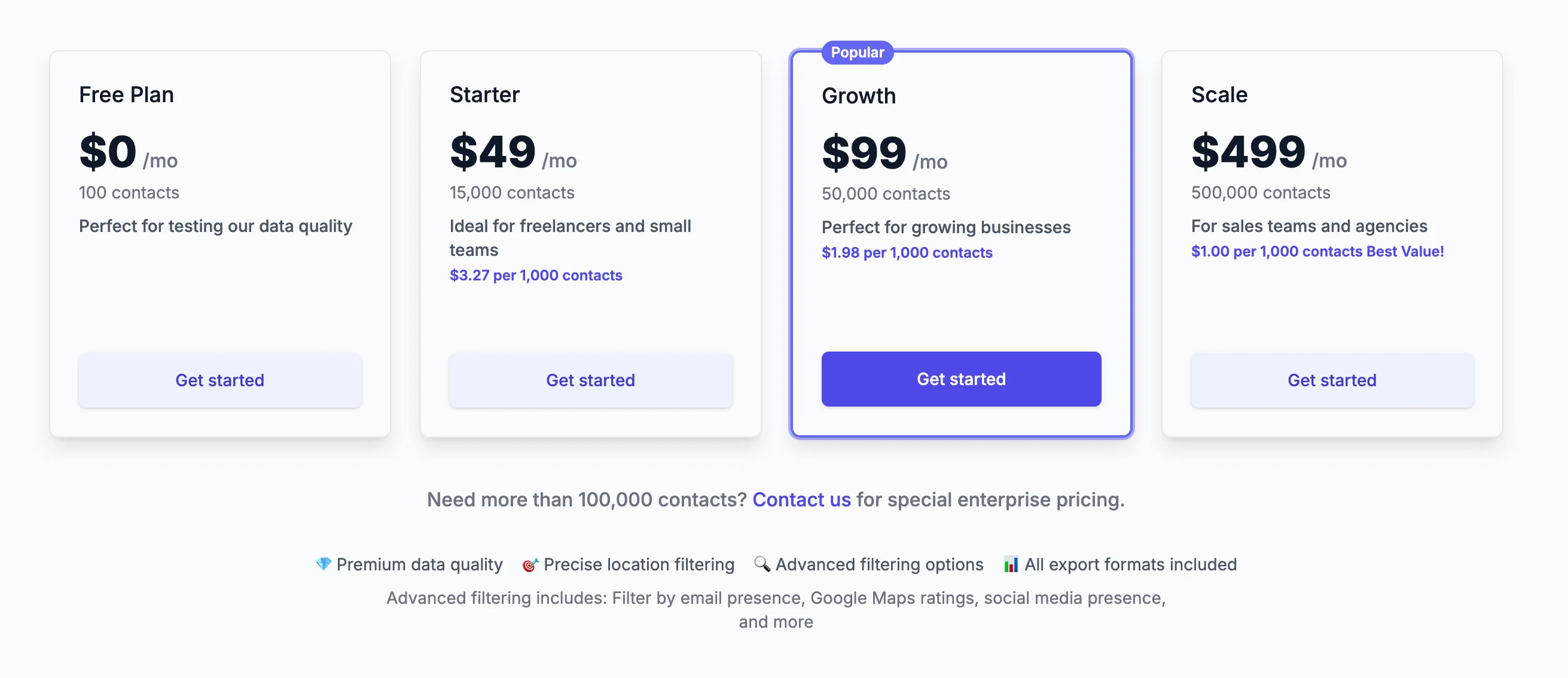
SphereScout uses a freemium model with straightforward monthly plans based on volume needs.
Free Plan:
- 100-500 leads per month (varies by promotion)
- Full access to all features and data fields
- No credit card required
- Perfect for testing or low-volume ongoing needs
Paid Plans (monthly, cancel anytime):
- Starter: $49/month for 15,000 contacts ($0.0033 per lead)
- Growth: $99/month for 50,000 contacts ($0.002 per lead)
- Pro: $499/month for 500,000 contacts ($0.001 per lead)
Custom bulk options: Instant quote system for one-off large downloads without monthly subscription
What's included:
- All features available in every plan
- Every contact includes email, phone, address, website, social links
- No per-field charges or data point fees
- CSV export for all leads
- No setup fees or onboarding costs
Cost comparison examples:
For 10,000 local business leads:
- BookYourData: ~$3,500
- SphereScout: $49 (Starter plan gives you 15,000)
- Savings: 98.6%
For 50,000 SMB contacts:
- BookYourData: ~$15,000-17,500
- SphereScout: $99
- Savings: 99.4%
For 100,000 business contacts:
- BookYourData: ~$30,000-35,000
- SphereScout: $499 (Pro plan gives you 500,000)
- Savings: 98.6%
The math is brutal. For volume-based local business prospecting, SphereScout costs 50-180x less than BookYourData.
Pricing Strategy and ROI
BookYourData's pricing makes sense when:
- You need highly specific decision-makers (VP of Sales at companies with 200-500 employees using Salesforce)
- Your average deal size is $10,000+ and justifies $400-500 per 1,000 qualified leads
- Email deliverability guarantees are critical for sender reputation
- You're doing ABM with small, curated contact lists
- Data enrichment for existing CRM records where precision matters
SphereScout's pricing makes sense when:
- You're targeting local businesses or small businesses at scale
- You need thousands of leads for broad outreach campaigns
- You're an agency, startup, or small sales team with limited budgets
- Multi-channel outreach (phone + email) where phone number accuracy matters
- Testing new markets or business categories without major financial risk
The honest take: BookYourData charges premium prices for premium features. If you're selling enterprise software and need the VP of Marketing at Fortune 1000 companies, paying $0.40 per perfectly verified contact is reasonable. If you're trying to book meetings with restaurant owners or contractors, paying $0.001 per contact makes infinitely more sense.
User Experience, Workflows, and Ease of Use
Platform complexity directly impacts team adoption and time-to-value. A powerful tool that nobody uses is worse than a simple tool everyone uses daily.
BookYourData's Professional Sales Intelligence Platform
BookYourData's interface mirrors enterprise sales tools—comprehensive dashboards, extensive filters, saved searches, and workflow automation.
The user workflow:
- Login to web dashboard: Cloud-based platform accessible from any browser
- Access Prospector tool: Main interface for building lead lists
- Configure search filters: Apply multiple criteria across 100+ filter options
- Preview results: See matching contacts (names, companies, titles) before purchase
- Select specific contacts: Choose exactly which leads to download
- Real-time verification: System validates emails at point of purchase
- Credits deducted: Only for verified contacts you actually download
- Export or integrate: Download CSV or push directly to CRM via integrations
User experience strengths:
- Intuitive dashboard despite complex capabilities
- Real-time search results that update as you adjust filters
- Saved searches for repeating similar queries
- Preview before purchase (see who you're getting)
- Selective downloading (only buy contacts you want)
- Quality flags visible before spending credits
Team collaboration features:
- Unlimited user seats (no per-user pricing)
- Shared credit pools across team
- Role-based permissions for larger sales teams
- Audit logs for compliance and tracking
CRM integrations and automation:
- One-click exports to Salesforce, HubSpot, Pipedrive
- API access for programmatic data enrichment
- Webhook support for automated workflows
- Custom field mapping for enterprise CRMs
Learning curve: Moderate. The basics are straightforward—search, filter, download. Mastering the advanced filters and understanding which data fields drive results takes a few sessions. Sales operations professionals and marketing teams familiar with LinkedIn Sales Navigator or similar tools will feel at home.
Time investment: Expect 10-15 minutes to build your first targeted list, 3-5 minutes once you know which filters matter for your use case.
Best for: Sales teams with dedicated sales intelligence resources, marketing teams running sophisticated campaigns, or anyone who values control and precision over speed.
SphereScout's Speed-Optimized Interface
SphereScout prioritizes simplicity and velocity over customization. The platform is designed for users who need leads now without configuration overhead.
The user workflow:
- Create account: 30-second signup, no credit card for free plan
- Enter search criteria: Business category + location in simple form
- See instant results: Immediate count of available matching businesses
- Apply optional filters: Toggle email/phone/website requirements, minimum rating
- Confirm download: One-click export
- Get CSV file: Instant download ready for import
User experience strengths:
- Virtually zero learning curve (simpler than Google search)
- Instant results (no waiting for list compilation)
- Transparent pricing (see cost before purchase)
- No complex decisions (just category and location)
- Fast iteration (test multiple markets in minutes)
Simplicity by design:
- Single search box interface
- Minimal form fields
- Clear lead count before purchase
- Instant CSV download
- No configuration paralysis
Team features:
- Shared account access
- Credit pool visibility
- Usage tracking dashboard
- Simple permission system
Learning curve: Zero. If someone can type in a search box and click a download button, they can use SphereScout effectively. No training required, no documentation to read, no onboarding calls.
Time investment: 60-90 seconds from "I need leads" to "I have a CSV file with thousands of contacts."
Best for: Solo marketers, small sales teams, agencies managing multiple clients, anyone prioritizing speed over precision, non-technical users who want immediate results.
Workflow Philosophy Comparison
BookYourData: Built for data-driven professionals who want control, precision, and integration into larger sales/marketing automation workflows. You define your ideal customer profile methodically, use the platform to extract exactly those contacts, and integrate seamlessly with your CRM and outreach tools.
SphereScout: Built for practitioners who need leads fast without overthinking it. You know what business category you're targeting, you know the geographic market, you download thousands of leads and start outreach. Speed and volume over precision targeting.
Neither approach is "better"—they solve different problems. Choose based on whether your bottleneck is lead quality (BookYourData) or lead quantity (SphereScout).
Integration Ecosystem: CRM Connections and API Access
How easily leads flow from data provider to your sales tools determines actual usability in production environments.
BookYourData's Integration Capabilities
BookYourData treats integrations as core infrastructure, not nice-to-have features.
Native CRM integrations:
- Salesforce (direct contact/lead creation)
- HubSpot (automatic contact enrichment)
- Pipedrive (seamless lead import)
- Other major CRMs via partnerships
How integrations work: Select contacts in BookYourData, click integrate, choose your CRM, and contacts appear in your CRM with all fields mapped correctly. No CSV downloads, no field mapping, no import errors.
API access:
- RESTful API for programmatic contact retrieval
- Available for all users (even pay-as-you-go accounts)
- Documentation and code examples provided
- Webhook support for automation workflows
Use cases for API:
- Enrich existing CRM records with missing emails/phone numbers
- Trigger automatic lead pulls based on specific events
- Build custom prospecting tools in your own infrastructure
- Integrate with proprietary sales intelligence systems
Data enrichment workflows:
- Upload company names or domains
- BookYourData returns verified contacts and enriched data
- Automatic credit calculation before processing
- Batch processing for large enrichment jobs
Export formats:
- CSV with custom field selection
- Excel with formatting options
- Direct CRM push (no file download needed)
- API JSON responses
Team and enterprise features:
- SSO integration for large organizations
- IP whitelisting for security requirements
- Custom data fields and tagging
- Advanced permissioning structures
The integration advantage: For established sales teams with sophisticated tech stacks, these integrations eliminate manual work. Your SDRs never leave Salesforce, your marketing automation runs on enriched data, and everything stays synchronized.
SphereScout's Straightforward Export
SphereScout keeps integrations intentionally simple: you get a CSV file.
Export format: Standard CSV with clear column headers
What's in the export:
- Business/Company Name
- Primary Email Address
- Phone Number
- Street Address
- City, State, Postal Code
- Country
- Website URL
- Facebook page (if available)
- Instagram profile (if available)
- LinkedIn page (if available)
- Google Maps rating
- Review count
Import process:
- Download CSV from SphereScout
- Open your CRM's import tool
- Upload CSV file
- Map fields (usually automatic)
- Import completes in seconds
Universal compatibility: Every CRM, marketing platform, and outreach tool accepts CSV imports. HubSpot, Salesforce, Mailchimp, Instantly, Smartlead, Apollo—all of them handle CSV files natively.
Time investment: 2-3 minutes to import 50,000 contacts into most platforms. Modern CRMs process large CSV files quickly.
Why no native integrations? For the target user (small teams, agencies, volume prospecting), CSV import is sufficient. The simplicity keeps costs down and eliminates integration maintenance overhead.
What you can do with the CSV:
- Import to any CRM for outreach campaigns
- Upload to email marketing platforms
- Feed into cold calling software
- Enrich with additional tools
- Merge with other data sources
- Build custom applications
The practical reality: Unless you're pulling leads daily and need automated workflows, spending 3 minutes importing a CSV file is not a meaningful friction point. You're saving thousands of dollars compared to platforms with native integrations.
Integration Verdict
BookYourData wins for enterprise sales organizations with established tech stacks, automated workflows, and dedicated sales operations teams who need seamless data flow between systems.
SphereScout works perfectly well for everyone else. The CSV export is universal, simple, and fast enough that the lack of one-click integrations is rarely a bottleneck in practice.
If your competitive advantage comes from sophisticated marketing automation and sales intelligence workflows, BookYourData's integrations matter. If your competitive advantage comes from volume and speed-to-market, SphereScout's simplicity is actually superior.
Competitor Landscape: How These Tools Compare to Other Options
Understanding where BookYourData and SphereScout fit in the broader B2B lead generation market helps clarify when each tool makes sense.
BookYourData's Competitive Position
BookYourData competes in the premium B2B contact data space alongside several established players:
vs. ZoomInfo: ZoomInfo is the enterprise standard with the most comprehensive database, advanced intent data, and sophisticated sales intelligence features. However, ZoomInfo's pricing starts around $15,000-30,000+ annually with forced annual contracts. BookYourData offers similar contact quality with pay-as-you-go flexibility at a fraction of the cost. Choose ZoomInfo if you're enterprise sales with big budgets and need the full platform. Choose BookYourData if you want quality data without enterprise pricing.
vs. Apollo.io: Apollo combines contact data with engagement tools (email sequences, calling). Apollo's freemium model is attractive for small teams, but data quality is inconsistent and the platform pushes you toward their outreach tools. BookYourData focuses purely on data quality with verified contacts. Choose Apollo if you want an all-in-one prospecting platform. Choose BookYourData if you have outreach tools already and just need verified contact data.
vs. Lusha: Lusha specializes in a Chrome extension for finding contacts while browsing LinkedIn or company websites. It's convenient but limited to real-time lookups rather than bulk list building. BookYourData's Prospector tool enables building large targeted lists. Choose Lusha for one-off contact discovery. Choose BookYourData for building comprehensive lead lists.
vs. Cognism: Cognism focuses on international B2B data, particularly in Europe, with strong GDPR compliance. Pricing is custom (typically enterprise-level), and they emphasize phone-verified mobile numbers for executives. BookYourData offers similar international coverage with more transparent pricing. Choose Cognism if you're enterprise sales in Europe needing mobile numbers. Choose BookYourData for broader use cases with predictable costs.
vs. UpLead: UpLead offers verified contacts with real-time validation and similar accuracy claims. Pricing is subscription-based ($74-149/month for limited credits). BookYourData's pay-as-you-go model gives more flexibility for sporadic usage. Choose UpLead if you want monthly subscription predictability. Choose BookYourData if you want credits that never expire.
vs. RocketReach: RocketReach focuses on finding individual contact information, particularly for recruiting and sales. It's strong for people search but lacks the advanced filtering and data enrichment capabilities. BookYourData offers more sophisticated prospecting tools. Choose RocketReach for personal contact discovery. Choose BookYourData for systematic B2B prospecting.
vs. Seamless.AI: Seamless offers real-time contact finding with a Chrome extension and claims AI-powered data validation. The platform is browser-based and integrated tightly with LinkedIn. BookYourData's web dashboard and bulk list building offer different workflows. Choose Seamless for LinkedIn-based prospecting. Choose BookYourData for filtered list building without LinkedIn dependency.
BookYourData's niche: Premium contact data with strong accuracy guarantees, flexible pricing, and no forced sales calls or enterprise contracts. It sits between enterprise platforms (ZoomInfo, Cognism) and freemium tools (Apollo, Seamless) in both capability and price.
SphereScout's Competitive Position
SphereScout competes in a different market—local business data and SMB prospecting:
vs. Traditional List Brokers: Old-school list brokers sell industry-specific email lists for $0.10-0.30 per contact. These lists are often outdated, unverified, and violate modern email regulations. SphereScout costs less while providing fresher, more compliant data. SphereScout wins on price, data freshness, and compliance.
vs. Lead411: Lead411 focuses on verified B2B contacts with growth intent signals, priced similarly to BookYourData ($75/month for limited exports). Lead411 targets mid-market corporate contacts, not local businesses. Choose Lead411 for growth-focused corporate prospecting. Choose SphereScout for local SMB volume.
vs. LeadIQ: LeadIQ is a prospecting platform with Chrome extension for capturing contacts from LinkedIn and websites, then pushing them to your CRM. It's designed for workflow integration, not bulk list building. Choose LeadIQ for real-time prospect capture during research. Choose SphereScout for building large local business lists.
vs. Clearbit: Clearbit specializes in data enrichment—taking existing email addresses or domains and enriching them with firmographic and technographic data. It doesn't provide contact discovery. Choose Clearbit for enriching your existing database. Choose SphereScout for discovering new local business contacts.
vs. Web Scraping: Some teams build custom scrapers for Google Maps or Yelp listings. This requires technical resources, ongoing maintenance, legal compliance concerns, and data cleaning. SphereScout provides the same data legally, cleaned, and verified for less than developer time would cost. SphereScout wins on time-to-value and compliance.
vs. Google Maps Manual Research: Anyone can manually search Google Maps and copy business information. This works for 10-20 businesses but becomes impossibly time-consuming at scale. SphereScout automates what would take weeks of manual work into 30-second downloads.
SphereScout's niche: High-volume local business contact data with transparent pricing, instant results, and focus on SMB/local outreach rather than corporate decision-makers.
Market Positioning Summary
BookYourData: Premium B2B contacts for targeting corporate decision-makers at established companies.
SphereScout: Volume-based local business contacts for targeting SMBs, service providers, and businesses with physical locations.
Neither directly competes because they serve different use cases. The "competition" only exists if you're unclear about whether you need corporate contacts or local business contacts.
Use Cases and Ideal Customer Profiles: Making the Right Choice
Let's get specific about who should use which platform based on real-world scenarios.
When BookYourData Is the Right Choice
Ideal user profiles:
- B2B SaaS companies selling to mid-market or enterprise
- Sales teams running account-based marketing programs
- Marketing teams managing demand generation for corporate products
- Recruiters sourcing candidates for specialized executive roles
- Data/ops teams enriching CRM records with verified contact information
- Consultants building strategic prospect lists for high-value engagements
Perfect use cases:
Example 1: Enterprise SaaS Sales You're selling project management software to companies with 500-2,000 employees. You need to reach VPs of Engineering, CTOs, and Directors of Operations at tech companies, professional services firms, and manufacturing companies in North America and Europe. You filter by job title, company size, industry, and technographic data (companies NOT currently using your competitors). BookYourData delivers 500 precisely targeted decision-makers with verified emails and direct dials.
Why BookYourData works: You can't waste time calling random people at random companies. Your average deal size is $50,000-200,000 annually. Spending $200-300 for a curated list of exactly the right people is trivial compared to one closed deal.
Example 2: Technical Recruiting You're recruiting senior data scientists for fintech companies. You need contacts currently working as "Senior Data Scientist" or "ML Engineer" at financial services companies with 200+ employees who are likely using modern tech stacks. BookYourData's filters let you find these individuals, see their LinkedIn profiles, and reach them via verified work emails and phone numbers.
Why BookYourData works: Each placement fee is $20,000-40,000. Paying $0.40 per verified contact for highly qualified candidates is negligible compared to the potential return. The precision targeting saves countless hours of LinkedIn searching.
Example 3: ABM Campaign Execution Your marketing team identified 200 target accounts (specific companies you want to close). You need to find 3-5 decision-makers at each company across different departments (IT, Finance, Operations). BookYourData lets you filter by company domain, then extract all relevant job titles at those exact companies.
Why BookYourData works: ABM requires precision. You're not looking for "any VP of Sales"—you need the VP of Sales at these specific 200 companies. BookYourData's targeting and verification ensure you're reaching the actual people you need.
Example 4: International Expansion You're expanding into Germany and France. You need contacts at manufacturing companies with €10-50M revenue who likely speak English (international companies). BookYourData's international coverage, multi-language support, and firmographic filters enable building these lists without local market expertise.
Why BookYourData works: Entering new markets requires understanding local business structures and job titles. BookYourData's localization and comprehensive data fields reduce the learning curve significantly.
When SphereScout Is the Right Choice
Ideal user profiles:
- Local marketing agencies selling services to SMBs
- B2B service providers targeting local businesses
- Sales teams doing high-volume cold outreach to service providers
- Startups with limited budgets testing new markets
- Agencies building contact lists for multiple clients
- Anyone targeting businesses with physical locations
Perfect use cases:
Example 1: Payment Processing Sales You're a payment processor looking to sign up restaurants, cafes, and retail stores across California. You don't need the CFO's name—you need to reach business owners or managers who make operational decisions. SphereScout gives you 5,000 restaurants in California for $49. Even if only 1-2% convert, that's 50-100 new merchants. At typical merchant fees, your ROI is massive.
Why SphereScout works: Small businesses don't have complex org charts. The person who checks the business email or answers the phone IS the decision-maker. You're playing a volume game where reaching 5,000 prospects for $49 beats reaching 125 "perfectly verified" prospects for $49.
Example 2: Local Marketing Agency Your agency sells Google Ads management, SEO, and social media services to local businesses. You need dentists, chiropractors, law firms, and home service providers in your metro area. SphereScout lets you download all dental practices in your city in 30 seconds. You run monthly outreach campaigns across different business categories as you scale.
Why SphereScout works: Agency economics require volume. You're charging $500-2,000/month per client. Acquiring contact lists for $49 that yield even 3-5 new clients pays for itself instantly. The simplicity means you can generate fresh lists for different campaigns weekly.
Example 3: B2B SaaS for Local Businesses You built scheduling software for service businesses (salons, spas, fitness studios). Your ICP is any business that books appointments. SphereScout gives you 20,000 salons and spas nationwide for $99. You run broad email campaigns and phone outreach. Anyone who responds gets personalized follow-up.
Why SphereScout works: You're targeting an entire business category, not specific people at specific companies. The volume approach identifies interested businesses quickly. Your product is self-serve with low ACV, so high-touch sales doesn't make economic sense. Volume prospecting matches your business model.
Example 4: Service Provider Prospecting You're a B2B service (IT support, janitorial services, office supplies) targeting small businesses. You need to reach companies with 5-50 employees in specific industries. SphereScout gives you thousands of businesses in your target categories. You call and email everyone, knowing that many won't need services now but some will.
Why SphereScout works: Small business services are relationship and timing-based. You need broad coverage in your market to find the subset currently in-market for your service. The low cost per contact makes broad outreach economically viable.
Example 5: Market Research and Testing You're launching a new product and need to understand which local business categories have the biggest pain points. You pull contacts across 10 different business categories (restaurants, retail, professional services, etc.) and run discovery surveys and interviews to inform product development.
Why SphereScout works: The free tier and low-cost paid plans let you test multiple markets without major investment. You're not even trying to sell yet—you're gathering market intelligence. SphereScout's volume and speed enable rapid market research.
The "Use Both" Strategy
Smart teams sometimes leverage both platforms for different stages:
Funnel strategy:
- Top of funnel (SphereScout): Pull 10,000 local businesses in target category for broad outreach
- Middle of funnel (Manual qualification): Identify 500 interested businesses from initial outreach
- Bottom of funnel (BookYourData): For the most promising 100 accounts, use BookYourData to find specific decision-makers for targeted follow-up
Total investment: $40 (SphereScout) + $40 (BookYourData) = $80 to generate thousands of leads and precisely target warm prospects.
This hybrid approach combines volume economics (SphereScout) with precision targeting (BookYourData) for maximum efficiency.
Final Verdict: Choosing Your BookYourData Alternative
Both platforms deliver value, but they solve fundamentally different problems. Your decision hinges on a single question: Are you targeting decision-makers at established companies, or are you targeting local businesses and SMBs?
Choose BookYourData if:
✅ You're selling to mid-market or enterprise companies
✅ You need specific job titles and individual decision-makers
✅ Your ideal customer profile requires precise segmentation
✅ Average deal sizes justify $0.30-0.40 per verified contact
✅ Email deliverability guarantees are critical for sender reputation
✅ You need CRM integrations and API access for workflow automation
✅ You're running account-based marketing or targeted campaigns
✅ Data enrichment for existing accounts is part of your strategy
Core strength: Premium B2B contact data with industry-leading accuracy guarantees and sophisticated targeting for corporate sales.
Best for: Sales teams at B2B companies, marketing teams running ABM, recruiters, and anyone needing verified corporate decision-makers.
Bottom line: BookYourData is the better solution when precision, data richness, and verification matter more than price per contact.
Choose SphereScout if:
✅ You're targeting local businesses, service providers, or small businesses
✅ Generic business emails are sufficient (you don't need individual names)
✅ You need large volumes of contacts quickly
✅ Budget constraints require maximizing leads per dollar
✅ Phone outreach is as important as email
✅ You value simplicity over complex filtering
✅ You're testing new markets without major financial commitment
✅ Your business model requires volume prospecting
Core strength: Massive volumes of verified local business contacts at unprecedented pricing with zero learning curve.
Best for: Local marketing agencies, SMB-focused sales teams, startups, anyone doing volume-based outreach to businesses with physical locations.
Bottom line: SphereScout is the better solution when volume, speed, and affordability matter more than individual precision targeting.
The Honest Recommendation
If you Googled "BookYourData alternative" because you're targeting local businesses or SMBs, SphereScout is almost certainly what you actually need. The pricing difference is so dramatic (40-180x cheaper) that unless you specifically need corporate decision-makers with job titles, the choice is obvious.
BookYourData is an excellent platform for what it does—verified B2B contacts at corporate entities. But it's designed for a specific use case. If you're trying to reach restaurants, contractors, dentists, law firms, or any other local business category, you're paying for features you don't need.
The practical test: Start with SphereScout's free plan. Pull 100 leads in your target business category. Run a test campaign (emails + calls). Measure results.
Most teams discover that the "generic" business contacts convert just fine because small business owners check their business emails and answer their phones. If results are solid, scale up with SphereScout's paid plans. If you discover you absolutely need individual job titles and corporate org charts, then invest in BookYourData.
The best sales intelligence strategy isn't about finding the "best" tool universally—it's about matching the right data provider to your actual target market, sales motion, and budget reality.
Bottom line: Both platforms are legitimate solutions. BookYourData excels at corporate B2B precision targeting. SphereScout excels at local business volume prospecting. Know which game you're playing, and choose accordingly.
Frequently Asked Questions About BookYourData Alternatives
What makes SphereScout a good BookYourData alternative?
SphereScout is an excellent BookYourData alternative specifically for teams targeting local businesses and SMBs rather than corporate decision-makers. While BookYourData provides detailed individual contacts at established companies ($0.30-0.40 per contact), SphereScout provides verified business contacts for local operations at $0.001-0.003 per contact. The 40-180x price difference makes SphereScout ideal for volume-based local business prospecting where generic business emails work as well as named individuals.
How does SphereScout's pricing compare to BookYourData?
BookYourData charges approximately $0.30-0.40 per verified contact depending on volume. SphereScout charges $0.001-0.003 per contact ($49/month for 15,000 contacts up to $499/month for 500,000 contacts). For 10,000 local business leads, BookYourData costs ~$3,500 while SphereScout costs $49. The dramatic price difference reflects different target markets: BookYourData targets corporate professionals while SphereScout targets local businesses.
Which tool has better email deliverability—BookYourData or SphereScout?
BookYourData offers a 97% email deliverability guarantee with real-time verification and credit refunds for invalid contacts. SphereScout doesn't provide a specific percentage guarantee but maintains data quality through monthly refreshes and active validation. Users report 85-90% deliverability for SphereScout's business emails. BookYourData wins on pure email accuracy, but SphereScout includes verified phone numbers for every contact, enabling multi-channel outreach that often compensates for slightly higher email bounce rates.
Can SphereScout replace BookYourData for B2B sales?
It depends on your target market. SphereScout effectively replaces BookYourData when targeting local businesses, service providers, and SMBs where generic business contacts suffice. However, SphereScout cannot replace BookYourData for enterprise sales, account-based marketing, or scenarios requiring specific job titles at corporate entities. If you need "VP of Sales at SaaS companies with 500+ employees," use BookYourData. If you need "restaurants in Texas" or "law firms in California," use SphereScout.
Does SphereScout work internationally like BookYourData?
Yes, both platforms provide global coverage. BookYourData covers 200+ countries with emphasis on corporate B2B contacts in North America, Europe, and Asia-Pacific. SphereScout also covers 200+ countries by pulling from Google's global business directory. SphereScout works well internationally for local businesses (e.g., "dentists in Paris" or "restaurants in Tokyo") while BookYourData excels for international corporate contacts with local job title variations.
What CRM integrations does SphereScout offer compared to BookYourData?
BookYourData offers native one-click integrations with Salesforce, HubSpot, Pipedrive, and other major CRMs, plus API access for custom workflows. SphereScout provides CSV exports that import into any CRM through standard upload tools. While BookYourData's native integrations are more sophisticated, SphereScout's CSV export works universally with every CRM and marketing platform. For teams pulling leads occasionally, the 2-3 minute CSV import process is not a meaningful limitation.
Is BookYourData worth it for small businesses, or should they use SphereScout?
Small businesses targeting other small businesses should almost always choose SphereScout. The pricing difference is enormous ($49/month for 15,000 contacts vs. $4,000+ for the same volume from BookYourData), and small businesses rarely need the sophisticated targeting or individual job titles that BookYourData provides. Small businesses selling to enterprise or mid-market companies might justify BookYourData if their deal sizes are large enough to support premium data costs.
Can I try both platforms before committing?
Yes. BookYourData offers 10 free credits (10 contacts) with no credit card required. SphereScout offers 100 free contacts per month on their free plan, also without requiring a credit card. Both free trials provide full access to features and data quality, letting you test deliverability and relevance for your specific use case before purchasing.
Which competitors should I consider besides BookYourData and SphereScout?
For corporate B2B targeting (similar to BookYourData): Consider ZoomInfo (enterprise-level with highest price), Apollo.io (all-in-one prospecting platform), Lusha (Chrome extension for LinkedIn), Cognism (international focus), UpLead (subscription model), or Seamless.AI (browser-based prospecting). For local business targeting (similar to SphereScout): Traditional list brokers (lower quality), Lead411 (corporate growth focus), or custom web scraping (technical overhead). Your choice depends on specific targeting needs, budget constraints, and workflow preferences.
How do I know if I need BookYourData or SphereScout?
Ask yourself: "Am I trying to reach a specific person with a specific job title at established companies, or am I trying to reach local businesses in a particular category?" If the former, use BookYourData. If the latter, use SphereScout. For example: "I need CMOs at Fortune 1000 tech companies" = BookYourData. "I need restaurants in California" = SphereScout. The distinction becomes obvious when you clarify whether your target is individuals at corporations or the businesses themselves.
Ready to test SphereScout as your BookYourData alternative? Start with the free plan—no credit card required—and discover why thousands of agencies and SMB-focused sales teams choose SphereScout for local business lead generation at a fraction of traditional B2B data costs.